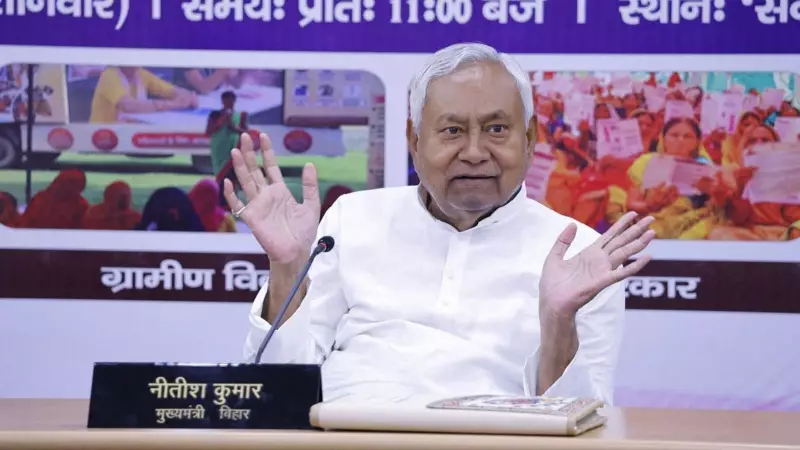
In a significant administrative overhaul focused on its major election promises, the newly re-elected NDA government in Bihar has established three crucial new departments. The move, announced on December 6, 2025, is centrally aimed at tackling the state's pressing issues of unemployment and skill development.
New Departments and Ambitious Targets
Chief Minister Nitish Kumar, sworn in for a historic tenth term on November 21, 2025, unveiled the new administrative structure. The most prominent is the Department of Youth, Employment and Skill Development, which has been handed the formidable task of creating employment for one crore young people in Bihar over the next five years (2025-30).
Alongside this, the government has created a separate Department of Higher Education to address long-standing issues in the sector, such as delayed academic sessions and a shortage of university teachers. A Department of Civil Aviation has also been formed, citing the expansion of airport infrastructure under the Centre's UDAN scheme.
This brings the total number of departments in the Bihar government to 40. The cabinet, limited to 36 ministers including the CM, currently has 26 ministers sworn in.
Addressing the Core Challenge: Migration and Unemployment
The government's push is a direct response to stark data on Bihar's workforce. While the state's unemployment rate for those aged 15 and above was 5.2% (below the national average of 5.4%) in the April-June 2025 quarter, this masks a deeper problem. Bihar's Labour Force Participation Rate (LFPR) is just 48.8%, meaning less than half the working-age population is actively seeking work.
The situation is particularly dire for youth (15-29 years), where only 33.9% are in the labour force—the lowest in India and well below the national average of 42%. Furthermore, the 2011 Census highlighted that 30% of Bihar's 74.54 lakh out-migrants cited employment as the primary reason for leaving, a figure higher than the national average of 23%.
Implementation Strategy and Political Credit
To achieve the one crore jobs target, the government plans a multi-pronged approach. The new youth department will focus on entrepreneurship opportunities and skill development schemes. The Higher Education department will aim for qualitative improvement and employment-oriented education.
Additionally, the state announced the creation of a Directorate of Micro, Small and Medium Enterprises (MSMEs) and the Bihar Marketing Promotion Corporation. The MSME directorate will set up "mega skill centres" in every district, while the marketing corporation will boost local products from agriculture, handicrafts, and cottage industries to generate employment.
However, the move has sparked a political debate over who set the agenda. The Opposition Mahagathbandhan, led by the RJD, claimed that the focus on jobs was pioneered by their leader Tejashwi Yadav. RJD spokesperson Subodh Kumar Mehta stated that Tejashwi had been "talking about employment since 2020" and that the government's action was a "much-delayed" adoption of their narrative.
In response, JD(U) spokesperson Neeraj Kumar said the departments were created to "respect the overwhelming mandate," citing existing schemes like the Mukhyamantri Mahila Rojgar Yojana. BJP state vice-president Santosh Pathak highlighted the government's past record of creating 28.5 lakh jobs in 19 years and expressed commitment to making Bihar an industrial destination.
The creation of these dedicated departments marks a formal institutionalization of the jobs and youth agenda that dominated the Bihar assembly polls, setting the stage for a closely watched five-year race against a formidable employment target.