

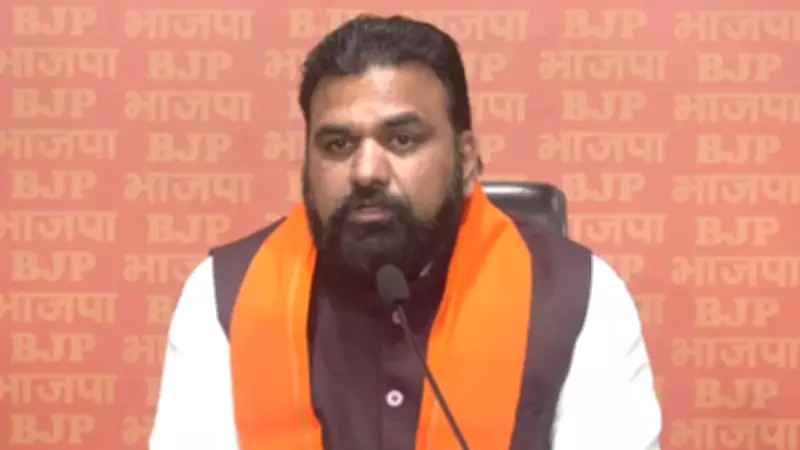
Bihar Declared Maoist-Free by Deputy CM Samrat Choudhary
In a significant announcement in the state assembly on Friday, Deputy Chief Minister and Home Minister Samrat Choudhary declared that Bihar has become Maoist-free. This milestone marks a major achievement in the state's long-standing efforts to combat left-wing extremism.
Major Security Recruitment Drive Announced
To further strengthen policing and maintain this security status, Choudhary unveiled a massive recruitment plan for the 2026-27 fiscal year. Over 60,000 security personnel will be recruited, including:
- 31,000 police personnel
- 17,000 Special Auxiliary Force (SAF) jawans
- 13,500 home guards
This recruitment drive represents one of the largest security expansions in recent state history.

Significant Maoist Arrests and Weapon Seizures
Choudhary provided detailed statistics supporting the Maoist-free declaration:
- 143 Maoists carrying rewards on their heads have been arrested
- Police have seized 2,727 cartridges
- 174 detonators confiscated
- 127 improvised explosive devices recovered
These operations have significantly weakened Maoist networks across the state.
Strategic Deployment and Recruitment Changes
The Deputy CM announced several strategic changes to security deployment:
- SAF jawans, previously stationed only at state headquarters, will now be deployed in districts
- The government is considering relaxation in recruitment norms for Agniveers
- This represents a fundamental shift in how specialized forces are utilized across Bihar
Budgetary Approval Amid Opposition Walkout
Choudhary made these announcements while replying to the House debate on the home department's budgetary demand of Rs 20,132.86 crore for 2026-27. A cut motion had been moved by BSP MLA Satish Yadav, but the House passed the budget by voice vote. Opposition members staged a walkout during the proceedings, highlighting the political context of these security announcements.
Comprehensive Jail Reforms Introduced
The government has initiated several prison reforms to enhance security:
- A high-security jail will be constructed in a mountainous area within Bihar
- This facility will have complete restrictions on cellphone access
- Regular raids are being conducted in prisons across the state
- All activities inside jails, including meetings with visitors (mulakatis), will be monitored through CCTV cameras
New Security Forces for Infrastructure Protection
Modeled after the Centre's CISF, Bihar will establish two battalions of the Bihar Industrial Security Force (BISF):
- BISF will provide security to metro rail projects in Patna and other cities
- The force will also protect industrial areas and proposed airports
- BISF-3 will be established in Nawada
- BISF-4 will be set up in Motihari or Bettiah
- Land acquisition for these facilities has already begun
Forensic Science Infrastructure Expansion
The state is significantly enhancing its forensic capabilities:
- An off-campus of the National Forensic Sciences University (NFSU) will be built in Punpun block of Patna district
- A Central Forensic Science Laboratory (CFSL) will also be established at the same location
- The process to acquire 50 acres of land for these facilities has already begun
Innovative Community Security Initiatives
Several community-focused security measures were announced:

- Police Didis will be deployed across districts to enhance security around schools
- They will be equipped with 1,500 scooters and 2,500 motorcycles
- Jeevika Didis have started operating a canteen at the Patna police line
- This initiative will be expanded to all 40 police lines in the state
- A school will be opened at every police line for the education of children of police personnel
These comprehensive announcements represent a multi-faceted approach to security in Bihar, combining traditional law enforcement with community engagement, infrastructure development, and specialized force creation. The Maoist-free declaration comes after years of sustained operations and represents a turning point in the state's security landscape.





