In a decisive move to transform Bihar's economic landscape and stem the outflow of its workforce, Chief Minister Nitish Kumar has unveiled an ambitious five-year industrial blueprint. The plan, christened 'Bihar Industrial Sankalp', targets a staggering Rs 50 lakh crore in investments to position the state as a premier industrial hub in eastern India and generate large-scale employment.
The Core of the Industrial Sankalp
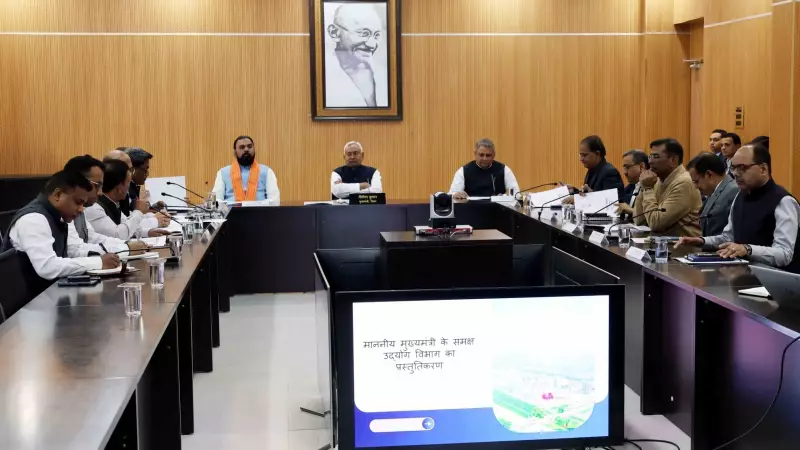
The roadmap was detailed during a high-level review meeting chaired by the Chief Minister at his Patna residence on Saturday, December 7, 2025. Chief Secretary Pratyay Amrit presented the comprehensive plan, which was attended by Deputy Chief Minister Samrat Choudhary, Industries Minister Dilip Kumar Jaiswal, along with senior bureaucrats and departmental heads.
The government's strategy hinges on aggressive infrastructure creation and business-friendly reforms. Key decisions from the meeting include a push for Ease of Doing Business reforms, the establishment of five mega food parks, the development of 10 new industrial parks, and the creation of a massive 100 MSME parks across the state over the next five years.
Infrastructure and Sectoral Focus
A major highlight is the fast-tracking of the Integrated Manufacturing Cluster (IMC) at Dobhi in Gaya, sprawling over 1,700 acres. Modelling on this, the state plans 31 new industrial parks covering 14,036 acres across 29 districts. Ten of these will be sector-specific, including dedicated textile and pharmaceutical parks.
To fuel this expansion, the state has earmarked Rs 26,000 crore for the next phase of industrial development. CM Kumar emphasized that large-scale industrialization is non-negotiable for rapid economic growth. He highlighted Bihar's industrial journey, noting that the number of industrial units has more than doubled since 2005, and industrial exports have skyrocketed from Rs 25 crore to Rs 17,000 crore.
Perhaps the most telling statistic was the growth of MSMEs, which have surged from 72,000 to 35 lakh, elevating industry's share in Bihar's GSDP from 5.4% to over 21%. "This reflects the work done for Bihar’s industrial growth," Kumar stated.
Beyond Manufacturing: Tech, Skills, and Jobs
The vision extends beyond traditional manufacturing. Bihar plans to position itself as a new-age technology hub. Committees have been formed to supervise proposals for a Defence Corridor, Semiconductor Manufacturing Park, Global Capability Centre, Mega Tech City, and a Fintech City.
Aligned with the job creation goal, the government will train seven lakh people in industry-linked skills, set up an MSME Directorate and MSME Centres in all districts, and establish a Bihar Marketing Promotion Corporation. Kumar reiterated the core objective: "We will also ensure that the youth of the state are not compelled to migrate for employment."
This industrial push dovetails with the administrative restructuring announced a day earlier, where Kumar created three new departments—Youth, Employment and Skill Development; Higher Education; and Civil Aviation—as part of a plan to provide one crore jobs between 2025 and 2030.
The announcement comes amid frequent changes in the Industries Department leadership, which has seen five different ministers since the last Assembly elections. The 'Bihar Industrial Sankalp' now represents a consolidated and high-stakes effort to translate industrial policy into tangible ground-level change and reverse decades of migration trends.