

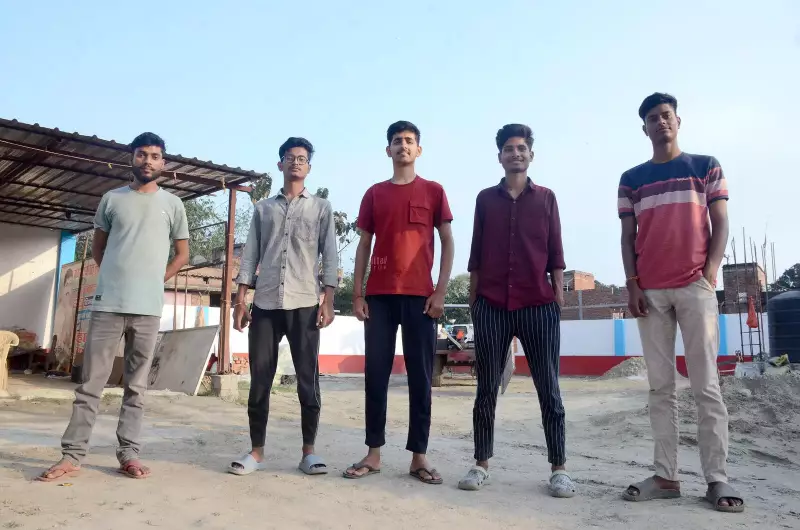
In the heart of Bihar's West Champaran district lies a village where towering height is the norm, not the exception. Marhiya, located in the Lauriya block, has earned the moniker "Village of Giants" due to the extraordinary stature of its young men. While this physical attribute has become a passport to coveted defence and police careers, it has spawned an unexpected social problem: a severe shortage of suitable brides.
The Land of the Tall: A Genetic Anomaly
Every morning, 23-year-old Aman Singh, a postgraduate standing at an impressive 6.9 feet, begins his day with rigorous physical training on the local school ground. His goal is clear: a job in the defence forces or police. Aman's confidence in his career prospects, however, is shadowed by a personal struggle shared by many in his village. "Well, good height and a smart personality are not a ticket to suitable brides here," lamented a local villager.
Aman is not an outlier. The village presents a remarkable demographic. Sahitya Singh, an Intermediate student, measures 6.2 feet. Shivam Singh, in Class X, is 6 feet tall, and graduate Vipul Kumar also reaches the 6-foot mark. Astonishingly, nearly 90% of the village's youths stand over 6 feet tall. This collective height advantage has proven beneficial, with villagers reporting that around 25 young men have successfully joined the Indian Army so far.

This stands in stark contrast to national averages. According to a report by the National Institute of Nutrition, the average height of Indian men is 5.8 feet. In Marhiya, the average for young men is a staggering 6.3 feet. The average height for girls in the village is around 5.2 feet, slightly below the national women's average of 5.3 feet.
Height's Double-Edged Sword: Jobs vs. Matrimony
The village's unique trait draws stares from passers-by and bewilderment from schoolteachers. During recruitment drives, competitors reportedly pray for these tall youths to fall sick to better their own chances. Yet, this impressive stature has created a complex matrimonial crisis.
Families are grappling with the challenge of finding matches for their children. Avinash Singh, a local working in a sugar mill, explained the paradox: "Height had clearly helped youths secure Army and police jobs, but created difficulties in marriage." The issue is two-fold. Tall young men struggle to find brides of proportionate height, while families with tall daughters also face difficulties securing suitably tall grooms.
Former village head (mukhiya) Sanjay Kumar pointed to heredity and local conditions for the tall population. He also highlighted governmental inaction, stating, "The beauty of this place is the taller population but the govt has not initiated steps to curb the unemployment crisis gripping our children." On marriages, he said, "It is very troublesome to find a bride... we are compelled to make compromises and marry shorter girls."
Ward councillor Murari Prasad echoed the sentiment, noting that families often have to settle for "matchless girls" due to the unavailability of perfectly matched partners. Social worker Laddu Singh added a lighter note, comparing the village's situation to the height difference between Bollywood icons Amitabh Bachchan and Jaya Bhaduri.
Contrasting Realities and Origins
The situation in Marhiya becomes even more striking when viewed against Bihar's broader nutritional landscape. Data from the National Family Health Survey (NFHS-5) for 2019-21 shows that 43% of children under five in Bihar are stunted due to undernutrition. This makes Marhiya's case a fascinating anomaly.
Md Ati Ullah, principal of the Upgraded Middle School in Marhiya, observed that children are of average height when admitted to Class I but undergo a significant growth spurt by Classes 6 and 7, turning "abnormally taller." While most youths in the village are tall, residents note that those from the Rajput community are particularly so. Marhiya, with roughly 300 houses and a population of 2,000, has Rajput villagers who trace their origin to the ancient Kaushik dynasty.
Thus, Marhiya remains a village of contrasts, where a genetic gift opens professional doors but closes personal ones, creating a unique narrative of aspiration and social adjustment in rural India.






