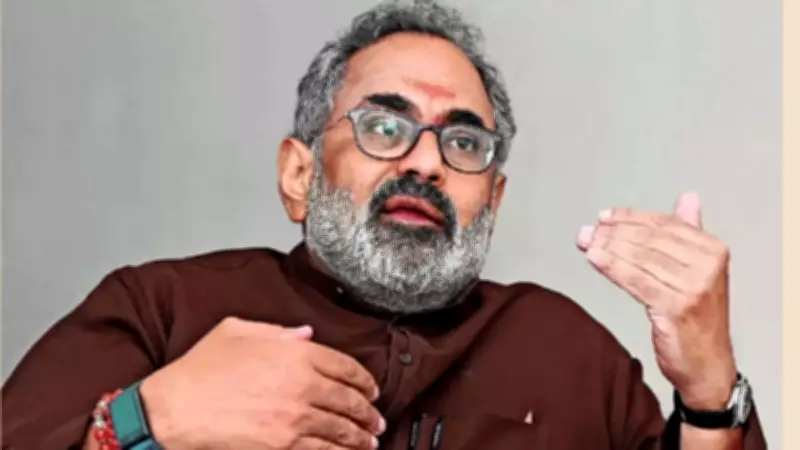
BJP State President Addresses 'Deal' Allegations and Outlines Kerala Vision
BJP state president Rajeev Chandrasekhar has firmly dismissed recent electoral 'deal' allegations while articulating the party's comprehensive development agenda for Kerala. In a detailed interview, he explained why he believes the state's long-standing two-front political order is approaching a significant collapse.
Responding to 'Deal' Allegations and Political Dynamics
What triggered these electoral 'deal' allegations?
"The deal allegations reflect panic in Congress and CPM camps," Chandrasekhar stated emphatically. "They are beginning to realize that the long-standing duopoly that worked in their favour is under serious threat. Isolating BJP has always been an integral part of their lazy political strategy."

He elaborated that as elections approach, these parties feel compelled to assert their individuality through what he described as "minority baiting" tactics. "With 45% of voters belonging to minority communities, they vilify BJP and demonize each other for allegedly being soft on us. However, people have seen through this fakery. The traditional political duo has no real understanding of which way the political wind is blowing in Kerala today."
Defending BJP's Development Agenda
How would you respond to allegations that BJP's development politics is merely a façade in Kerala?
"It is certainly not a façade," Chandrasekhar asserted. "If BJP stands for anything today, it is the tangible development delivered under Prime Minister Narendra Modi's government over the past twelve years. We are proud of that record and welcome scrutiny of it. The progress India has achieved, even in terms of global standing, has no parallel in our history."
He emphasized that today's BJP under Modi focuses squarely on India's progress through economic development, youth empowerment, and women's empowerment. "This is no façade, and it doesn't contradict BJP's political values. Development and cultural heritage are not opposing ideas for our party; they go hand in hand."
Community Outreach and Electoral Strategy
Addressing BJP's outreach to Christian communities, Chandrasekhar clarified: "We don't reach out to any community purely for electoral gain. Our outreach is to every Malayali, regardless of caste or community. Different communities face different challenges, and we engage with each accordingly."
He cited recent examples: "Four former MLAs from the scheduled caste community recently joined BJP. They stated that other parties had never delivered justice to their community, and BJP-NDA is the only front that genuinely cares about their development. Our engagement with Christian and Muslim communities follows the same principle—it is not transactional."
Predicting Political Transformation
What do you see as the most significant outcome of this election?
"One thing is certain: Kerala's political dynamics will fundamentally change," Chandrasekhar predicted. "The practice of fooling people will lose currency. Secondly, this will likely be the last election fought between three distinct fronts. The UDF vs LDF vs NDA formation may collapse as UDF and LDF could merge into one entity."
He revealed internal assessments: "Our surveys suggest that both UDF and LDF are likely to win only 50 to 52 seats each, indicating their weakening position."
Electoral Targets and Vote Share
Regarding BJP's fluctuating vote share—which fell to 12.47% in 2021 from nearly 15% in 2016—Chandrasekhar took an ambitious stance: "I am not focused on vote share, and I won't give you a specific seat number either. Our manifesto and our message for change have the potential to resonate across the state, barring a few pockets in Malappuram. So why would I set my sights at anything below 120 seats?"
He explained this confidence: "It is widely accepted that 60% of Malayalis are fed up with LDF and UDF. With twelve years of an impressive track record at the Centre, there is every reason for BJP to appeal to the vast majority of voters who want genuine development and progress in Kerala."
Addressing Specific Controversies
Why has BJP's response to the Sabarimala gold heist seemed disproportionate given the crime's gravity?

"The question is what the party's appropriate response should be," Chandrasekhar countered. "You need not take to the streets and clash with police. People in Kerala know what happened at Sabarimala. They also remember how BJP stood with devotees in 2018. Those who know the truth do not need anyone to channel their anger for them. The BJP does not need to keep shouting its position day and night. Voters will remember everything when they step into the voting booth."
If LDF and UDF leaders are corrupt, why hasn't the Central government acted against them?
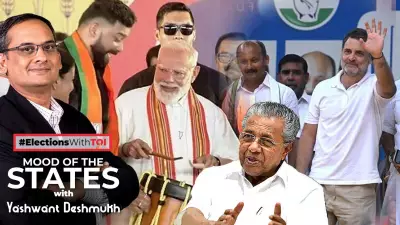
"I would like every crook to be thrown behind bars," Chandrasekhar responded passionately. "I'm the one who exposed the 2G scam. Am I happy to watch A Raja standing for election, continuing to pontificate in parliament about secularism while attacking BJP? No. Am I happy to see Chief Minister Pinarayi Vijayan and his daughter not being prosecuted under the prevention of corruption act? No. Am I happy to see Rahul Gandhi out on bail in the National Herald case? No."
He clarified the constitutional position: "But what can I do? The courts have to decide the process. Cases have been filed. You cannot conflate the court system with the government. We cannot and we will not influence the process of law."
Chandrasekhar's comprehensive interview presents BJP's Kerala strategy as focused on development outreach while positioning the party as the agent of change in a state where traditional political alignments appear increasingly fragile.