All-Night BJP Protest Rocks Karnataka Assembly Over Excise Scam Allegations
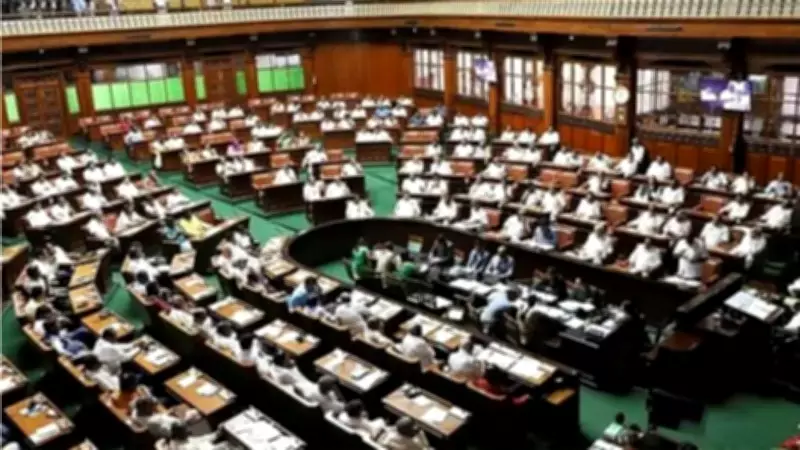
The Karnataka Legislative Assembly descended into chaos on Tuesday as the Opposition BJP staged an all-night protest, demanding the immediate resignation of Excise Minister R B Thimmapur over his alleged involvement in a massive excise department corruption scandal. The dramatic protest unfolded even as the Congress government tabled a significant resolution calling for the reinstatement of the Mahatma Gandhi National Rural Employment Guarantee Act (MGNREGA) and the repeal of the central government's Viksit Bharat Guarantee for Rozgar and Ajeevika Mission Gramin (VB-G RAM G) Act.
BJP's Corruption Allegations and Disruption Tactics
The BJP legislators attempted to disrupt the discussion on the Congress resolution, focusing instead on their demand for Minister Thimmapur's ouster. Leader of Opposition R Ashoka leveled serious accusations, claiming a "massive Rs 2,500-crore bribery scam" within the excise department. According to Ashoka, illicit funds were allegedly being diverted through Thimmapur to finance election campaigns.
The corruption allegations gained momentum following the recent arrests of three excise department officials by the Karnataka Lokayukta Police. Excise Deputy Commissioner Jagadeesh Naik, Superintendent of Excise K M Thammanna, and Excise Constable Lakkappa Gani were apprehended last month after they reportedly demanded an Rs 80 lakh bribe for issuing a bar (CL-7) and microbrewery license, ultimately accepting Rs 25 lakh.

The BJP further claimed to possess an audio recording as evidence suggesting that collected bribes were channeled to either the minister or his son. Opposition leaders detailed a systematic bribery structure:
- Rs 1.25 crore charged for each CL-7 license, totaling approximately Rs 1,225 crore
- Rs 1.5 crore for each CL-2 license, amounting to around Rs 925 crore
- Rs 92 crore for each CL-9 license
- Mini-brewery licenses allegedly costing Rs 2.5 crore in bribes
Despite these serious allegations, Excise Minister Thimmapur has categorically denied any wrongdoing, asserting that no evidence links him to the bribery charges against individual officials in his department.
Congress Government's Resolution on MGNREGA Reinstatement
Amid the political turmoil, Chief Minister Siddaramaiah tabled the Congress resolution, which strongly criticized the central government's actions regarding rural employment schemes. The resolution described MGNREGA, originally introduced by the United Progressive Alliance (UPA) government, as a "lifeline for low-income individuals in rural areas."
Siddaramaiah emphasized that the Karnataka legislature has taken serious note of the unilateral move to repeal MGNREGA, stating that this action would adversely affect people's rights. The resolution argued that replacing MGNREGA with the VB-G RAM G Act violates the right to life and livelihood guaranteed under Article 21 of the Indian Constitution.
The Chief Minister outlined several key demands while presenting the resolution:
- Complete repeal of the VB-G RAM G Act
- Reintroduction of the MGNREGA scheme
- Restoration of people's right to employment
- Re-establishment of panchayat powers
- Implementation of a nationwide minimum wage of Rs 400
Siddaramaiah expressed particular concern about the removal of Mahatma Gandhi's name from the employment guarantee scheme, calling it an insult to the national leader. He confirmed that the resolution would be formally sent to both the Central Government and the President of India.
Concerns About Rural Development and Employment
The Chief Minister highlighted several critical issues with the VB-G RAM G Act, noting that states were not consulted before its implementation. He specifically mentioned concerns about the 60:40 grant ratio introduced under the new legislation.
Siddaramaiah warned that the repeal of MGNREGA would have far-reaching negative consequences:

- Increased unemployment rates across rural areas
- Decline in women's participation in the workforce
- Lack of minimum wage protection for workers
- Increased economic pressure on Dalit and Adivasi families
- Reduced powers for panchayats to decide on local development projects
"This is a fatal law for rural development and rural life," Siddaramaiah declared, contrasting the previous guarantee of 100 days of employment annually under MGNREGA with the new provision of only 125 days of work contingent upon central government notification and budget allocation.
The political standoff in the Karnataka Assembly reflects the deepening divide between state and central governments on crucial policy matters, with corruption allegations and employment guarantee schemes becoming focal points of intense legislative confrontation.