With the crucial Assam Assembly elections scheduled for March-April 2026, the ruling Bharatiya Janata Party (BJP) has intensified its political campaign, framing the upcoming contest in starkly polarising terms. Top party leaders, including Prime Minister Narendra Modi and Home Minister Amit Shah, have made a flurry of visits to the state in December 2025, setting the stage for a high-stakes battle.
The Core Campaign: A 'Civilisational Conflict'
The party's central narrative, crystallised in recent strategic meetings, presents the election as a fundamental clash. Chief Minister Himanta Biswa Sarma has explicitly described it as a "civilisational conflict between Sanatani civilisation and that of the Bangladeshi-origin Miya Muslims." This builds on the state BJP's earlier announcement that the polls would be a contest between the indigenous Assamese populace and the Miya Muslim community, framing the outcome as critical for Assam's future, security, and civilisational continuity.
A key element of this rhetoric is the focus on demographic change. CM Sarma has repeatedly claimed that by the time of the next Census in 2027, Bengali-origin Muslims could constitute about 40% of Assam's population, while the indigenous population declines. This, he argues, represents a "demographic invasion" that needs to be countered.

Symbolism and Policy: Evictions and Historical Narratives
The BJP's sharpened pitch is backed by policy actions and symbolic gestures. Leaders have actively highlighted the state government's hardline actions, including large-scale evictions from government lands. These evictions, often targeting settlements of Bengali-origin Muslims on Sattra lands, reserved forests, and other government properties, are portrayed by the CM as a necessary crackdown against encroachment and demographic change.
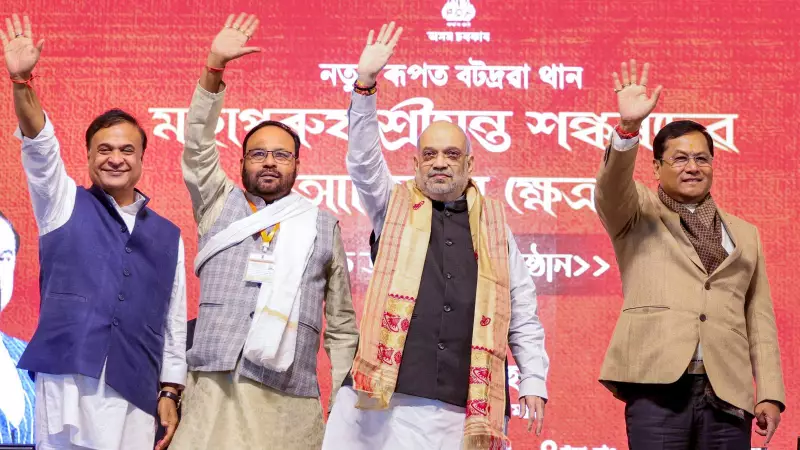
The symbolism was particularly potent during Union Home Minister Amit Shah's recent visit to Nagaon district. Shah inaugurated the Batadrava Cultural Centre at the sacred Batadrava Sattra, the birthplace of Vaishnavite saint Srimanta Sankardev. The development holds deep political significance as it stands on land where, three years prior, 359 Bengali-origin Muslim families were evicted in a major demolition drive.
Further aligning with this majoritarian narrative, CM Sarma has sought to recast Assam's history of pluralism. He dismissed the popular syncretic saying "Assam is the land of Sankar-Azan"—referring to Sankardev and Sufi saint Azan Faqir—as a "false narrative." He also controversially labelled Bagh Hazarika, a celebrated Muslim warrior in the Ahom army, a "fictitious character."
Political Calculus and Opposition Challenge
While sharpening its rhetoric against Bengali-origin Muslims, the BJP is also working to consolidate a broader Hindu vote bank. The party is attempting to align Assamese sentiments with other key constituencies, including Bihari, Marwari, and Bengali Hindus, groups whose historical relations with the indigenous Assamese have often been complex.
On the other side, the opposition remains fragmented. The Congress and the All India United Democratic Front (AIUDF), which draw significant support from Bengali-origin Muslims, are not expected to form an alliance for the 2026 polls. The Congress is instead focusing efforts on building a coalition with smaller regional parties and Left factions, a challenge in the face of the BJP's sharply focused campaign.
In his public addresses, Home Minister Amit Shah has reinforced the core message, vowing that if the BJP returns to power, "all of Assam will be made free of infiltrators." As the election cycle gains momentum, the political discourse in Assam is set to be dominated by issues of identity, demography, and land, marking a definitive shift from broader developmental agendas to a more confrontational majoritarian politics.