

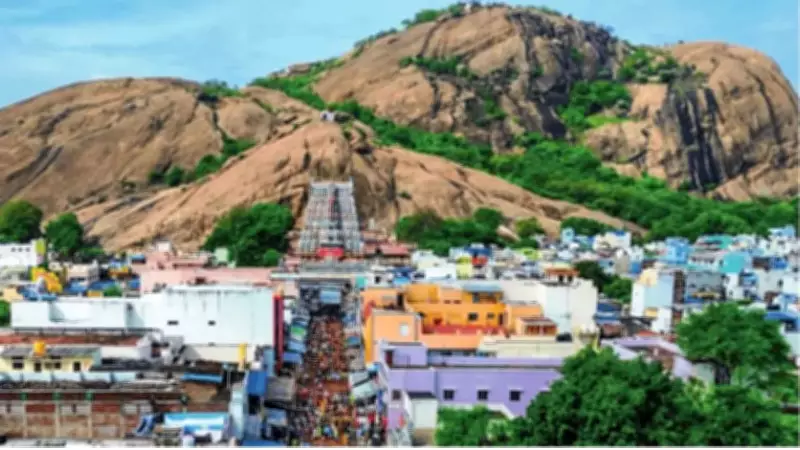
BJP's Religious Campaign Strategy Faces Political Hurdles in Sacred Thiruparankundram
For countless devotees across Tamil Nadu, Thiruparankundram stands as one of the six most sacred abodes of Lord Murugan, a site of profound spiritual significance. For politicians, however, the Thiruparankundram assembly segment has historically represented a fiercely contested battleground, particularly challenging for those opposing the dominant AIADMK. In the upcoming 2026 Assembly election, the Bharatiya Janata Party (BJP) has launched an aggressive campaign centered on the contentious Karthigai Deepam controversy, aiming to convert religious sentiment into electoral gains.
The BJP's Deepam Promise and Political Maneuvering
In its recently released poll manifesto, presented by former national president J P Nadda, the BJP made a specific pledge to ensure that the traditional Karthigai Deepam is lit on the historic 'lamp pillar' atop the Thiruparankundram hillock. This commitment follows a strategic visit by Prime Minister Narendra Modi to Madurai last month, where he deliberately offered prayers at the temple and met with the wife of Poorna Chandran. Chandran allegedly died by suicide after being distressed over the denial of permission to light the lamp on the 'deepathoon', adding emotional weight to the BJP's narrative.
Despite these efforts, the BJP finds itself politically isolated on this issue. Other major parties, including its own ally AIADMK, have consciously distanced themselves from the Deepam controversy. Perhaps anticipating limited electoral benefits, AIADMK opted to field its own candidate, V V Rajan Chellappa, instead of allocating the seat to BJP, even as the latter amplified the controversy. Chellappa has provided only a cryptic assurance about implementing the high court's order on the matter, focusing his campaign instead on AIADMK's development programmes and the legacy of the late chief minister J Jayalalithaa.

AIADMK's Strategic Calculations and Electoral History
AIADMK's cautious approach is rooted in both numerical advantage and demographic reality. The party has secured victory in Thiruparankundram five times since 2001, with the DMK managing just a single win. Rajan Chellappa himself triumphed in the 2021 election, leveraging his personal influence and the party's extensive grassroots network. Furthermore, the constituency hosts a sizeable minority electorate, making overt religious polarisation a potentially risky strategy. In the absence of a consolidated Hindu vote, Muslim voters often play a decisive role, encouraging all major candidates to avoid divisive religious issues.
Consequently, candidates including AIADMK's Rajan Chellappa, DMK's Kiruthiga Thangapandian, and TVK general secretary CTR Nirmal Kumar have all chosen to steer clear of the Deepam controversy in this high-stakes three-cornered contest. Their campaigns have consistently emphasized welfare schemes, governance records, and manifesto promises, reflecting a broader political consensus on development-focused messaging.
Voter Apathy and Broader Political Reactions
Local voters appear largely unmoved by the Deepam issue, with many expressing indifference toward its electoral relevance. "It does not influence our decision on whom to vote for," stated P Hema Bharathi, a resident of Thiruparankundram, echoing a sentiment shared by numerous constituents. Chief Minister M K Stalin has further reinforced this perspective by highlighting Tamil Nadu's longstanding tradition of religious harmony, accusing the BJP of attempting to create artificial divisions. DMK deputy secretary for Madurai South, P S R Airport Pandian, noted that lighting the Deepam is not a major concern for the local populace, pointing out that the DMK government successfully conducted the temple's consecration in 2025 after a 14-year gap.
Even within BJP ranks, there is a growing acknowledgment of the issue's limited traction. A party functionary admitted privately that the Deepam controversy has not resonated strongly with the public, suggesting that had BJP been allotted the seat, they might have built a more concentrated campaign around it. Nevertheless, BJP leaders remain cautiously optimistic about the alliance's prospects, citing Rajan Chellappa's familiarity among voters and the relative newness of the DMK's candidate as potential advantages.

As the election approaches, the Thiruparankundram contest underscores a classic clash between religious symbolism and pragmatic politics, with development and governance emerging as the dominant themes for most stakeholders.





