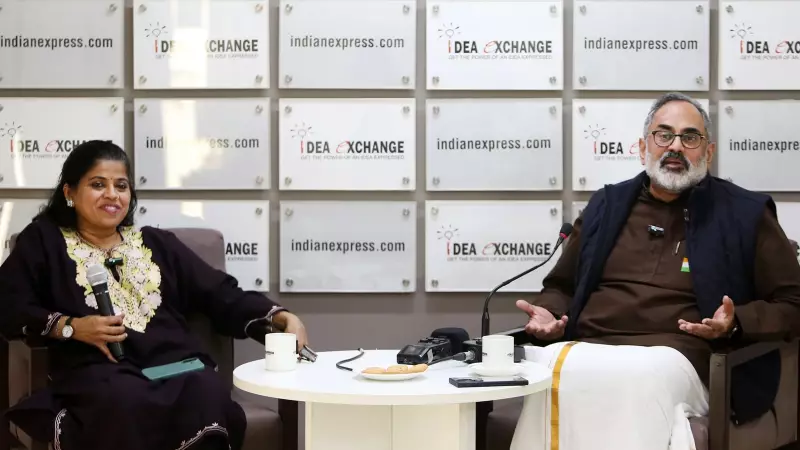
In a candid conversation at The Indian Express Idea Exchange, Bharatiya Janata Party's Kerala State President, Rajeev Chandrasekhar, outlined the significant economic and political challenges facing the state. He attributed Kerala's lack of investment and flight of talent to a governance model stuck in ideological debates, while asserting that the BJP-NDA is emerging as a formidable political force ahead of the crucial 2026 assembly elections.
The Economic Stagnation and Talent Drain
Chandrasekhar painted a stark picture of Kerala's economic reality. He highlighted a critical comparison with neighbouring Tamil Nadu, noting that while Tamil Nadu employs 24 lakh industrial workers, Kerala has less than a lakh. This, he argued, is a direct result of a failed governance model.
"When entrepreneurship is booming in all southern states, Kerala is the only state from where there is a flight of talent," Chandrasekhar stated. He explained the vicious cycle: "Investments go to where the talent is and talent goes to where the opportunities are. If there are no opportunities in Kerala, talent will flee. Why then would investments come?"

He dismissed the much-touted 'Kerala model', calling it a "CPM model or a Congress model" that has led to the highest food inflation and unemployment in the country. The 2026 elections, he predicted, will be a referendum on the state's economic future, moving away from ideological peddling to real issues of jobs and development.
Political Barriers and BJP's Ground Strategy
The BJP leader identified two fundamental hurdles for his party's growth in Kerala. First, a carefully cultivated narrative branding the BJP as a communal party, amplified by both the LDF and UDF. Second, a tacit understanding between these rival fronts to prevent the BJP's rise, evidenced by strategic vote transfers in constituencies like Thrissur South and Kodungallur.
Despite this, Chandrasekhar pointed to the party's expanding footprint. In the recent local body elections, the BJP-NDA was number one in 2,000 wards and number two in over 500 wards. "We are now a leading political force... the number two opposition in a large part of the local bodies," he claimed. The victory in the Thiruvananthapuram Corporation, he suggested, signals a "deep tectonic change" in Kerala's politics.
Organizationally, the party is shifting towards a digital-first approach and micro-meetings, attracting 100-200 new young faces in the last six months. For outreach to minority communities, which constitute about 45% of the population, the strategy is direct: "We will go to the two-and-a-half crore homes and tell people... this is what we intend to do."
On Central Policies and the Road to 2026
Addressing controversies, Chandrasekhar countered the opposition's criticism of Hindi imposition in central scheme names as "the laziest type of politics." He argued the debate should focus on policy substance, like why MNREGA is being reformed, rather than nomenclature.
He also expressed a personal opinion on a recent regulatory move, stating the mandatory installation of the Sanchar Saathi app was "unnecessary," advocating for more nuanced solutions to digital safety.
Looking ahead, Chandrasekhar framed the 2026 assembly battle as a clear choice. With the LDF, in his view, rejected by voters, the discourse will be between the UDF and the NDA. "The politics of Kerala will certainly change in 2026," he asserted, "and we will leave this ideological peddling of imaginary fantasy issues and move to the real problems and real solutions." He concluded that the BJP's mission in Kerala, though the most difficult challenge of his career, is breaking through decades-old barriers to offer a new developmental alternative.