BMC Elections: Shiv Sena (UBT) Faces Crucial Test in Mumbai Civic Battle
The upcoming Brihanmumbai Municipal Corporation elections on January 15 represent a critical moment for the Shiv Sena (UBT). This marks the party's third electoral contest since the dramatic split of June 2022. Having governed Mumbai's civic body for twenty-five consecutive years as the undivided Shiv Sena, the faction now seeks to reclaim control of India's richest municipal corporation.
The last BMC polls occurred in February 2017. Since then, political dynamics have shifted dramatically across Maharashtra.
Forming Strategic Alliances
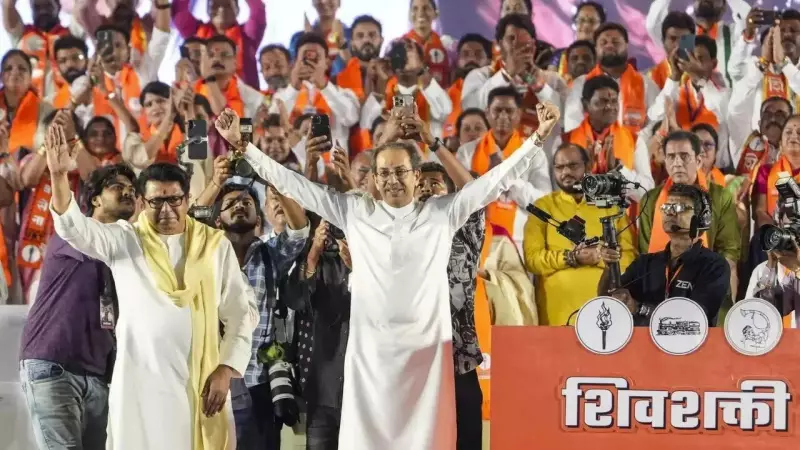
Uddhav Thackeray leads the Shiv Sena (UBT) into this challenging election. The former Maharashtra chief minister has formed an alliance with his once-estranged cousin, Raj Thackeray. Raj broke away from the Shiv Sena in November 2005 to establish the Maharashtra Navnirman Sena in March 2006.

This reunion aims to consolidate Marathi votes in Mumbai. However, multiple hurdles stand between Sena (UBT) and its goal of regaining control of Maharashtra's capital city.
The Significance of BMC
The Municipal Corporation of Greater Mumbai holds exceptional importance in Indian politics. Established in 1873, the BMC conducted its first elections based on adult franchise in 1948, one year after India's independence.
The corporation's annual budget exceeds those of several small Indian states. Its current strength stands at 227 seats, a number fixed in 2002. Previous configurations included 140 seats in 1963, 170 in 1982, and 221 in 1991.
As the civic body of India's financial and entertainment capital, BMC elections often attract more attention than many state assembly contests. The corporation's close links with Maharashtra politics amplify its significance.
Challenges Confronting Shiv Sena (UBT)
A significantly weakened Shiv Sena (UBT) faces several obstacles in its bid to regain BMC control.
Historical Performance Limitations: The BMC has frequently been described as a "Sena-controlled" body, but this characterization overlooks important details. The party has never secured an outright majority independently, always governing through alliances.
Shiv Sena first won the BMC in 1985 with 74 out of 170 seats. Its best performance came in 1997 with 103 of 221 seats. Since then, its tally declined, settling at 84 seats in 2017.
BJP's Rising Influence: The Bharatiya Janata Party has transformed from junior partner to dominant force in Maharashtra politics. Its BMC tally surged dramatically to 82 seats in 2017, just two short of its then-ally Shiv Sena. The BJP now aims to control the corporation for the first time.
Impact of the Split: The Shiv Sena division delivered a double blow to Uddhav Thackeray. It brought down his Maha Vikas Aghadi government and cost him the status of the "real" Shiv Sena. Eknath Shinde took away substantial ground cadre and traditional vote base from the original party.
In the 2019 assembly elections, the united Shiv Sena secured approximately 16% of votes. Five years later, the two factions together would have achieved over 20% as a joint entity, with 12% for the Shinde group and 10% for Uddhav's faction.
The current score stands at one victory each. Uddhav's faction performed better in the 2024 Lok Sabha polls, while Shinde's group led in subsequent state elections.
Questionable Alliance Strength: Raj Thackeray's Maharashtra Navnirman Sena has struggled to convert rhetoric into lasting electoral success. The party peaked early, winning 13 seats in the 2009 Maharashtra assembly elections and 27 seats in the 2012 BMC polls. Since those brief highs, MNS has found maintaining electoral relevance challenging as Maharashtra politics consolidated around larger players.
Demographic Realities: Marathi-speaking residents constitute only 35% of Mumbai's population according to the 2011 Census. Hindi speakers represent 25% of residents. Not all Marathi speakers vote for either Thackeray-led party, and their anti-migrant image limits appeal among non-Marathi communities.

Muslim Vote Dynamics: Historically, Muslims largely avoided voting for Shiv Sena due to its Hindutva identity. This changed in 2019 with the formation of the Maha Vikas Aghadi. Many Muslim voters supported Sena (UBT) to keep BJP out of power, a pattern seen with anti-BJP parties elsewhere in India.
Uddhav's moderate image played a significant role in attracting Muslim support. According to a CSDS study, the MVA secured 55% of Muslim votes in the 2024 state elections, while the BJP-led Mahayuti received 22%.
With Sena (UBT) now aligned with MNS, another Hindutva party, Muslim voting patterns remain uncertain. Traditional Muslim-supporting parties could fragment this crucial vote bloc. Muslims constitute 21% of Mumbai's population according to the 2011 Census.
Civic Governance Record: Annual monsoon waterlogging remains one of Mumbai's most persistent problems. Despite repeated promises and substantial spending on drainage projects, large city areas face paralysis each year. Given Shiv Sena's long dominance of BMC, this issue directly links to its civic governance record, creating a crucial test for Sena (UBT).
Potential Advantages for Sena (UBT)
Political observers often note that one plus one can equal eleven rather than two in electoral mathematics. With little to lose and much to gain, the Thackeray reunion could work to their advantage.
While sympathy factors did not help Uddhav Thackeray in the 2024 state polls, a renewed alliance with his cousin might resonate strongly with Marathi pride and identity.
Encouraging signs emerge from recent electoral data. Of Sena (UBT)'s twenty seats in the Maharashtra assembly, Mumbai alone accounts for half. In six of these constituencies, UBT candidates defeated nominees from the Shinde faction, suggesting the party's core base in the metropolis has not completely eroded.
Alliance Promises and Manifesto
The Shiv Sena (UBT)-MNS alliance released a joint manifesto titled "Vachan Nama, Shabd Thackerencha" (promissory note of the Thackerays). Key promises include:
- Using Mumbai's land exclusively for housing Mumbaikars
- Establishing BMC's own housing authority
- Providing 100 units of free residential power through BEST Undertaking
- Offering Rs 1,500 financial assistance for house helps and women from the Koli community
- Building women's restrooms on major roads
- Implementing property tax waivers for houses up to 700 square feet
Future Implications
The long-delayed BMC elections will test Sena (UBT)'s relevance in Mumbai, the city of its birth and traditional stronghold. After years of political turbulence, results will reveal whether the Thackeray faction can rebuild its base and reclaim influence.
A victory would provide much-needed momentum for the party. A defeat would raise serious questions about its future direction and viability in Maharashtra politics.