Chennai Eviction Drive Sparks Protests Over Housing Allotment Disparities
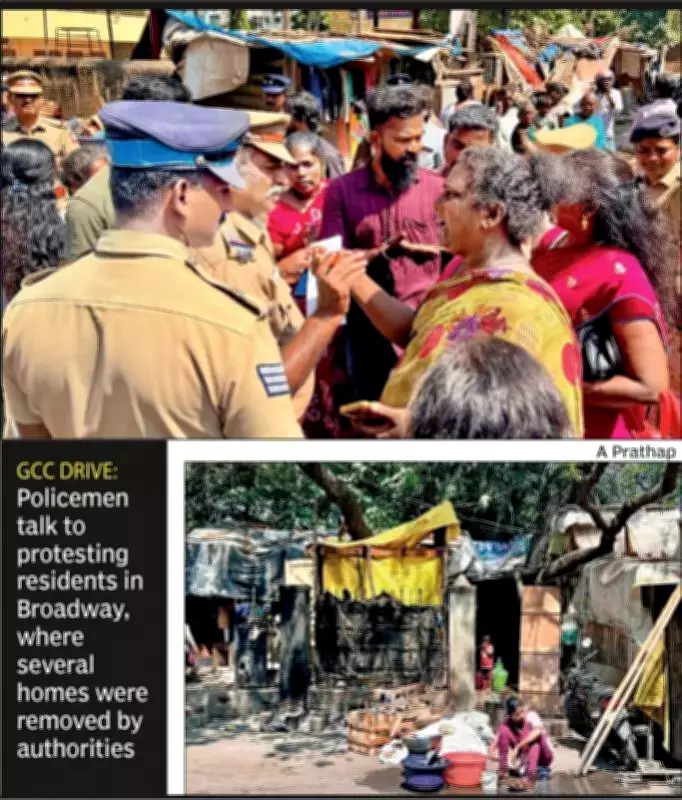
In a significant urban enforcement action, the Greater Chennai Corporation (GCC) conducted an eviction drive on Thursday, removing approximately 50 families from public land they had illegally occupied for decades. The operation targeted several Broadway streets, including Lone Square, Mooker Nallamuthu Street, and Vaniyar Street, where nearly 500 families have been residing without legal authorization.
Protests Erupt Over Allocation Inequities
The eviction triggered immediate protests from the displaced occupants, who expressed frustration over what they perceive as an unfair housing allocation process. According to the residents, only a select few among them received official allotment orders for housing in the Tamil Nadu Urban Habitat Development Board tenement located near Government Stanley Hospital. This disparity fueled anger and led to organized demonstrations.
Around 10:30 AM, GCC officials arrived at the Broadway area accompanied by excavators and a strong police presence. They proceeded to evict the families for whom housing orders had already been issued, systematically demolishing the encroachments. However, this action prompted those left without allocation orders to stage a road roko, blocking traffic in a show of defiance and desperation.

Residents Demand Local Relocation
In response to the escalating protests, civic authorities offered assurances that alternative accommodation would be provided within the city limits. Nevertheless, the residents remained steadfast in their demand to be relocated to the same tenements near Stanley Hospital. They emphasized that their livelihoods are intricately tied to the locality, making a move to suburban areas economically unviable.
B Parimala Devi, a resident of Vaniyar Street, voiced the community's collective disappointment: "Recently, corporation authorities took photographs and collected details; however, housing allotments were given to only a few. When we enquire about the rest of us, there is no proper response. We were finally relieved that the government was allotting houses for us, but we are disappointed again."
Generational Struggle and Documentation Issues
The affected families revealed that they have been living on these roadside locations for nearly 80 years, spanning four generations. They lamented a pattern of bureaucratic inaction, noting that authorities have annually collected application forms and photographs for housing allocation without making substantial progress. According to their accounts, only about 100 families have received allocation orders to date.
Locals also raised concerns about the transparency of the allocation criteria. Despite possessing essential documents such as Aadhaar cards, ration cards, and voter IDs, they feel left in the dark regarding how houses are allotted to only a fraction of the eligible residents.
Economic Dependence and Official Responses
G Vinayagam, a resident of Mooker Nallamuthu Street, highlighted the economic implications of relocation: "We are not willing to move to houses in the suburbs as we depend on jobs in this locality. If we move elsewhere, it will be difficult for us to find work and sustain ourselves."
Another resident, E Reegan, pointed to political awareness of the issue: "Authorities, including minister P K Sekarbabu, are aware of the issue. We have submitted multiple petitions to them seeking house allotments. However, allotments were given only to residents whose houses obstruct vehicular movement, while interior houses have been neglected."
Officials, however, indicated that providing allotments to all residents is not feasible. C Vijayababu, the zonal officer of Royapuram, stated: "Allotment orders were issued to around 30-40 residents in each street and shifting is underway. The encroachment eviction drive is expected to be completed within the next two-three days."
The situation underscores the complex challenges of urban development, housing equity, and community displacement in rapidly growing cities like Chennai. As the eviction drive continues, the fate of the remaining families hangs in the balance, with their demands for fair and local relocation remaining unmet.