

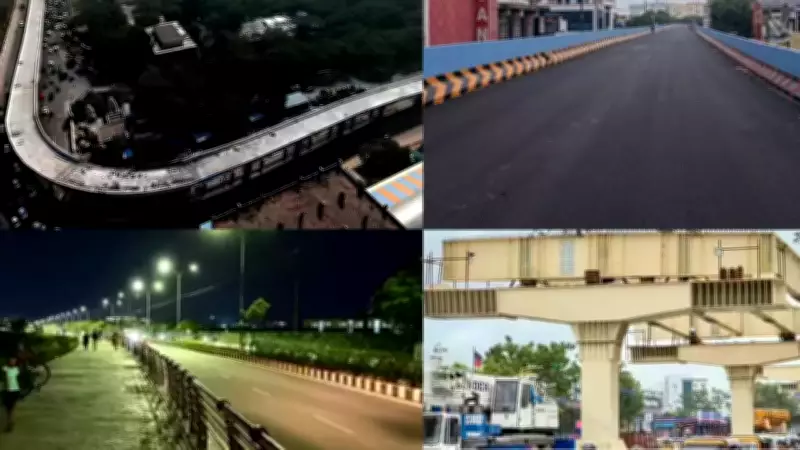
Chennai's Elevated Corridor Revolution Transforms Urban Mobility
Chennai's skyline is undergoing a dramatic transformation, and with it, the fundamental experience of navigating India's bustling metropolitan hub. A sweeping wave of elevated corridor construction is systematically reshaping daily commutes, offering tangible relief at historically congested junctions while sparking crucial conversations about urban infrastructure quality and long-term planning.
Anna Salai Flyover Extension Nears Completion
Among the most significant developments is the Anna Salai flyover extension, a critical upgrade along one of Chennai's most heavily trafficked and stretched arterial corridors. A substantial portion between Saidapet and CIT Nagar has already opened to traffic, providing partial but welcome relief to thousands of daily commuters. Construction continues toward Teynampet, where work proceeds amid complex traffic diversions.
This project represents engineering complexity at its peak, with sections being built over existing metro infrastructure requiring meticulous alignment and phased execution. Once fully operational, the corridor promises to alleviate pressure at multiple notorious choke points that routinely see extensive queues during peak hours. Currently, motorists must navigate narrowed lanes and temporary diversions—an unavoidable interim challenge in a city building vertically to solve ground-level congestion.

Madhya Kailash Flyover Delivers Mixed Results
The recently opened Madhya Kailash flyover was anticipated to dramatically reduce delays at one of south Chennai's busiest intersections, connecting Rajiv Gandhi Salai (OMR) with Sardar Patel Road. The structure has indeed improved traffic flow, particularly for office-goers heading toward the IT corridor, with peak-hour snarls that once stretched across multiple signal cycles showing measurable improvement.
However, this relief has arrived with significant caveats. Within days of inauguration, commuters began reporting issues with ride quality, describing certain stretches as uneven. This criticism quickly gained momentum, prompting calls for closer examination of construction standards and turning what was intended as a showcase project into a political talking point about execution quality.
T Nagar Link Alters Core City Movement Patterns
In Chennai's densely packed commercial heart, the T Nagar flyover has fundamentally altered traffic dynamics. Connecting South Usman Road with CIT Nagar, this elevated stretch has reduced travel times for vehicles moving between Saidapet, Guindy, and surrounding areas. Regular commuters report the most noticeable improvements during evening peak hours, when gridlocks were previously inevitable.
This project introduced innovative construction methodology, utilizing steel structures not widely seen in Chennai's earlier flyovers. Officials highlight faster construction timelines as a primary advantage of this approach. Yet, as with most infrastructure upgrades in dense urban environments, benefits remain uneven. While through traffic has improved significantly, internal roads within T Nagar continue experiencing congestion, particularly during weekends and festive seasons.
Velachery Corridor Emerges as Next Major Focus
Attention is now shifting to Velachery, where a major flyover project is poised to commence. The proposed corridor aims to ease traffic along Velachery Main Road, a critical stretch connecting residential neighborhoods with commercial hubs that suffers from daily bottlenecks. This area, home to shopping malls, office complexes, and dense housing clusters, has long struggled with congestion at multiple junctions.
Upon completion, the flyover is expected to streamline movement for substantial commuter volumes, particularly those traveling toward Guindy and the IT corridor. For residents, the expectation is straightforward: reduced idling time at signals and more predictable daily travel durations.

Expanding Infrastructure Network and Future Considerations
The Tamil Nadu government has outlined ambitious plans for additional flyovers across Chennai as part of a comprehensive infrastructure strategy. While specific locations are still emerging, the objective remains clear: reduce dependence on signal-based intersections and create smoother corridors for through traffic. Officials emphasize focusing on areas where congestion persists despite previous road-widening efforts.
Simultaneously, attention is turning to pedestrian safety. In sections along OMR, ongoing flyover construction has necessitated the removal of foot overbridges, creating challenges for pedestrian crossings. Authorities have implemented temporary measures including speed breakers and warning signs, with growing emphasis on improving safety during construction phases. Urban experts suggest this presents opportunities for future projects to better integrate pedestrian infrastructure, ensuring that improved vehicular flow doesn't compromise safety for those on foot.
Sustained Construction Amid Regulatory Challenges
Even regulatory constraints like the Model Code of Conduct haven't slowed ongoing construction. Authorities have permitted work on major infrastructure projects, including flyovers, to continue uninterrupted, though formal inaugurations may experience delays. This approach reflects the urgency attached to completing projects already in advanced stages.
Historical Context and Future Implications
Chennai possesses a long history with flyovers, beginning with the iconic Gemini Flyover decades ago as a symbol of urban modernization. Today's push occurs at unprecedented scale and under intensified scrutiny. Urban experts increasingly question whether flyovers alone can solve congestion in a rapidly expanding metropolis. While they alleviate specific junction bottlenecks, they sometimes displace congestion further along road networks. Concerns persist regarding construction quality, long-term maintenance, and broader impacts on urban design.
For now, Chennai's flyover initiative shows no signs of deceleration. With multiple projects underway and more in planning stages, the city is investing heavily in elevated corridors to maintain traffic mobility. For daily commuters, even marginal travel time improvements represent significant quality-of-life enhancements. The ultimate test lies in balancing speed with safety, expansion with thoughtful planning, and immediate relief with long-term urban sustainability. As Chennai builds upward, the fundamental question evolves from how fast vehicles can move to how effectively the entire transportation ecosystem serves all road users.





