

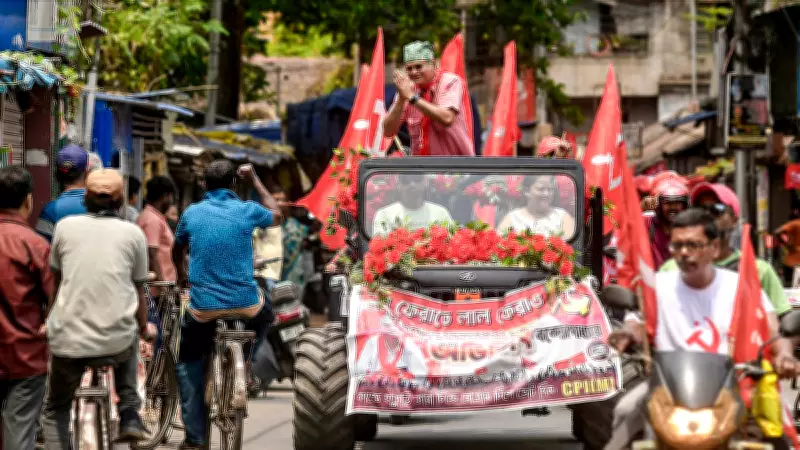
The Communist Party of India (Marxist), or CPI(M), finds itself at a crossroads in West Bengal as the state gears up for the 2026 assembly elections. Once a dominant force, the party now struggles to navigate a polarized political landscape shaped by the ruling Trinamool Congress's welfare politics and the Bharatiya Janata Party's majoritarian appeal.
A Struggle for Relevance
After a prolonged decline following the Left Front's defeat in 2011, the CPI(M) is attempting to reassert itself. The party has focused on grassroots mobilization and alliance-building with other secular forces. However, internal factionalism and a shrinking support base remain significant hurdles.
Welfare vs. Majoritarianism
The political battlefield in West Bengal is largely defined by two competing narratives: the Trinamool Congress's emphasis on social welfare schemes and the BJP's Hindu nationalist agenda. The CPI(M) seeks to position itself as a third alternative, advocating for class-based politics and secularism. Yet, critics argue that the party has failed to offer a distinct vision that resonates with voters.

Old Challenges Endure
Despite efforts at renewal, the CPI(M) continues to face familiar problems. Organizational decay, lack of charismatic leadership, and a fragmented opposition have hindered its revival. The party's traditional base among industrial workers and rural poor has been eroded by the Trinamool's patronage networks and the BJP's cultural appeals.
As the elections approach, the CPI(M) must decide whether to stick to its ideological roots or adapt to the changing political dynamics. Whether this signals a genuine renewal or a repetition of past mistakes remains to be seen.






