

Darjeeling Elections: Gorkhaland Fades as Development Takes Center Stage
In the picturesque hills of Darjeeling, faded posters demanding a separate state of Gorkhaland still cling to moss-covered walls, serving as a quiet reminder of a movement that once singularly defined the region's politics. However, as the constituency heads to the polls on Thursday, the dominant narrative has given way to a more layered and fragmented contest. Development, governance, and corruption-free administration are steadily reshaping voter priorities, marking a significant transition in an area long defined by ethnic identity politics.
A Shift in Political Landscape
For decades, politics in Darjeeling, along with neighbouring Kurseong and Kalimpong, revolved almost entirely around the Gorkhaland movement. Parties rose and fell based on their ability to champion this cause. The Gorkha National Liberation Front (GNLF) dominated the landscape through the late 1980s and 1990s under Subash Ghisingh, before the emergence of the Bimal Gurung-led Gorkha Janmukti Morcha (GJM) in 2007. While regional parties held sway in assembly segments, the Bharatiya Janata Party (BJP) expanded its influence by backing the Gorkhaland cause, establishing a stronghold in the Darjeeling Lok Sabha seat, which it has held since 2009.
Aftermath of the 2017 Agitation
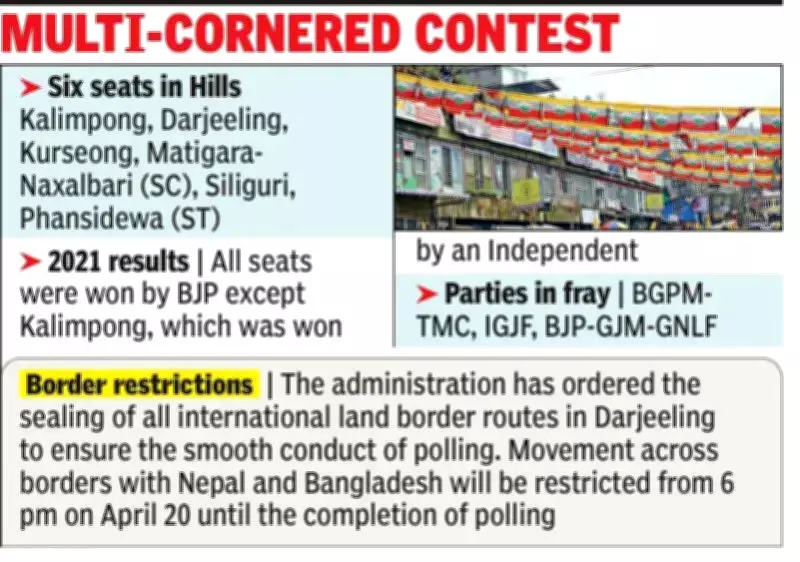
The political landscape underwent a major churn following the 2017 Gorkhaland agitation—a 100-day shutdown that paralysed life in the hills. In its aftermath, the once-dominant GJM split into factions, weakening its organisational grip. The emergence of the Bharatiya Gorkha Prajatantrik Morcha (BGPM) under Anit Thapa, and its alignment with the Trinamool Congress, further altered political equations. This fragmentation has led to a multi-cornered contest, with voters now focusing on more immediate concerns.

Changing Voter Priorities
Local residents highlight this shift in priorities. Rakesh Yadav, a trader from Darjeeling, notes, "Earlier, everything was about Gorkhaland. Now, people are asking about roads, jobs, and stability." Similarly, Hari Prasad, a voter from Kurseong, adds, "Peace matters now. We don't want shutdowns again. Whoever ensures stability will get support." This sentiment was reflected in the 2021 assembly elections, where the BJP, allied with GJM factions, retained a strong foothold, while the BGPM, backed by Trinamool, made significant gains and eventually took over the Gorkhaland Territorial Administration (GTA).
New Entrants and Competing Issues
Adding a fresh dimension to the contest is the Hamro Party, led by entrepreneur Ajay Edwards, owner of the iconic Glenary's. Edwards has centred his campaign on corruption and systemic reform, appealing to voters tired of traditional politics. Across Darjeeling, Kurseong, and Kalimpong, electoral discourse now reflects a mix of competing priorities:
- Infrastructure gaps and poor road conditions
- High unemployment rates among youth
- Traffic congestion in urban areas
- Environmental concerns and sustainable development
Sudesh Pradhan, a resident of Darjeeling, explains, "It's not that people have forgotten Gorkhaland, but everyday issues are now equally important."
Lingering Statehood Question
Despite this shift, the statehood question continues to linger beneath the surface. Noman Rai, the GJM-BJP candidate from Darjeeling, asserts, "We are contesting on the BJP symbol, but our core commitment remains Gorkhaland." GJM chief Bimal Gurung has thrown his weight behind Rai, even stating, "I will quit politics if my candidate loses." This indicates that while the movement may have faded from the forefront, it remains a potent undercurrent in the region's political psyche.
Mobilising Non-Nepali Voters
Another notable transition is the conscious push to mobilise non-Nepali, Hindi-speaking voters in Darjeeling. This effort marks a departure from a constituency long defined by ethnic identity politics, suggesting a broader, more inclusive electoral strategy as parties adapt to changing demographics and voter expectations.

As Darjeeling heads to the polls, the election represents a critical juncture—where the echoes of the past meet the demands of the present, shaping a future that balances historical aspirations with contemporary needs for development and stability.





