Dead Voters Come Alive at Mamata Banerjee's Protest Against Electoral Roll Purge
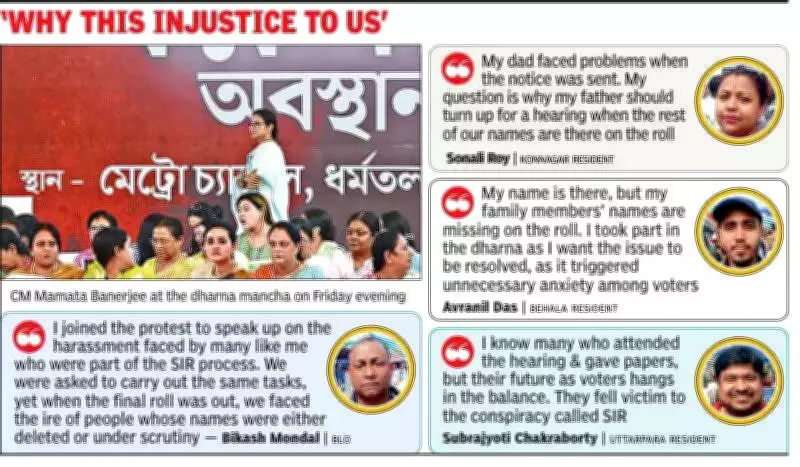
In a dramatic turn of events, several voters officially listed as deceased in West Bengal's electoral rolls physically appeared at Chief Minister Mamata Banerjee's protest rally in Kolkata's Esplanade area on Friday. The demonstration was organized against the Summary Revision (SIR) process that has removed approximately 63.6 lakh voters from the state's electoral list and placed another 60 lakh under adjudication status.
Living Proof Against Electoral Errors
These supposedly dead citizens stood at the dharna mancha as living proof of what they claim are serious errors in the Election Commission's verification process. Archana Mondal, a 65-year-old resident of Alipore, expressed her frustration after discovering her name had been struck off the roll because authorities mistakenly marked her as deceased.
"How did the Election Commission get the idea that I died?" Mondal questioned. "Even my enumeration form was submitted along with all required documents, and I never received any notification for a hearing. When the final roll was published on February 28, I discovered my name was missing. My son contacted the Booth Level Officer and learned that the EC had declared me dead."
Diverse Voices of Protest
The protest attracted citizens from various backgrounds who shared similar experiences of being incorrectly classified. A monk who served as president of the Minakhan Ramakrishna Sarada Mission in North 24 Parganas for fourteen years joined the demonstration after finding his name deleted from the electoral roll.
The monk stated, "Despite my long service and community standing, my name was excluded. I am a disciple of Swami Vireshwarananda, the tenth president of Belur Math. I came to Didi today to express my concern - if this continues, what will become of our democracy? From this platform, I pray that truth prevails and the SIR process is suspended."
Mass Participation from Konnagar
Large groups of protesters traveled from Konnagar in separate contingents, each comprising 150 to 200 people. Many admitted they might not understand every technical detail of the SIR process but joined the protest because neighbors in their communities were struggling with repeated document submissions and verification delays.
Chandrika Chakraborty, a Konnagar resident, explained her participation: "I joined the dharna to seek clarity about the future of so many voters whose names were either deleted or marked under adjudication. I want to hear directly from the Chief Minister about possible solutions to this crisis."
Systemic Concerns Emerge
Dillip Shaw raised questions about inconsistencies in the revision process: "How did my name not appear when both my parents' names were on the initial list? Despite attending the hearing as required, my name was absent from the electoral roll published on February 28."
Long-time voters expressed anxiety about whether they would be able to exercise their franchise in upcoming elections. Manoj Singh from Amherst Street reported that in his locality alone, 107 names were currently under adjudication. The protest also attracted professionals including a head teacher from an Uttarpara educational institution associated with the education department.
Sumit Shaw, a gas delivery worker, summarized the sentiment of many protesters: "I came seeking an explanation because my name is missing from the final electoral roll despite being a legitimate voter."
Broader Implications for Democracy
The protest highlights growing concerns about the integrity of the electoral revision process in West Bengal. With millions of voters potentially disenfranchised through deletions or adjudication status, citizens are demanding greater transparency and accuracy in voter list maintenance. The physical presence of those declared dead but very much alive has added a powerful visual dimension to these concerns, challenging the official records and procedures that determine who can participate in India's democratic process.