

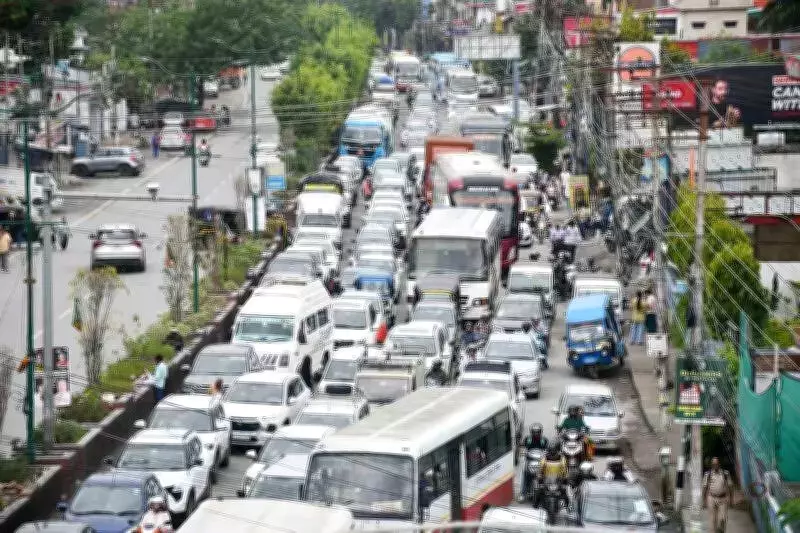
Dehradun's Key Transport Corridor Plunged Into Daily Traffic Chaos
The bustling six-kilometer stretch from Rispana Square to the Dehradun Inter-State Bus Terminal (ISBT) on the Haridwar bypass road has become synonymous with chronic traffic congestion, creating a routine nightmare for commuters and residents alike. This critical transport artery is buckling under the pressure of a rapidly increasing number of vehicles and a steady influx of visitors to the city, leading to persistent gridlocks that disrupt daily life.
A Vital Yet Congested Gateway
Rispana Square functions as a primary entry point for thousands of commuters traveling from Rishikesh and Haridwar into Dehradun. The stretch is heavily utilized by those heading to the ISBT, as well as individuals accessing populous residential areas like Nehru Colony and Dharampur directly from the bus terminal. The situation deteriorates markedly during evening peak hours, particularly between 6 PM and 8 PM, when the road regularly transforms into a parking lot of frustrated motorists.
Local business owners and residents squarely blame systemic traffic mismanagement for the unending snarls. "Despite being designed as a four-lane road, it witnesses frequent and severe jams, largely due to inadequate traffic management," stated Naveen Uniyal, a bakery owner operating along the troubled corridor. "The problem is severely compounded by widespread improper driving behaviors, including a complete lack of lane discipline. With tourism and related activities in Dehradun poised for further growth, Rispana Square will continue to bear an ever-increasing traffic load. Unless these fundamental issues are addressed proactively, the congestion will only persist and worsen," he warned.

Manual Regulation and Heavy Vehicle Woes
Another local trader, Suryansh Gulati, highlighted the counterproductive practice of manual traffic regulation by police personnel instead of relying on optimized traffic signals. "During the worst peak-hour congestion, traffic is managed manually. While this approach might be necessary in genuine emergencies, employing it as a routine strategy only exacerbates the situation," Gulati explained. He further drew attention to the specific segment between Kargi Chowk and the ISBT, which experiences intense movement of trucks and buses, underscoring the critical and urgent need to ease traffic flow in that particular zone.
Calls for Experimental Solutions and Official Response
Anoop Nautiyal, a city-based social activist and founder of the Social Development for Communities Foundation, suggested that experimental, targeted measures could offer much-needed relief to beleaguered commuters. "One viable option is to dedicate specific lanes exclusively for heavy vehicles such as buses and trucks. Implementing clear road markings and signage, coupled with robust public awareness campaigns focusing on lane discipline and strict adherence to traffic signals, could also yield significant improvements," Nautiyal proposed.
When contacted by the media, Shahjahan Ansari, SP (Traffic) for Uttarakhand, affirmed that the traffic police are in constant coordination with relevant departments to tackle the escalating problem. "While we are diligently working on developing long-term, sustainable solutions, we are also actively considering a shift towards managing vehicular movement through automated traffic signals instead of manual regulation," Ansari said. "If this method proves to be more effective, especially during demanding peak hours, we will adopt it formally. Other comprehensive measures will be implemented in close coordination with all concerned departments to ensure a holistic resolution," he assured.
The chronic congestion on this vital Dehradun stretch highlights a growing urban infrastructure challenge, demanding immediate and coordinated action from authorities, coupled with responsible driving from the public, to restore smooth mobility.






