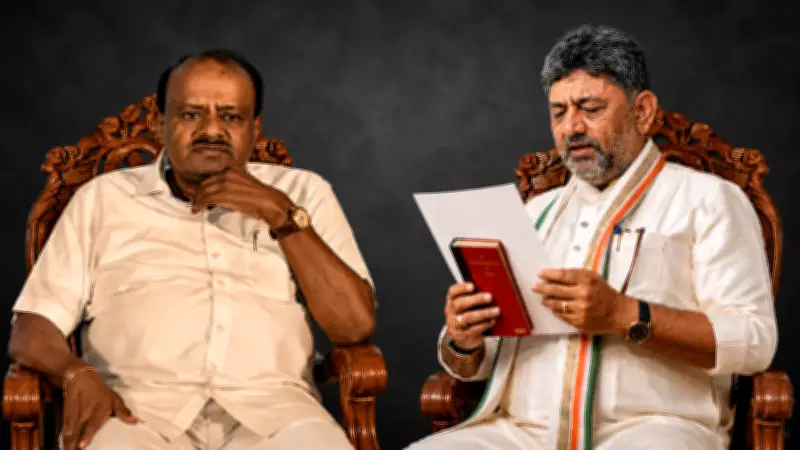
The DK Shivakumar era has officially commenced in Karnataka. The Congress party's foremost troubleshooter has finally assumed the role of chief minister, fulfilling a long-cherished dream that he nurtured and worked toward for years. Shivakumar took the oath of office, swearing in the name of the revered seer "Gangadhar Ajja," while holding a copy of the Constitution. His elevation, after an extensive wait, has the potential to significantly alter the political dynamics of the state.
Shivakumar's Journey to the Top Post
The Karnataka Congress chief had first staked his claim to the top position in 2023 after leading the party to a record victory over the Bharatiya Janata Party (BJP) in the assembly elections. However, the Congress high command chose to side with Siddaramaiah's experience at that time, asking Shivakumar to wait under a rotational power-sharing agreement. Now, with the transition finally realized, the party has managed a smooth handover despite earlier hiccups, positioning the grand old party advantageously ahead of the 2028 assembly elections in the state.
The Congress leadership hopes that this change will help counter any potential anti-incumbency sentiment against the Siddaramaiah government. But the significance of this leadership swap extends beyond mere anti-incumbency. It also involves how shifting caste equations may influence the success of political parties in Karnataka.

Impact on Opposition: BJP and JD(S) Face New Challenges
Unsurprisingly, the BJP and the Janata Dal (Secular) (JD(S)) will closely observe the 64-year-old Vokkaliga Congress strongman in action as chief minister. This move forces both parties, currently occupying the opposition space in the state, to revisit their strategies and recalibrate the caste factor ahead of the 2028 elections.
BJP's Strategic Dilemma
For the BJP, Shivakumar's elevation potentially disrupts a strategy the party has spent years building in Karnataka. The state's politics have long revolved around two influential communities: the Lingayats and the Vokkaligas, who essentially hold the keys to power. Members of these groups have occupied the chief minister's office far more often than any other community in Karnataka's history, making them central to every party's electoral calculations.
While the BJP's strength has traditionally come from the Lingayat belt, particularly under BS Yediyurappa, its expansion plans depended on making deeper inroads into the Vokkaliga-dominated Old Mysuru region. This was one of the key reasons behind the BJP's alliance with the JD(S). The strategy was clear: the BJP would bring its Lingayat support base, while the JD(S), led by HD Deve Gowda and HD Kumaraswamy, would help deliver Vokkaliga votes. Together, the alliance hoped to create a coalition capable of challenging the Congress across southern Karnataka. However, the elevation of Shivakumar, one of the most influential Vokkaliga leaders in the state, as chief minister complicates that calculation.
Shivakumar gives the Congress something its rivals would have preferred it did not have: a powerful Vokkaliga face not just within the party but actually occupying the state's top job. His elevation comes at a time when the BJP has been carefully balancing its own caste equations. The party appointed R Ashoka, a Vokkaliga leader, as leader of the opposition, while handing the state unit presidency to BY Vijayendra, son of Lingayat strongman BS Yediyurappa. The message was clear: a Lingayat would lead the organization, and a Vokkaliga would lead the fight against the government. With Shivakumar now in the chief minister's chair, that balancing act may need to change.
Concerns within sections of the BJP indicate that a Vokkaliga chief minister could make it harder for the National Democratic Alliance (NDA) to consolidate support in southern Karnataka. There is also the possibility that the Congress may seek to expand its social coalition further by reaching out to sections of backward classes and Dalits who may have been disappointed by Siddaramaiah's exit. For a BJP hoping to broaden its footprint beyond traditional strongholds, Shivakumar's rise presents a fresh challenge.

JD(S) Forced to Defend Core Support Base
While the BJP has a caste balance in place, its ally the JD(S), led by former Prime Minister HD Deve Gowda and his son HD Kumaraswamy, faces a more direct challenge. The party has treated the Vokkaliga-dominated Old Mysuru region as its impregnable fortress. The community, which forms one of the most powerful agrarian and socio-political blocs in Karnataka, has traditionally rallied behind the Deve Gowda clan, viewing them as ultimate guardians of Vokkaliga pride.
However, Shivakumar being the chief minister directly threatens this monopoly. He is no longer just a political challenger but now wields authority as chief minister to woo the community with administrative decisions. The JD(S) must now rework its strategy to defend its core voter base from a formidable, sitting Vokkaliga CM who has the state machinery, necessary resources, and a point to prove. This becomes even more challenging given that the JD(S) has been on a downward trajectory for some time.
In the 2023 assembly elections, the party won just 19 seats and secured around 13% of the vote share, a sharp contrast to the Congress, which swept to power with 135 seats. Significantly, Congress made major gains in several parts of the Old Mysuru region, which has been a JD(S) stronghold for years.
The rivalry between Shivakumar and Kumaraswamy has also intensified over the years. The two leaders have repeatedly traded barbs, with Kumaraswamy accusing the Congress of attempting to politically weaken the JD(S), while Shivakumar dismisses claims that the regional party remains indispensable in Karnataka politics. The JD(S), which has shared power with the Congress in the past, now has a task at hand: it needs to strategize to ensure that Chief Minister DK Shivakumar does not push the party into the fringes of state politics.
Shivakumar's Challenge: From Organizer to Administrator
DK Shivakumar, on the other hand, must prove that his governance skills are as effective as his crisis management abilities. The diehard Congressman, who has spent years building his image as an efficient organizer capable of delivering victories and protecting the party during its most difficult moments, now has to show that he can also lead the party with success. His tenure will be closely watched by allies and rivals alike, as the political landscape of Karnataka enters a new chapter.