DK Shivakumar Sworn In as Karnataka Chief Minister
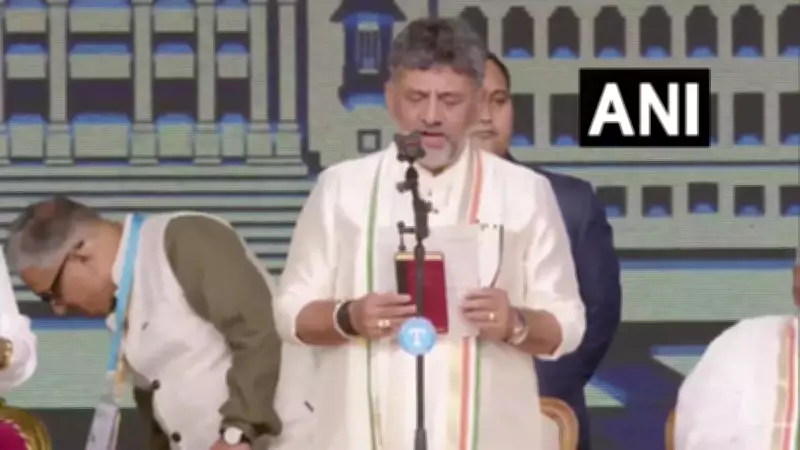
Karnataka Congress president DK Shivakumar was sworn in as the chief minister of Karnataka on Wednesday at a ceremony held at Lok Bhavan in Bengaluru. Along with him, 13 legislators took oath as ministers in the first phase of cabinet expansion. The oath of office and secrecy was administered by Governor Thaawarchand Gehlot at 4:05 pm at the Glass House of Lok Bhavan.
The 64-year-old Vokkaliga strongman, who was elected as the leader of the Congress Legislature Party on May 30, is expected to announce eight populist schemes, particularly focused on farmers and women, soon after taking oath. This is seen as an early effort to shape the governance agenda and define the policy direction of his government.
First Batch of Ministers Sworn In
Congress MLA TB Jayachandra confirmed that the party high command finalized the schedule for ministers taking oath. The first batch of ministers took oath alongside Chief Minister Shivakumar, while the second batch is expected to be inducted after June 18, following the completion of Rajya Sabha elections. Jayachandra stated that with Legislative Council and Rajya Sabha elections continuing till June 18, a full government will be in place only after the second phase.

Chief Minister-designate DK Shivakumar had earlier stated that the Congress high command would release the final list of ministers on Wednesday ahead of the swearing-in ceremony.
Rahul Gandhi Arrives in Bengaluru
Leader of Opposition in Lok Sabha, Rahul Gandhi, arrived in Bengaluru on Wednesday morning to attend the oath-taking ceremony. He left from IGI Airport in New Delhi for Bengaluru. Other prominent Congress leaders, including party chief Mallikarjun Kharge, general secretary KC Venugopal, and Karnataka Congress in-charge Randeep Surjewala, also attended the event. Several Congress chief ministers marked their presence at the ceremony.
Supporters Gather Outside Shivakumar's Residence
Earlier in the day, DK Shivakumar greeted a large number of supporters gathered outside his residence in Bengaluru ahead of the ceremony. His supporters organized special prayers and celebrations, while his constituency, Kanakapura, was decked up with banners and cutouts congratulating him on becoming chief minister. An eight-time MLA and Karnataka Pradesh Congress Committee president, Shivakumar is known as the party's "troubleshooter," having risen through the ranks with a strong grassroots base and a reputation for handling political crises.
BJP Criticizes Congress Ahead of Oath
Ahead of the swearing-in ceremony, BJP MP Ashok Bajpai claimed that "factionalism has grown a lot in the Congress" and that the state will suffer as the government might not be able to manage public welfare schemes. Speaking to ANI, Bajpai said, "Because of this internal conflict within the Congress, the people of Karnataka will have to suffer. The internal politics within the Congress have come to the surface today, revealing how much discord exists, and because of this factionalism, public welfare work is impossible in Karnataka." He added that the swearing-in ceremony was taking place but Siddaramaiah and DK Shivakumar had not yet reached an agreement, preventing cabinet expansion.
Shivakumar Visits Yediyurappa
Earlier, DK Shivakumar visited BJP leader and former Chief Minister BS Yediyurappa ahead of the swearing-in ceremony. After the meeting, Shivakumar said, "They have guided and worked for the state. All of us have to work together."
Challenges Ahead for Shivakumar
For DK Shivakumar, the journey to the chief minister's office has been long and arduous. After decades of building influence within the Congress and emerging as one of the party's most resourceful functionaries, he finally secured the state's top post. Yet, bigger challenges await. More than running the government, Shivakumar will have to establish himself as a leader with a distinct political identity while succeeding Siddaramaiah, arguably Congress's most influential functionary in Karnataka over the past decade.

Political analysts say the transition presents both an opportunity and a challenge. While the CM post gives Shivakumar administrative authority, Siddaramaiah continues to enjoy considerable influence among legislators, ministers, and party workers. As a result, the new CM will inevitably be measured by the achievements of his predecessor. "Becoming CM is one thing and becoming the principal political face of the party is another. Siddaramaiah occupied that space for years," said MN Patil, a political commentator. "Shivakumar will have to create his own narrative and convince people that he represents a new phase for Congress in Karnataka."
Observers point out that Shivakumar cannot afford to move away from Siddaramaiah's political legacy too quickly. The Ahinda coalition remains Congress's strongest electoral asset, and any perception of weakening that social base could prove costly. Yet, Shivakumar must gradually expand his appeal beyond his traditional Vokkaliga support base if he hopes to emerge as the party's dominant face.
The contrast in governance styles is also expected to attract attention. Siddaramaiah's tenure was defined by his command over administration, although many believe he slowed down because of age and health concerns in the second term, and his rustic style created a sense of fear among the bureaucracy. Shivakumar is known to be administratively aggressive and is likely to place greater emphasis on execution, project delivery, and visible infrastructure development. Supporters believe his reputation for quick decisions and close monitoring of projects could give administration a different character.