

Former Kurmi Samaj Leader Rajesh Mahato Aligns with BJP in West Bengal Political Shift
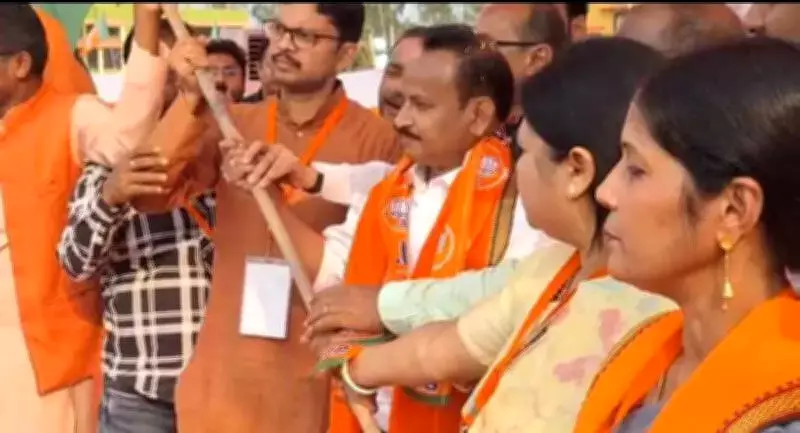
In a significant political development in West Bengal, Rajesh Mahato, the former state president of the Kurmi Samaj organization, formally joined the Bharatiya Janata Party (BJP) on Sunday. The induction occurred during the BJP's high-profile 'Poriborton Yatra' event held in Garbeta, located within the West Midnapore district. This move marks a notable realignment within the state's political landscape, particularly concerning the influential Kurmi community.
A Three-Decade Veteran of the Kurmi Movement
Rajesh Mahato is not a newcomer to community activism. For nearly thirty years, he has been a pivotal and prominent figure within the Kurmi movement in West Bengal. The movement's core demands have consistently centered on two primary objectives: the official inclusion of the Kurmali language in the Constitution's Eighth Schedule and the granting of Scheduled Tribe (ST) status to the Kurmi community. These longstanding issues have been sources of significant agitation and political discourse in the region.
Distancing from Kurmi Samaj and Legal Entanglements
It is important to note that Mahato had previously stepped back from his formal role within the Kurmi Samaj. He resigned from his position as state president on January 7, 2025, and has since maintained a distance from the organization's active leadership. His political journey has also been fraught with legal challenges. Mahato's name was linked to an attack on the convoy of State Forest Minister Birbaha Hansda during Trinamool Congress national general secretary Abhishek Banerjee's 'Nabo Jowar' program in Jhargram on May 26, 2023.

Following that incident, he was arrested and remained in custody for a period of 42 days. Currently, Rajesh Mahato faces a staggering total of 49 separate legal cases and has been arrested on seven different occasions, painting a picture of a figure deeply entangled with the law.
Reactions from Kurmi Samaj and Political Rivals
The reaction from his former organization was measured. Kaushik Mahato, the current state chief of the Bengal chapter of Kurmi Samaj, characterized Rajesh's decision as a purely "personal" choice. He stated, "The organization has no comment on the matter. His decision won't significantly impact the movement," suggesting a deliberate effort to separate the individual's political affiliation from the community's collective struggle.
From the ruling Trinamool Congress, Jhargram vice-president Prasun Sarangi offered a cautionary note. "The Chief Minister has always been respectful towards the Kurmi community and sincere about its demands," Sarangi said. "Rajesh-bhai should weigh his decision more carefully," implying that the switch in allegiance might not be in the best interest of the community's goals.
The Path to BJP and Future Ambitions
Speculation about Rajesh Mahato's political leanings began circulating when he was observed attending a meeting with several BJP heavyweights. The gathering included Union Forest and Environment Minister Bhupender Yadav, former Tripura Chief Minister Biplab Deb, MP Jyotirmoy Singh, and BJP's West Bengal state president, Samik Bhattacharya. His presence there fueled rumors that were ultimately confirmed with his official induction.
Upon joining the BJP, Mahato clarified his motivations. "I will continue the movement for our demands," he asserted. "I joined a political platform because this is a larger stage where I can work for society." When questioned about the possibility of contesting in the upcoming elections, Mahato deferred to the party's leadership, stating that such a decision would rest entirely with the BJP.
The Enduring Kurmi Demand for Recognition
The backdrop to this political shift is the persistent and restless demand from the Kurmi communities residing in both West Bengal and Jharkhand. Their quest for official recognition as a Scheduled Tribe (ST) remains a potent and unresolved issue. The West Bengal government has reportedly forwarded their demand to the central government for consideration. This submission is supported by studies conducted by the state's own Cultural Research Institute, lending academic and administrative weight to the community's claim.

Rajesh Mahato's move to the BJP injects a new dynamic into this complex socio-political equation. It remains to be seen how his three decades of activism will translate within the structures of a national party and whether this shift will accelerate or complicate the Kurmi community's long-standing aspirations for constitutional recognition and status.





