

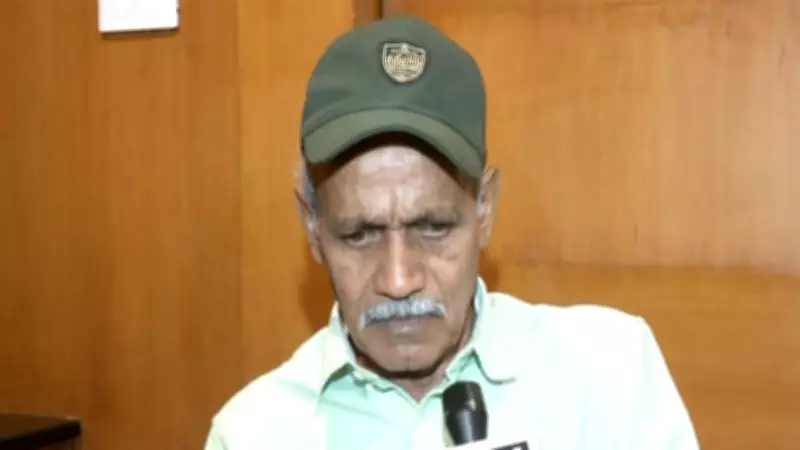
Former Maoist Leader Challenges Official Surrender Narrative, Claims He Was Arrested
In a startling revelation that contradicts the official police account, former Maoist leader Rajireddy has publicly challenged the Telangana police's version of his surrender, asserting that he was actually arrested. Recalling the specific circumstances of February 18, Rajireddy alleged a pattern where authorities apprehend senior Maoist figures and subsequently present these detentions as voluntary surrenders to bolster their anti-Naxal operations narrative.
"I did not surrender; I was arrested on February 18," Rajireddy stated emphatically. "It was decided that we would resolve this issue within the framework of the law and in a relatively peaceful manner. Whoever is caught, the government portrays it as a surrender." This claim directly challenges the police's public statements and raises questions about the transparency of surrender procedures in ongoing counter-insurgency efforts.
Rajireddy's Analysis of Maoist Strategy and Future Challenges
Beyond his personal case, Rajireddy offered a strategic analysis of the Communist Party (Maoist)'s current predicament. He expressed his view that the organization, which has historically conducted class struggles and guerrilla warfare in remote interior regions, now faces considerable operational difficulties in sustaining its traditional armed activities.

"It appears to me that the party, which has been waging class struggles and guerrilla warfare in the interior regions, may find it difficult to sustain such operations in the future," Rajireddy observed. "Consequently, instead of engaging in overt armed conflict, they may opt to secretly mobilise the masses for struggle; in doing so, they would move to external areas to reorganise and guide their party." This insight suggests a potential strategic shift from overt confrontation to covert mobilization and reorganization in new geographical areas.
Major Surrender Event in Telangana with 130 Cadres and 124 Weapons
Meanwhile, in a separate but related development, Telangana witnessed a significant breakthrough in its anti-Naxal operations on March 7 when 130 cadres of the CPI (Maoist) formally surrendered to authorities. The surrender program was conducted at the Integrated Command and Control Centre (ICCC) in Hyderabad in the presence of Telangana Chief Minister A. Revanth Reddy.
Telangana Director General of Police B. Shivadhar Reddy reported that the surrendering cadres handed over an impressive arsenal of 124 weapons to the police. "130 cadres of the CPI (Maoist) party surrendered today. They handed over 124 weapons to the police, including INSAS and AK-47 rifles," Reddy told reporters. "All these weapons were looted from the police force. This is a major success for the government and the Telangana Police Force."
The surrendered weaponry included:
- 1 INSAS LMG rifle
- 31 AK-47 rifles
- 21 INSAS rifles
- 20 SLR rifles
- 18 .303 rifles
- 33 other assorted weapons
High-Profile Surrenders and Government's Rehabilitation Offer
Officials revealed that among those who surrendered were several high-ranking Maoist members, including three State Committee members, one Regional Committee member, ten Divisional Committee members, 46 Area Committee members, and 70 other party members. This represents a substantial blow to the Maoist organizational structure in the region.
At a press conference following the surrender ceremony, Chief Minister Revanth Reddy made a direct appeal to top Maoist leaders still active in the movement. "I appeal to top Maoist leaders, including Central Committee member Ganapati, to surrender, join mainstream life, and contribute to Telangana's reconstruction," Reddy stated. He congratulated the surrendered cadres for responding to the government's call and choosing to reintegrate into society.
The Chief Minister further announced that the government is prepared to revoke cases registered against the Naxalites within the purview of law. "If needed, we will form a committee to review pending cases," Reddy added, outlining a potential legal pathway for the rehabilitation of former insurgents.

This dual narrative—Rajireddy's claim of arrest versus the police's account of surrender, juxtaposed with the mass surrender event—highlights the complex dynamics of India's ongoing counter-insurgency efforts in Maoist-affected regions. It raises important questions about procedural transparency while simultaneously demonstrating significant operational successes against armed left-wing extremism.





