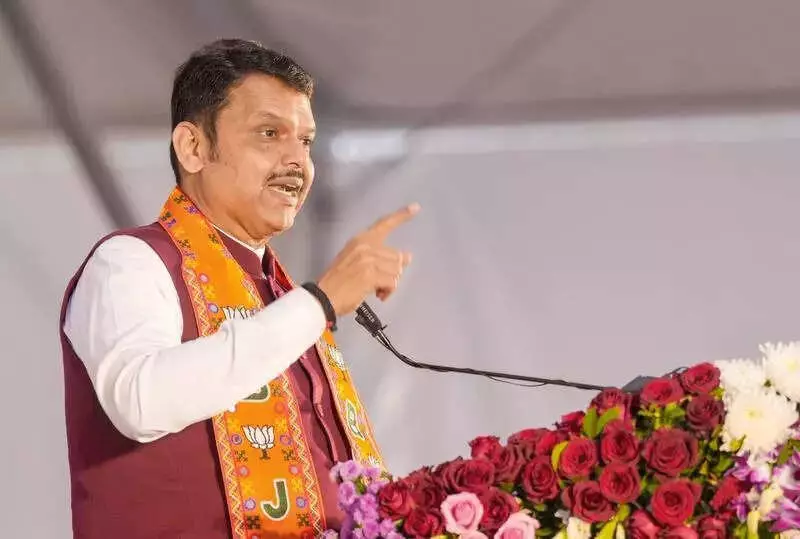
Deputy Chief Minister Devendra Fadnavis launched a sharp political offensive against the Congress while rolling out a comprehensive blueprint for urban infrastructure across the Marathwada region. Campaigning for the January 15 municipal corporation elections, Fadnavis on Monday toured three key districts—Jalna, Parbhani, and Nanded—promising transformative projects and accusing previous governments of decades of civic neglect.
Jalna's Ascent to a Top 10 City
Kicking off his tour in Jalna, Fadnavis argued that an excessive historical focus on rural development had crippled Indian cities. He stated that urban centres were left struggling with severe water shortages, inadequate sewage systems, public health crises, and pollution. The BJP leader credited the Narendra Modi-led central government for reversing this trend by injecting substantial funds into urban renewal schemes.
He set an ambitious goal for Jalna: to break into the list of "top 10 cities" in Marathwada. To achieve this, he announced a major Rs 100-crore solar power project designed to drastically cut the municipal corporation's electricity bills. On the infrastructure front, Fadnavis highlighted the dry port, enhanced connectivity via the Nagpur-Mumbai expressway, a centre of the Institute of Chemical Technology, a new railway station building, a train maintenance pit line, and a ring road.

Addressing Jalna's water woes, he committed over Rs 125 crore for the water supply project, aiming for completion within the next few months. Fadnavis emphasized that with these improved logistics, Jalna and Chhatrapati Sambhajinagar are becoming prime destinations for industrial investment.
Parbhani's Push for Civic Upgrades and Jobs
In Parbhani, Fadnavis reassured citizens that the popular Ladki Bahin scheme would continue and announced a state target of creating 50 lakh "Lakhpati Didis." He blamed earlier administrations for ignoring urban development, leading to slum expansion and deteriorating civic conditions, and promised ownership rights for landless urban poor in the coming year.
He unveiled two critical civic projects for the city: Rs 406 crore for an underground sewerage system and Rs 33 crore for solid waste management, noting that tender processes are already underway. In a significant move, the state government will bear the municipal corporation's 30% share for the sewerage project. To boost the local economy, Parbhani has been included in a special incentive package for districts with a limited industrial base.
Fadnavis also announced a skills partnership, revealing that a memorandum of understanding has been signed with Tata Trust for an incubation centre to train 3,000 youths annually. Connectivity upgrades include linkage to the Samruddhi Expressway, completed railway line doubling, the introduction of Vande Bharat services, and a sanctioned Rs 750-crore ring road project. The city will also receive 40 electric buses.
Nanded's Transformation as a Religious and Industrial Hub
Concluding his tour in the Sikh religious centre of Nanded, Fadnavis underscored the city's importance by announcing the release of Rs 879 crore for underground drainage, water pipelines, and pumping stations. He declared that the upcoming Nanded-Jalna expressway would slash travel time from Mumbai to Nanded to approximately eight hours.
Positioning Nanded as the next growth engine, Fadnavis stated it is poised to become the third major industrial hub in Marathwada, after Chhatrapati Sambhajinagar and Jalna. He also announced a Godavari River Cleaning Mission and a new 150-bed cancer hospital for the city.
A Call for a BJP Mandate
Wrapping up his campaign blitz, Devendra Fadnavis appealed to voters to support the BJP in the January 15 elections. He expressed strong confidence that his party would secure the mayoral posts and ensure five years of sustained and accelerated urban development across the region, contrasting it with what he termed the "Congress's legacy of neglect."