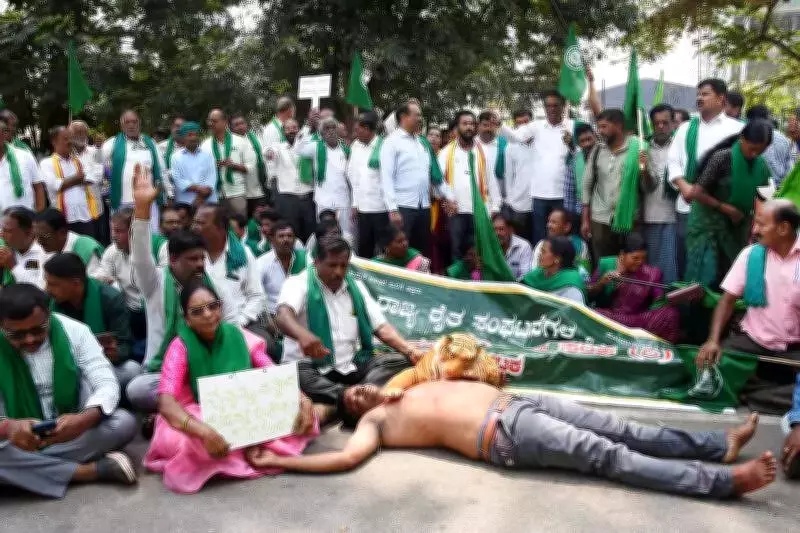
Karnataka Farmers Stage Massive Protests Against Tiger Reserve Safari Reopening
Farmers from Mysuru and Chamarajanagar districts in Karnataka launched large-scale demonstrations on Wednesday, vehemently opposing the state government's decision to resume forest safari operations in the Bandipur and Nagarahole tiger reserves. The protests, organized by farmer functionary Kurubur Shanthakumar and the Karnataka State Sugarcane Growers' Association, highlighted growing tensions between conservation tourism and agricultural communities living near protected forest areas.
Bike Rally and Memorandum Submission at District Collector's Office
The day-long agitation commenced with a massive bike rally involving hundreds of farmers, which traveled from Gun House Circle in Mysuru to the District Collector's office. Protesters carried placards and raised slogans condemning the safari resumption, which they view as a direct threat to village safety and farming livelihoods. At the collectorate, they submitted a formal memorandum demanding the immediate withdrawal of the order permitting safari activities to restart in the two prominent tiger reserves.
The farmers specifically accused the state government and Forest Minister Eshwar Khandre of prioritizing tourism revenue over the welfare of forest-fringe communities. They argued that reopening safari routes would inevitably increase human-wildlife encounters, putting both farmers and their livestock at heightened risk of attacks from tigers, elephants, and other wild animals. This, they contend, exacerbates an already precarious situation for those whose farmlands border the dense forests.
Semi-Nude Demonstration and Symbolic Tiger Installation
Meanwhile, near the regional commissioner's office, the protest escalated dramatically as members of the Kabini Raitha Hitha Rakshana Samiti staged a semi-nude demonstration to draw urgent attention to their grievances. In a powerful visual statement, they displayed an installation depicting a tiger attacking a farmer, symbolically representing the daily dangers faced by agricultural workers living along forest boundaries.
Farmer leaders Honnur Prakash and Manju Kiran led this segment of the agitation, emphasizing that the safari issue is not isolated but connected to broader systemic neglect of agrarian communities. "When tourism profits are placed above human safety and food security, it reflects a profound failure in governance," one protester was quoted as saying.
Broader Agrarian Demands and One-Month Ultimatum
Linking the safari controversy to wider agricultural distress, the protesting farmers also presented additional demands to address pressing rural issues. These included:
- Uninterrupted power supply for irrigation pumpsets to support farming operations
- Immediate filling of lakes from river sources to combat anticipated summer water shortages
- Comprehensive measures to mitigate human-wildlife conflict in forest-adjacent villages
The demonstrators issued a stern one-month ultimatum to the district administration and forest department, warning that failure to address their concerns would result in intensified agitation. Threatened actions include gheraos (encirclements) of government offices and larger-scale protests that could potentially disrupt administrative functions across the region.
This protest underscores the complex balancing act between wildlife conservation, tourism development, and agricultural sustainability in Karnataka's ecologically sensitive zones. As climate change and resource scarcity intensify, such conflicts between different land-use priorities are likely to become more frequent and politically charged across India's forest-rich states.