

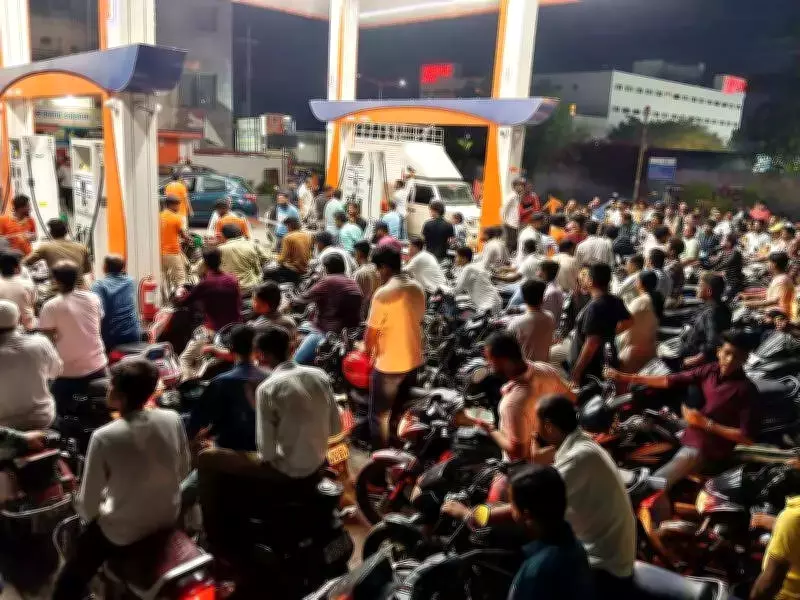
Fuel Rationing Enforced Across Three Districts in Maharashtra's Marathwada Region
District administrations in Chhatrapati Sambhajinagar, Jalna, and Nanded have implemented strict fuel rationing measures across the Marathwada region of Maharashtra. This decisive action was taken on Thursday in response to widespread panic buying that triggered extensive queues and temporary depletion at numerous fuel stations throughout the area.
Specific Sales Limits Imposed to Curb Hoarding
The new regulations, enforced through official district-level orders, restrict petrol sales to a maximum of Rs 200 for two-wheelers and Rs 2,000 for three- and four-wheelers. Officials have emphasized that there is no actual shortage of petrol or diesel in the supply chain. However, fear-driven bulk purchases by consumers have created an artificial scarcity-like situation on the ground, necessitating these temporary controls.
Chhatrapati Sambhajinagar district supply officer Praveen Fulari provided clarification on the situation: "Fuel pumps have been explicitly directed not to dispense petrol or diesel into cans, bottles, or drums. The daily fuel supply to our region is completely adequate, but people are rushing to fill more than their immediate requirements. This behavior is putting undue pressure on the distribution system and leading to localized outages."

Panic Buying Leads to Serpentine Queues and Temporary Dry Pumps
On Thursday, residents witnessed serpentine queues forming at multiple petrol pumps across all three affected districts. Several outlets temporarily ran dry and were forced to display "no fuel" boards, further fueling public anxiety. Authorities have attributed these scenes entirely to sudden, irrational spikes in consumer demand rather than any disruption in the actual supply of fuel from refineries or distributors.
Adding a layer of complexity, petrol pump operators are now required to make advance payments for their fuel procurement. Supplies are only released if these payments are credited by 3 PM each day. Failure to meet this deadline can result in delayed replenishment, which has contributed to some of the perceived shortages at individual stations.
Industry and Official Perspectives on the Crisis
Akhil Abbas, president of the Petrol Dealers' Association, commented on the aggravating factors: "There is no severe or systemic shortage of fuel. The real issue is unnecessary crowding and excess purchasing, which is worsening the problem exponentially. In some specific cases, dealers could not restock their tanks in time due to pending advance payments, and this logistical delay added to the public's anxiety. We expect the situation to stabilize soon once the rationing measures take full effect and public confidence is restored."
Divisional commissioner Jitendra Papalkar outlined the administrative rationale behind the rationing. He confirmed that district collectors in Chhatrapati Sambhajinagar, Jalna, and Nanded have fixed the sales limits based on the prevailing conditions. "Adequate fuel is available in the system. However, panic buying is causing individual pumps to run dry. Once a pump is emptied, restoring its supply takes time due to logistics and payment procedures. This cycle is why preventive rationing has been introduced as a temporary measure," Papalkar explained.
Exemptions and Supply Statistics
To ensure critical services remain unaffected, authorities have officially exempted essential vehicles from the new restrictions. This includes ambulances, fire engines, and other emergency service vehicles, allowing them to operate without interruption.
Officials provided context on the scale of normal operations, noting that Chhatrapati Sambhajinagar district alone requires approximately 19 lakh litres of fuel daily. This volume is supplied regularly through the established network. The district is serviced by 47 petrol pumps within the city limits and an additional 337 pumps spread across the wider district area, highlighting the extent of the distribution network now under strain from consumer panic.






