

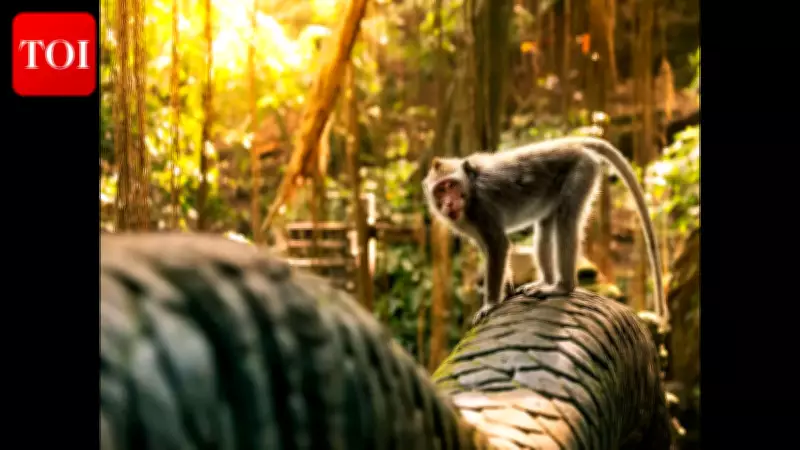
Goa Government Announces Comprehensive Strategy to Address Monkey Menace
In a significant development, Goa's Forest Minister Vishwajit Rane declared on Tuesday that the state government will introduce a comprehensive forest management plan specifically designed to control the growing monkey menace across various regions. The announcement came during the ongoing legislative session, where multiple legislators raised concerns about the escalating human-wildlife conflict.
Legislators Voice Concerns Over Widespread Problem
Bicholim MLA Chandrakant Shetye highlighted the serious nature of the monkey problem, particularly in Latambarcem and Sal areas within his constituency. Shetye emphasized that this issue extends beyond his district, affecting numerous other constituencies throughout Goa. He expressed dissatisfaction with what he described as "an academic reply" from the government, questioning whether any substantial groundwork had been undertaken to address the crisis.
"What steps have been taken by the department to control this menace?" Shetye demanded during the session, reflecting growing frustration among legislators and constituents alike.

Minister Outlines Multi-Pronged Approach
Forest Minister Vishwajit Rane responded by detailing the government's proposed strategy, which includes creating water bodies and planting fruit-bearing trees to provide natural food sources for monkeys within forest areas. The minister confirmed that some of these measures have already been implemented, but acknowledged the need for a more systematic approach.
"There is a need for a comprehensive plan, and we will take up a comprehensive plan and table it in the House," Rane stated firmly. "The plan has to be implemented effectively."
The minister further noted that existing compensation mechanisms for farmers suffering crop damage have proven inadequate, emphasizing that the forest department must take more serious and proactive measures to resolve the underlying problem.
Systematic Planning and Interdepartmental Coordination
Rane outlined a structured approach involving detailed mapping of problem areas, developing both short-term (three-year) and long-term (five-year) action plans, and conducting regular meetings with all stakeholders. He specifically mentioned that MLAs would be included in these discussions to ensure transparency and collaborative decision-making.
"We need to map where the problem is, what we are doing in the next three years and in the next five years," Rane explained. "We can hold a meeting and discuss it. I told the department to have a meeting, and MLAs will be taken into confidence."
The minister acknowledged that managing wildlife movement cannot be accomplished overnight, but stressed the importance of developing strategies to prevent animals from venturing out of forest areas in search of food.
Opposition Questions Policy Framework and Budget Allocation
Leader of Opposition Yuri Alemao raised critical questions about the absence of a formal human-wildlife conflict management policy in Goa. Alemao inquired whether any budgetary provisions existed for such a framework and whether the minister would commit to developing a comprehensive policy.
Rane responded positively, stating, "There is no issue in coming out with such a policy, and that I would speak to the chief minister and take a decision. We have budget provision for such a framework."
Alemao further pointed out coordination gaps between the agriculture and forest departments, noting that no comprehensive study has been conducted on the monkey menace despite its widespread impact.
Additional Legislator Concerns and Implementation Timeline
Siolim MLA Delilah Lobo joined the discussion, questioning when the government would finalize and implement the proposed plan for planting fruit-bearing trees. Her inquiry reflected broader concerns about timely execution of announced measures.

The forest minister's announcements represent a significant step toward addressing a problem that has affected agricultural productivity, public safety, and human-wildlife coexistence in Goa. The proposed comprehensive forest management plan aims to balance ecological conservation with practical solutions to mitigate conflicts between humans and wildlife, particularly the persistent monkey menace affecting multiple constituencies across the state.





