The persistent call for establishing a 'Greater Vijayawada' is once again at the forefront of civic discourse in Andhra Pradesh. This long-pending proposal, which involves merging approximately 75 villages surrounding the current city limits into the Vijayawada Municipal Corporation (VMC), has gained fresh momentum after nearly two decades of advocacy by residents and public representatives.
Stark Contrast in Development and Amenities
At the heart of this renewed push is the glaring disparity in infrastructure and civic services between areas within the VMC and those in the adjoining gram panchayats. For about 20 years, people living on the city's outskirts have watched as core Vijayawada enjoyed systematic development, while their own areas remained neglected despite rapid urbanization.
Within VMC limits, residents benefit from well-maintained roads, a reliable supply of treated drinking water sourced from the Krishna river, and efficient sanitation services. The city's consistent performance in the national Swachh Bharat rankings, often placing within the top 10, is a testament to its civic upkeep, with prompt attention given to even minor infrastructural repairs.

In sharp contrast, numerous gram panchayats that are geographically and demographically part of the urban sprawl struggle for basic amenities. In Vijayawada rural mandal alone, 12 gram panchayats with populations comparable to the city lack adequate infrastructure. Areas like Prasadampadu, Enikepadu, and Nidamanur—each with an average population of around 20,000 and falling under the Gannavaram assembly constituency—continue to function as panchayats.
Residents here grapple with poor road conditions, severe drinking water shortages, and insufficient sanitation staff. The groundwater quality has deteriorated alarmingly, with reports indicating total dissolved solids reaching 3,000, rendering the water unfit for consumption and linked to health issues like skin ailments and hair fall. With only 20 to 50 sanitation workers for these densely populated zones, maintaining cleanliness remains a major challenge.
Political Push and Government Assurance
On Thursday, a significant step was taken when Vijayawada MP Kesineni Shivanath (Chinni) and Vijayawada East MLA Gadde Rammohan Rao submitted a formal representation to Chief Minister N Chandrababu Naidu at the state secretariat. They urged the government to expedite the formation of a Greater Vijayawada Municipal Corporation.
MP Chinni argued that merging about 75 surrounding villages with the existing municipal corporation would enable comprehensive and planned infrastructure development, moving away from the current fragmented approach and ensuring sustainable urban growth. This sentiment was echoed by Gannavaram MLA Yarlagadda Venkat Rao and Mylavaram legislator Vasantha Krishna Prasad, who highlighted the panchayats' inability to provide even minimum drinking water facilities.
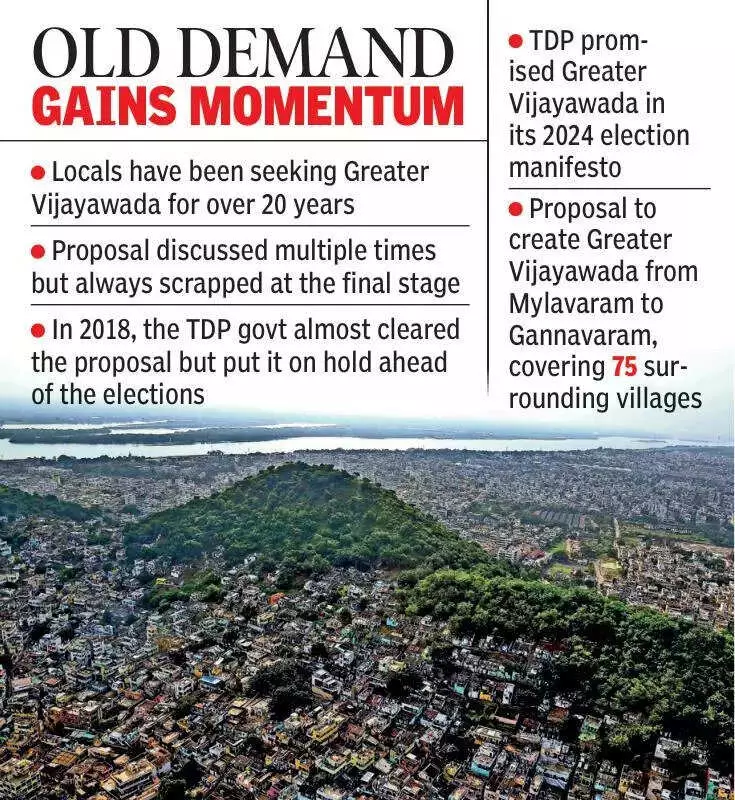
The leaders reminded the Chief Minister that the Telugu Desam Party (TDP) had included the promise of creating a Greater Vijayawada in its 2024 election manifesto. In response, Chief Minister Naidu reacted positively to the proposal and assured the delegation that the government would carefully examine the matter, keeping Vijayawada's future growth and development in mind.
A Two-Decade-Old Demand Seeking Fulfillment
The quest for Greater Vijayawada is not new. Local communities have been advocating for this expansion for over 20 years. The proposal has been discussed on multiple occasions but was invariably scrapped at the final stage. Notably, in 2018, the previous TDP government had nearly cleared the proposal but decided to put it on hold ahead of the elections.
The current proposal envisions creating a Greater Vijayawada stretching from Mylavaram to Gannavaram, encompassing the approximately 75 surrounding villages. The revival of this demand underscores the urgent need for equitable urban planning and resource distribution to address the widening development gap between the city core and its rapidly urbanizing periphery.