Gujarat Gears Up for Massive Local Body Elections with 4.19 Crore Voters
In a significant democratic exercise, Gujarat is set to hold local body elections on April 26, with an estimated 4.19 crore voters out of the state's total 4.4 crore eligible electorate expected to cast their ballots. The elections will determine representatives for a wide array of local governance bodies, including 15 municipal corporations, 84 municipalities, 34 district panchayats, and 260 taluka panchayats across the state.
Voting Process and Schedule Details
The State Election Commission (SEC) announced that voting will be conducted using electronic voting machines (EVMs) from 7 am to 6 pm on April 26. The counting of votes is scheduled for April 28, with provisions for repolling on April 27 if necessary. State Election Commissioner S Murali Krishna emphasized that the model code of conduct has been enforced from the announcement date, ensuring a fair electoral process.
Expanded Electoral Landscape with New Corporations
This election marks a historic expansion as it includes the first polls in nine newly constituted municipal corporations. While the BJP currently holds power in the six existing corporations, the new additions are Karamsad-Anand, Gandhidham, Nadiad, Navsari, Porbandar, Mehsana, Morbi, Vapi, and Surendranagar. This brings the total municipal corporations to 15, with other major cities like Ahmedabad, Vadodara, Surat, Rajkot, Bhavnagar, and Jamnagar also up for grabs.

Multi-Cornered Contests and Seat Distribution
A multi-cornered contest is anticipated among key political players, including the BJP, Congress, Aam Aadmi Party (AAP), smaller parties, and independents. Elections will be held for 9,992 seats across urban local bodies, district panchayats, and taluka panchayats. Additionally, by-elections for 13 seats in 11 municipalities will take place, bringing the total seats to be decided to 10,005. The breakdown includes:
- 1,044 seats in municipal corporations
- 2,637 seats in municipalities
- 1,090 seats in district panchayats
- 5,234 seats in taluka panchayats
Key Electoral Facts and Infrastructure
The SEC provided detailed voter demographics and logistical arrangements:
- 4,18,91,747 eligible voters, with 1,10,39,469 in municipal corporation areas, 33,66,333 in municipality areas, and 2,74,85,945 in district and taluka panchayat areas.
- Voter gender distribution: 2,16,17,803 male voters, 2,02,72,979 female voters, and 965 others.
- Polling will occur at 49,591 polling stations statewide, with 4,49,097 polling staff deployed to ensure smooth operations.
- Approximately 11,000 polling booths have been declared sensitive, highlighting the need for heightened security measures.
Historic Changes and Reservation Implementation
This election is notable as the first major poll following the implementation of 27% reservation for Other Backward Classes (OBCs). Alongside this, the creation of nine new municipal corporations, seven new municipalities, and several new taluka panchayats reflects ongoing efforts to decentralize governance and enhance local representation. The elections span 7,253 wards, including 261 in municipal corporations, 668 in municipalities, 1,190 in district panchayats, and 5,234 in taluka panchayats.
Election Timeline and Important Dates
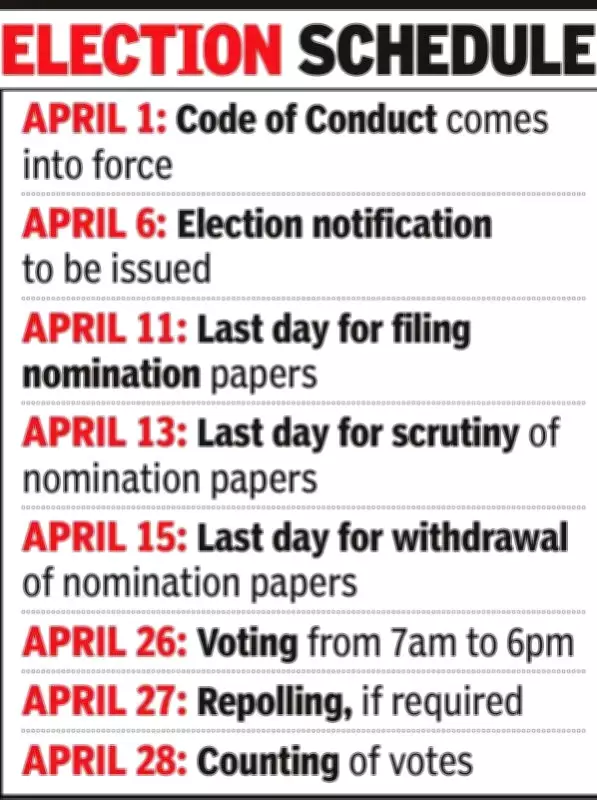
The SEC outlined a comprehensive schedule for the electoral process:

- April 1: Model code of conduct comes into force.
- April 6: Election notification to be issued.
- April 11: Last day for filing nomination papers.
- April 13: Last day for scrutiny of nomination papers.
- April 15: Last day for withdrawal of nomination papers.
- April 26: Voting from 7 am to 6 pm.
- April 27: Repolling if required.
- April 28: Counting of votes.
As Gujarat prepares for this extensive democratic event, all eyes are on the outcomes that will shape local governance across the state for the coming term.