

Himachal Pradesh Government Declares 'Black Day' Over 16th Finance Commission's RDG Withdrawal Proposal
The proposed discontinuation of the Revenue Deficit Grant (RDG) for Himachal Pradesh by the 16th Finance Commission has ignited a fierce political confrontation, pushing the ruling Congress into an aggressive stance while placing the state BJP on the defensive. Chief Minister Sukhvinder Singh Sukhu has termed February 1, 2026—the day Union Finance Minister Nirmala Sitharaman presented the Union Budget 2026–27 and tabled the FC-16 report in Parliament—a "black day" for Himachal Pradesh.
Mounting Debt and Constitutional Concerns
With the state's debt burden crossing Rs 1.12 lakh crore and escalating to approximately Rs 1.20 lakh crore, the withdrawal of RDG threatens to exacerbate an already severe financial crisis. Chief Minister Sukhu has accused the Centre of violating Article 275(1) of the Constitution, which empowers Parliament to provide grants-in-aid to states requiring financial assistance.
"All options to reclaim the RDG are open, but before taking any step, we will meet Prime Minister Narendra Modi," Sukhu declared. The state had anticipated around Rs 50,000 crore as RDG for the 2026–31 period, following receipt of approximately Rs 48,000 crore under the 15th Finance Commission between 2022 and 2026.

BJP's Defense and Political Ramifications
The BJP leadership in Himachal Pradesh has defended the Finance Commission's recommendation, arguing that RDGs under previous commissions were intended as temporary, front-loaded transition support, particularly in the aftermath of the COVID-19 pandemic. Former Chief Minister and Leader of Opposition Jai Ram Thakur, along with state BJP chief Rajeev Bindal and all BJP MPs from the state, maintained that the move was expected.
BJP MP Anurag Thakur emphasized that states were expected to improve tax effort and rationalize expenditure to approach near-zero revenue deficits by 2025–26. "States were expected to improve tax effort and rationalise expenditure to approach near-zero revenue deficits by 2025–26," Thakur stated.
Congress Unity and Internal Warnings
The RDG issue has surprisingly united factions within the Congress party. PWD Minister Vikramaditya Singh, often known for independent stances, asserted, "RDG is a constitutional right of the people of Himachal Pradesh. We stand united with the Chief Minister."
A Congress Cabinet minister, speaking anonymously, suggested political motivations behind the RDG withdrawal, noting, "The timing suggests an attempt to destabilise a government already facing a severe financial crisis."
Potential Catastrophic Consequences
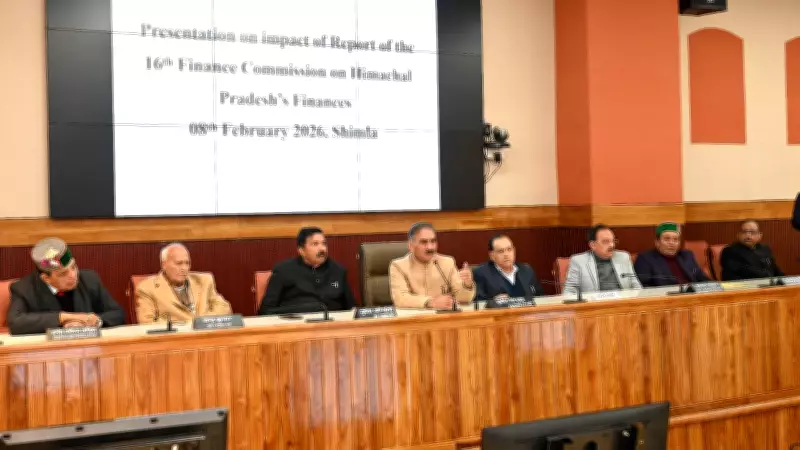
Principal Secretary (Finance) Devesh Kumar presented a dire assessment of the fiscal impact, warning that the state may be forced to:
- Discontinue subsidies on electricity, water, and food
- Review social security pensions
- Freeze dearness allowance payments
- Halt pay revision arrears
"We are heading towards a catastrophic situation," Kumar cautioned, estimating a resource gap of about Rs 6,000 crore in the 2026-27 fiscal year, excluding development works and pending liabilities.
Historical Context and Commission Rationale
Revenue Deficit Grants have been provided to Himachal Pradesh since its formation in 1971, with the first RDG of Rs 55.19 crore awarded for 1974–79 under the 6th Finance Commission. The 16th Finance Commission cited several reasons for recommending discontinuation:
- Increased tax devolution following the 14th Finance Commission
- Merger of Plan and Non-Plan expenditure
- Himachal Pradesh collects significantly less tax than its potential
- The state allocates a relatively small share of its budget to capital expenditure
- Fiscal discipline described as "less encouraging" with amendments to FRBM Act raising fiscal deficit target to 6% in 2022–23
Despite discontinuing RDG, the commission placed Himachal Pradesh among states with higher tax potential for other grants, including local body and disaster relief grants for 2026–31.

Constitutional and Legal Dimensions
The controversy centers on Article 275(1) of the Constitution, which authorizes Parliament to provide grants-in-aid from the Consolidated Fund of India to states in need of financial assistance. Chief Minister Sukhu has indicated that approaching the courts remains "also an option," though any such decision would require Cabinet approval.
As the state Cabinet prepares to meet on February 12, 2026, the political and financial implications of the 16th Finance Commission's recommendations continue to unfold, with Himachal Pradesh facing what officials describe as potentially catastrophic fiscal consequences.





