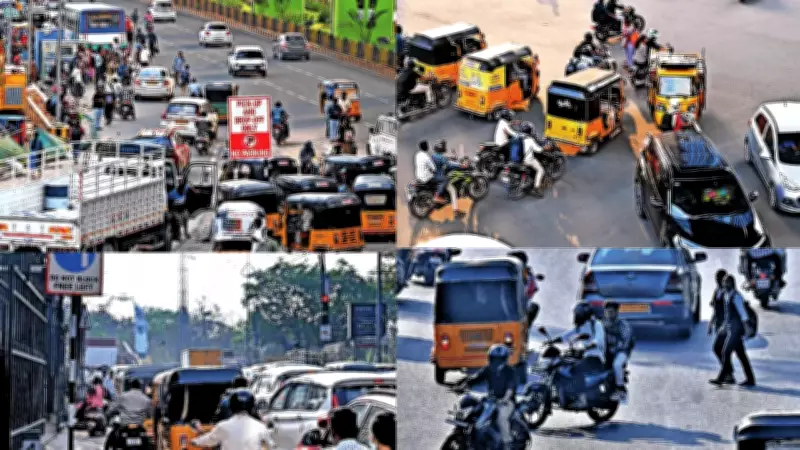
Hyderabad's Traffic Nightmare: A Crisis of Conduct, Not Just Capacity
HYDERABAD: The city's notorious traffic congestion is not merely a product of soaring vehicle numbers or constrained road infrastructure. A significant portion of this daily ordeal is self-inflicted, driven by widespread disregard for basic traffic rules. From rampant signal jumping and perilous wrong-side driving to the blocking of free left turns and reckless lane changes, everyday violations are systematically transforming key junctions into paralyzing choke points.
Staggering Numbers: 1.3 Crore Challans in a Single Year
Across Hyderabad, Ranga Reddy, and Medchal-Malkajgiri districts, a colossal fleet of nearly 90 lakh vehicles collectively amassed a staggering 1.3 crore traffic challans in the year 2025 alone. This alarming statistic persists despite sustained enforcement drives and public awareness campaigns, underscoring how persistent indiscipline continues to fuel severe congestion, increase accident risks, and heighten commuter frustration across the metropolitan region.
Primary Violations Crippling Junction Efficiency
Signal Jumping: This remains the most persistent and disruptive violation. More than three lakh motorists were penalized for jumping red signals this year. This act often blocks cross-traffic, forcing entire junctions into chaos that can take multiple signal cycles to resolve. Traffic volunteers warn that such actions directly sabotage junction efficiency.
"When a driver crosses the stop line after the signal turns red, it disrupts the transition between phases. Vehicles from the other direction, which have just received green, are forced to slow down or stop. This reduces signal efficiency and prevents smooth flow," explained Lokendra Singh, a traffic volunteer.
Wrong-Side Driving: This dangerous practice saw over 10 lakh challans issued last year across the city's three police commissionerates. Motorists often risk driving against traffic flow to avoid U-turns on stretches like Jubilee Hills, Hi-Tec City, and Ameerpet. Officials warn that even a single wrong-side vehicle can disrupt an entire lane, confuse junction movement, and sharply elevate the risk of head-on collisions.
Illegal Parking and Lane Indiscipline: Haphazard roadside parking silently shrinks carriageway width, forcing abrupt merging and triggering bottlenecks. Simultaneously, rampant lane indiscipline—vehicles switching lanes without indicators, occupying multiple lanes, or squeezing into narrow gaps—triggers sudden braking and ripple slowdowns. The unpredictable weaving of two-wheelers between cars makes steady movement nearly impossible.
Infrastructure Gaps and Enforcement Challenges
While behavioral issues are central, motorists and experts point to concurrent infrastructure and procedural gaps. Many argue that amber light timers require better calibration and synchronization to prevent confusion during signal transitions. There are also concerns about challan issuance processes.
"There is inadequate verification of number plates before challans are generated. They are imposed based on visible images without thorough verification. By the time the real owner realises the mistake, the challan is already issued," noted T Harsha from Team Road Squad.
Civic coordination has also come under scrutiny, with calls for the Greater Hyderabad Municipal Corporation (GHMC) to work more closely with traffic police to ensure clearly painted stop lines, visible road markings, and properly installed signal poles at major junctions.
A Call for Shared Responsibility and Behavioral Shift
Authorities emphasize that enforcement alone is insufficient to restore order. "Traffic discipline is a shared responsibility. Enforcement cannot solve the problem if motorists continue to disregard basic rules. Every time a motorist jumps a signal, drives on the wrong side or blocks a free left, it affects several commuters. Small acts of compliance can collectively improve road safety and traffic flow," asserted Ranjan Rathan Kumar, DCP (Traffic) of Cyberabad police.
Road safety experts advocate for a holistic approach combining strict enforcement, sustained public awareness campaigns, school-level education, and technology-driven monitoring. "As Hyderabad expands and vehicle numbers surge, restoring order will require a fundamental shift in driving behaviour. Without discipline at intersections and respect for lane rules and pedestrian crossings, even modern infrastructure will struggle to deliver relief. Until then, congestion will remain a daily ordeal," said T Satyanarayana Reddy, a traffic planning expert.
Global Benchmarks in Traffic Discipline
The path forward may involve learning from global cities where traffic discipline is deeply ingrained:
- Helsinki, Finland: Drivers, cyclists, and pedestrians strictly follow signals. Vehicles stop instantly at red lights and yield consistently at zebra crossings. Honking is rare, and lane discipline is strong.
- Copenhagen, Denmark: Reflects a culture of shared road responsibility with widespread respect for signals and lane boundaries. Yielding at zebra crossings is standard.
- Zurich, Switzerland: Known for strict rule compliance and predictable driving. Motorists stop precisely at red lights and halt for pedestrians, with mutual respect defining road use.
- Amsterdam, Netherlands: Exemplifies disciplined coexistence where cars, cyclists, pedestrians, and trams operate within defined spaces, with speed limits widely respected.
For a rapidly expanding metropolis like Hyderabad, the solution lies not solely in constructing more flyovers and wider roads but in cultivating everyday discipline. Until motorists universally respect signals, lanes, and basic right-of-way rules, the city's traffic will remain less a crisis of capacity and more a profound crisis of conduct.