

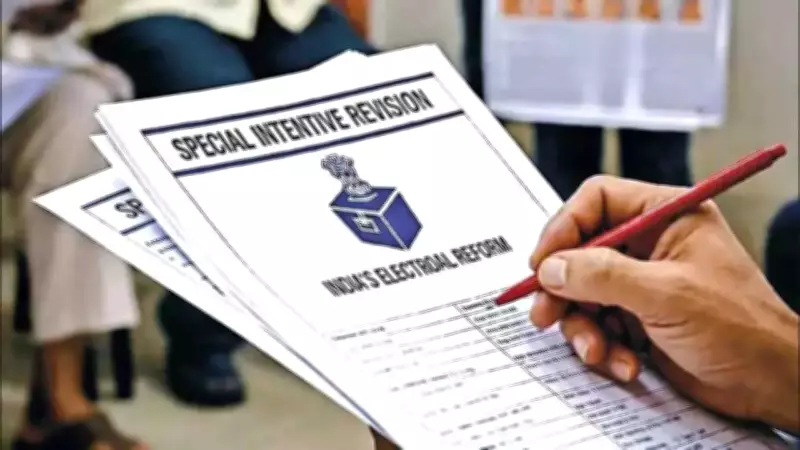
Hyderabad Emerges as Weakest Link in Telangana's Voter Roll Cleanup
Hyderabad has recorded the lowest mapping coverage in Telangana's ongoing preparatory exercise to clean up and verify electoral rolls, with just 28% completion under the pre-Special Intensive Revision (SIR) process. This figure highlights a stark urban-rural divide in voter verification across the state.
Statewide Performance Shows Clear Disparities
While Telangana has achieved an overall 53% mapping progress, Hyderabad's performance lags significantly behind. Following the capital, the lowest coverage districts include Medchal Malkajgiri at 30%, Rangareddy at 44%, Warangal at 45%, Sangareddy at 46%, and Nizamabad at 53%. In contrast, several districts posted substantially higher figures, with Siddipet leading at 80%, followed by Rajanna Sircilla at 78%, Yadadri Bhuvanagiri at 75%, and Nalgonda at 75%.
Urban Challenges and Official Explanations
Chief Electoral Officer of Telangana C Sudharshan Reddy explained that mapping has progressed faster in rural areas and smaller districts, while cities continue to pose significant challenges. He attributed the slow pace in urban constituencies to frequent migration and repeated changes of residence, which complicate establishing linkages between older and newer electoral rolls.

The current activity represents only a preparatory mapping exercise, not the actual SIR. The full Special Intensive Revision will commence only after formal notification by the Election Commission of India, with expectations pointing to April-May for implementation.
Verification Process and Methodology
Under the ongoing exercise, booth-level officers (BLOs), each responsible for approximately 250 voters per booth, are verifying the 2025 electoral rolls against the 2002 rolls finalized during the last SIR. Verification occurs through a mobile application linked to the ERONET platform, with BLOs confirming electors through field visits and digital checks to establish continuity across the rolls.
Mapping proceeds through two primary methods:
- Direct mapping applies when a voter's name appears in both the 2002 and 2025 rolls.
- Progeny mapping is utilized when a voter is listed only in the 2025 roll but can be linked through parents or grandparents whose names appear in the 2002 roll.
Expanded Verification and Future Steps
Until recently, verification was limited to records within Telangana. Over the past week, the system has expanded nationwide, allowing officials to verify whether electors appear in rolls of other states as well. This enhancement aims to address cases involving inter-state migration more effectively.
As preparations continue, political parties have been urged to appoint at least one booth-level agent for every polling station. Sudharshan Reddy emphasized the need for close coordination at the booth level, noting that the actual SIR window will likely be limited to approximately one month once officially notified.
Preparatory work includes table-top mapping to link electors, followed by comprehensive house-to-house field verification, particularly in urban areas where mapping gaps remain widest. The combination of digital tools and physical verification aims to create more accurate and comprehensive electoral rolls ahead of future elections.






