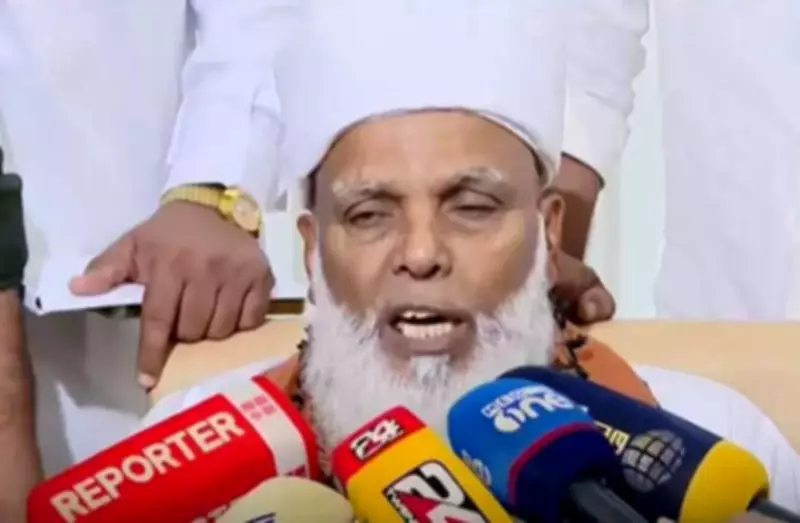
IUML Critic Ummer Faizi Mukkam Appointed to Kerala Waqf Board Amid Political Tensions
In a significant development, Ummer Faizi Mukkam, a prominent member of the Samastha Mushawara and a leading voice among detractors of the Indian Union Muslim League (IUML) within the influential body of Islamic scholars, has been nominated to the Kerala State Waqf Board. This decision is widely viewed as a strategic move that could further intensify the existing divide between pro- and anti-IUML factions within Samastha, adding a new layer of complexity to the state's political and religious landscape.
Background of the Nomination and Internal Divisions
The nomination of Faizi, who is also noted for his proximity to the Left, comes at a time when internal dynamics within Samastha are increasingly polarized. Traditionally, the AP faction of Samastha, led by Kanthapuram A P Aboobacker Musaliyar, has been perceived as aligned with the Left. However, within the EK faction, internal differences have spurred the emergence of a group advocating for Samastha's independence from political influences. This context underscores the potential for Faizi's appointment to sharpen factional rifts.
In November of last year, Samastha issued a notice to Faizi over his controversial remarks against IUML state president Panakkad Sadikkali Shihab Thangal, where he questioned Thangal's credentials to serve as a qazi. Pro-IUML leaders had subsequently demanded action against him, highlighting the ongoing tensions. Responding to his nomination, Faizi expressed his willingness to articulate his views on protecting waqf properties in Kerala, including the contentious Munambam land. He asserted that the Munambam land is waqf property, alleging that a large portion had been encroached upon and the remaining land was sold by the Farook College committee—actions he deemed wrong and unacceptable under Islamic principles.

Reconstitution of the Waqf Board and Legal Proceedings
The state government has informed the Kerala High Court that the Waqf Board has been reconstituted, with notable inclusions such as Rajya Sabha member A A Rahim and Kuttiady MLA Kunhammed Kutty as members, while allowing current chairperson M K Sakeer to continue. The government nominated these new members under the Unified Waqf Management Act but has yet to appoint the two non-Muslim members required by law. This submission was made in response to a Public Interest Litigation (PIL) filed by the Kerala Waqf Samrakshana Vedhi, which sought the board's reconstitution as its term expired on December 14, 2024.
A government order issued on Wednesday also includes several other appointees:
- P U Ali, an Islamic theology scholar
- Sareena Salam, a Kasaragod district panchayat member
- Sumitha Nisaf, Kodungallur municipality vice-chairperson
- C K Usman Haji, a business management professional
- V M Rahana, additional secretary in the law department, as an ex-officio member
The order further stated that the appointment of two more members would be made shortly, indicating ongoing administrative adjustments.
Legal Challenges and the Waqf (Amendment) Act, 2025
In its petition, the Waqf Samrakshana Vedhi argued that although the board's term had expired, a division bench of the high court, in an order dated November 28, 2024, had permitted existing members to continue until new members were elected. This was based on the state government's assurance that elections were underway and would be completed within four months. Subsequently, the Waqf (Amendment) Act, 2025, came into force on April 8, 2025. The petitioners contended that the state government's failure to appoint new members even after the enactment of the amended Act was illegal and arbitrary, raising questions about procedural delays and governance.
This situation highlights the intricate interplay between religious bodies, political factions, and legal frameworks in Kerala, with Faizi's appointment serving as a focal point for broader discussions on waqf management and Islamic governance in the state.