

Jaipur's Pedestrian Safety Crisis: Six Months After Supreme Court Mandate, 'Right to Walk' Remains Unimplemented
In a significant development highlighting governance gaps, the Rajasthan government has failed to implement the "Right to Walk" in Jaipur, even six months after the Supreme Court mandated crucial improvements for pedestrian safety under Article 21 of the Constitution, which guarantees the Right to Life. This delay persists despite clear judicial directives aimed at protecting citizens' fundamental rights to safe movement.
Notification Issued But Implementation Lags
The state's Local Self Government department did issue a notification calling for standardized pavements across the city. However, concrete measures have been woefully inadequate, with key authorities including the Jaipur Development Authority, Jaipur Municipal Corporation, and the traffic police failing to execute comprehensive plans. This bureaucratic inertia has left pedestrians vulnerable and exposed to daily hazards.
Three Critical Problems Plaguing Pedestrian Safety
Stakeholders and road safety experts have identified three fundamental issues that continue to endanger pedestrians in Jaipur:

- Absence of Pavements: The majority of roads in the Pink City lack proper pavements, forcing pedestrians to walk directly on busy streets alongside fast-moving vehicles.
- Encroachment of Existing Pavements: Where pavements do exist, they are frequently encroached upon by shops, street vendors, and parked vehicles, rendering them unusable for safe walking.
- Poor Utilization of Infrastructure: Residents often avoid using available footbridges or underpasses, and unlike in other metropolitan areas, police in Jaipur rarely enforce regulations against jaywalking, exacerbating safety risks.
Authorities Prioritize Speed Over Safety
Neha Khullar, Executive Director of Muskaan, a Jaipur-based NGO dedicated to road safety, expressed deep concern over the authorities' approach. "Even after the Supreme Court order, while designing or constructing infrastructure, the authorities are least bothered about safe movements of pedestrians. Road planning must prioritize safety over speed and access over travel-time claims, because a road that is unsafe for pedestrians is a failure of design," she stated emphatically.
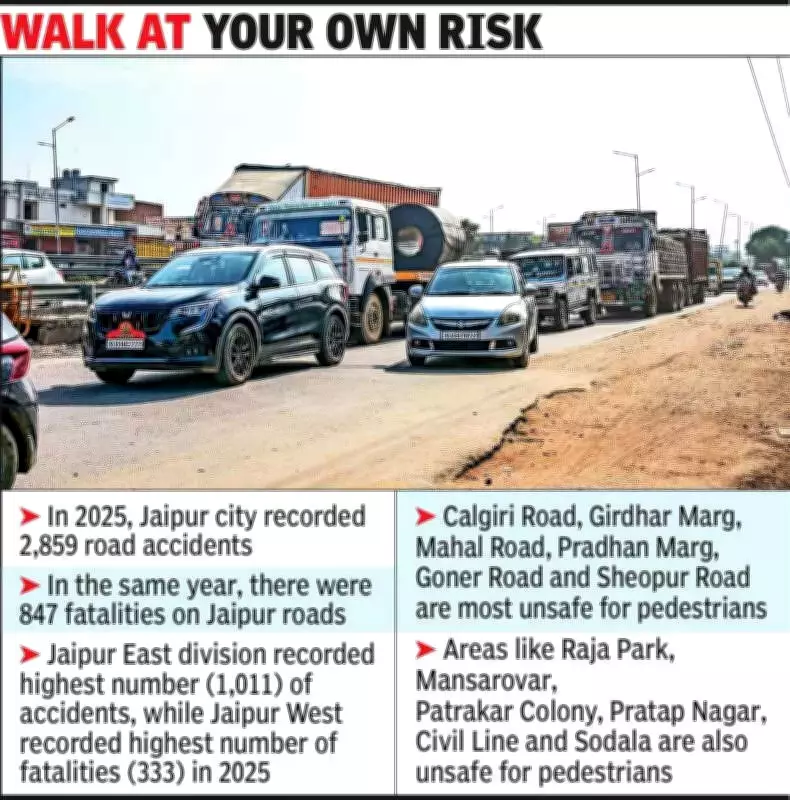
This sentiment is echoed by alarming statistics. Sumeet Meharda, Deputy Commissioner of Police (Traffic) for the Jaipur Commissionerate, revealed that pedestrian-involved accidents are disproportionately high in the city. In 2025, such accidents accounted for over 40% of all road incidents in Jaipur, a figure significantly higher than the national average of 20-25%.
Future Plans and Proposed Measures
DCP Meharda acknowledged the severity of the situation and outlined some steps being taken. "We have implemented a few steps to ensure safe movements of pedestrians on city roads. There are a few other plans that we would implement in future after getting clearance from the traffic control board," he stated, though specifics on these measures remain vague.
In a positive development, the Jaipur Development Authority has proposed constructing pavements along the entire stretches of Sikar Road and Mahal Road, with a commitment to keep them free from encroachments. Additionally, special drives are being organized to ensure pedestrian infrastructure outside all educational institutions in the city.
A JDA official added, "In future we will not construct infrastructure on any roads without pavements on both sides, maintaining their standard shape and size." This pledge, however, comes after years of neglect and raises questions about the timeline for actual implementation.
The continued failure to enact the "Right to Walk" not only violates the Supreme Court's directive but also puts countless lives at risk daily. As pedestrian fatalities remain alarmingly high, the need for immediate, concerted action by all governmental bodies in Jaipur has never been more urgent.






