

Jaipur Residents Face Sewerage Nightmare Amid Jurisdictional Gaps
About three months ago, residents of a large residential complex on Ajmer Road in Jaipur encountered a severe and persistent challenge. Despite all efforts by the residents' welfare association (RWA), attempts to clean the sewerage tank within the complex proved entirely futile.
Jurisdictional Hurdles Exacerbate Civic Woes
Since the complex is located outside the jurisdiction of the Jaipur Municipal Corporation, RWA members were unable to persuade the civic body to address the tank cleaning. Both the local panchayat and the Jaipur Development Authority (JDA) informed residents that they do not provide such services to individual households.
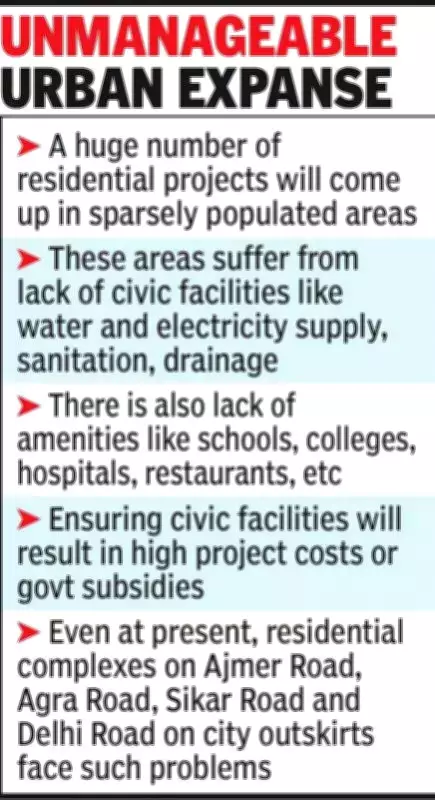
This incident underscores a broader issue in Jaipur's peripheral colonies and residential projects, where residents routinely struggle to access basic civic amenities. Urban planning experts have expressed concerns that the proposed expansion of JDA's jurisdiction under Master Plan 2047 could intensify these difficulties.

High Court Intervention and Expert Warnings
The Rajasthan High Court recently stayed the proposed expansion of JDA limits, adding to the urgency of the situation. Experts note that even in areas already approved by JDA, sparse habitation and inadequate service delivery have forced many residents to rely on private arrangements for essentials like sewerage, roads, and sanitation.
"JDA has announced plans to double its jurisdiction to 6,500 square kilometers under Master Plan 2047, set for implementation in 2027," explained a town planner. "Currently, JDA covers only 2,940 square kilometers. Such a vast expansion, with an urbanisable area of 3,500 square kilometers, will likely increase colonies in remote locations, thereby amplifying resident problems."
Urban Sprawl Concerns and Policy Shortcomings
Some planners highlight that an area of nearly 6,500 square kilometers would make Jaipur's planned spread almost five times the size of Bengaluru, yet the projected population for this area is only 80 lakh, less than half of Bengaluru's. This mismatch suggests a pattern of urban sprawl rather than compact, efficient growth.
"Therefore, the resulting development would not only be very scattered but substandard," stated another town planner.
Officials point to the Rajasthan Township Policy 2024, which commits to phase-wise development based on eight criteria, including infrastructure availability and public transport feasibility. However, it critically adds that "guidelines for phased development will be issued separately." More than a year since the state cabinet approved the policy, no urban local body or development authority in Rajasthan has constituted the required committee or notified a phased development zone.
"JDA has extended the jurisdiction to increase its land banks by 'hijacking' agricultural land and to boost property rates for builders," alleged another town planner. "Projects in these urbanisable areas may remain underdeveloped with no basic infrastructure."
This ongoing crisis highlights the pressing need for coordinated urban planning and effective governance to ensure that Jaipur's growth does not come at the expense of resident welfare and essential services.






