

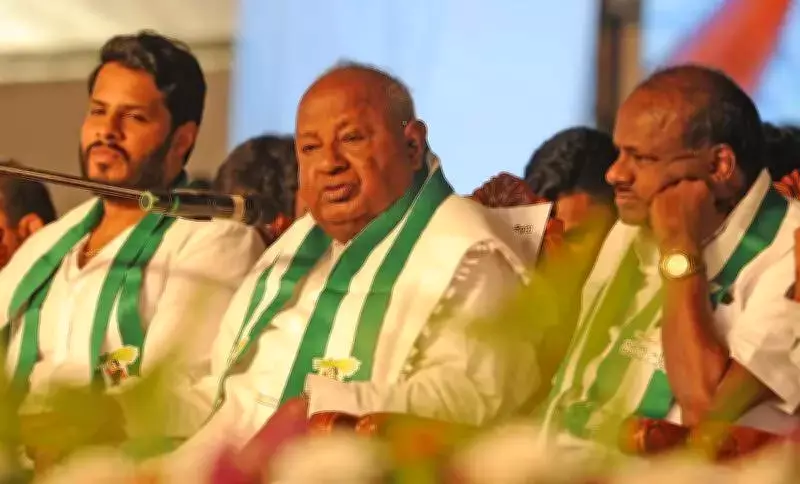
Bengaluru: Barely a few days away from its silver jubilee, the Janata Dal (Secular) finds itself at a crossroads, facing questions over its identity, shrinking social base, and organizational future amid shifting political equations.
Formation and Early Years
Formed in 1999 after a split from the Janata Dal, the party was led by former Prime Minister H.D. Deve Gowda, who built it as a secular, agrarian-focused alternative rooted in backward-class politics. Over the years, it established a stronghold in the Old Mysuru region, drawing support from the Vokkaliga community, sections of minorities, and rural communities.
Electoral Journey
The party's electoral performance has been patchy. From 115 seats and over 33% vote share in 1994 as part of the undivided Janata Dal, it dropped to 10 seats in 1999 before recovering to 58 in 2004, when it emerged as kingmaker and formed the government, first with the Congress and later with the BJP. Its strength then declined, with 28 seats in 2008, 40 in 2013, and 37 in 2018, when it formed a government with Congress support for a year. In 2023, it recorded its weakest performance, winning 19 seats with around 13% vote share.

Leadership Transition
With Deve Gowda ageing, his son and Union Minister H.D. Kumaraswamy, and grandson Nikhil Kumaraswamy have taken charge of reviving the party. However, internal dissent and speculation over closer alignment with the BJP have complicated the transition. Observers point to the possibility of JD(S) being repositioned alongside the BJP, especially as the saffron party looks for a strong state-level face after B.S. Yediyurappa's era.
Analysts' Perspectives
Analysts attribute the decline to structural issues and strategic shifts. Professor Harish Ramaswamy said the party's early promise as a "third alternative" weakened over time. "Ignoring grassroots workers who were outside the Deve Gowda family or Vokkaliga fold diluted its image as a common man's party," he said, noting that perceptions of dynastic control and limited internal democracy eroded its broader appeal.
Professor Ravindra Reshme said: "The very edifice of JD(S) was built around Deve Gowda's personality when he was the only national leader from Karnataka."
Alliance Shifts and Ideological Consistency
JD(S) first allied with the Congress in 2004 and 2018, and the BJP in 2006 and during the 2024 Lok Sabha elections. Analysts say these shifts have raised concerns about ideological consistency. The recent alignment with the BJP has posed a fresh challenge, especially in retaining minority support, which historically backed the party. "JD(S) had a distinct identity as a soft secular party, but the alliance with BJP has changed that perception," said Ramaswamy.
Electoral Trends
Electoral trends show minority voters, especially in the Old Mysuru belt, have increasingly shifted towards the Congress. This has narrowed the party's social coalition. Reshme said: "JD(S) is increasingly being seen as a party limited to a specific caste base. With minority voters drifting away, its electoral arithmetic has become more constrained."
Challenges in Hassan Bastion
Adding to its challenges is the erosion of influence in Hassan, long considered the party's bastion. The district, closely associated with the Deve Gowda family, has seen a dent in the party's grassroots image following criminal cases involving Deve Gowda's son and MLA H.D. Revanna and allegations linked to Revanna's sons, Prajwal and Suraj. Recent developments show its hold is weakening.






