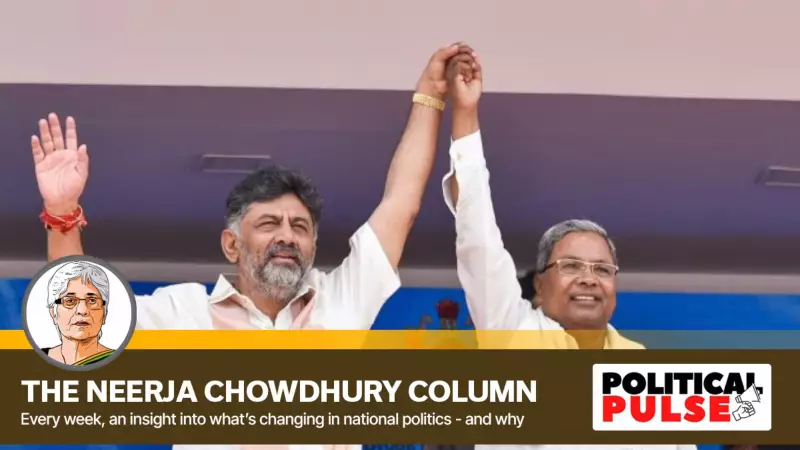
The recent political drama in Karnataka has laid bare the deep-seated fissures within the Congress party. The public confrontation between Chief Minister Siddaramaiah and his deputy, D K Shivakumar, is more than a personal rivalry; it is a symptom of a systemic malaise affecting the national opposition. At the heart of the turmoil lies a contentious power-sharing agreement, a weakened central leadership, and the looming spectre of the Bharatiya Janata Party's (BJP) southern ambitions.
The Timing of Shivakumar's Gambit
One of the most intriguing aspects of the crisis is why Deputy Chief Minister D K Shivakumar chose to escalate his demand to replace Siddaramaiah at this particular moment. Shivakumar, a seasoned organisational man, is acutely aware that Siddaramaiah commands the support of a majority of the Congress's 135 MLAs in the state. Without the explicit backing of the party's high command, his challenge was always an uphill battle.
Analysts suggest this was a "now or never" move. With the next assembly elections due in 2028, and the BJP confident of a comeback in the 2026 polls, Shivakumar may have felt that the window to claim the chief minister's chair was closing. He is believed to have acted on an alleged power-sharing pact made when the Congress formed the government in 2023. Furthermore, he chose a moment when the national leadership was at its most vulnerable—reeling from the political explosion in Bihar and facing questions about Rahul Gandhi's stewardship.
Siddaramaiah's Political Fortress and the High Command's Dilemma
Chief Minister Siddaramaiah is not without his own formidable strengths. He enjoys the crucial support of Rahul Gandhi, whose focus on backward class politics and caste census aligns perfectly with Siddaramaiah's core AHINDA constituency—a coalition of Other Backward Classes (OBCs), Dalits, and minorities. As the party's only sitting OBC chief minister, and a Kuruba leader, his removal would be a politically sensitive decision for the high command.
The recent "peace breakfast" at the CM's official residence, 'Cauvery', brokered by Congress general secretary K C Venugopal, has provided a temporary reprieve. Both leaders have publicly vowed to follow the high command's directives. However, the truce is fragile. All eyes are on key dates: January 7, 2025, when Siddaramaiah is set to become Karnataka's longest-serving chief minister, and March 2025, when presenting the state budget could offer him a platform to bolster his popularity. Siddaramaiah may also seek to buy time by implementing policies based on the caste census, a key project for Rahul Gandhi.
A Symptom of a Larger Disease: The Rotational CM Trap
The Karnataka crisis is a stark reminder of a failed organisational strategy. The two-and-a-half-year rotational chief ministership formula, often used by the Congress to manage factional demands, has repeatedly proven to be a recipe for intensified internal conflict. The precedent is worrying: similar promises in Rajasthan (to Sachin Pilot) and Chhattisgarh (to T S Singh Deo) not only led to public infighting but also contributed to the party's subsequent electoral defeats in those states.
This model has succeeded only once in recent history—in the Jammu and Kashmir coalition government in 2005. In Karnataka, the very anticipation of a mid-term change has created debilitating uncertainty, damaging governance and public perception. For a state that is India's IT hub and knowledge capital, such instability sends negative signals to investors and citizens aspiring for a modern, forward-looking administration.
Ultimately, the episode underscores the weakening authority of the Congress high command, crippled by a long streak of electoral losses. Its inability to enforce discipline or ensure compliance with internal agreements has emboldened regional satraps. For the BJP, which views Karnataka as the critical gateway to the south, this Congress infighting is a strategic advantage. The survival of the Congress government in Bengaluru is not just about one state; it is about maintaining a crucial bulwark against the BJP's pan-Indian dominance.