The recently concluded winter session of the Karnataka legislature has left a major piece of legislation hanging in the balance. The Karnataka Hate Speech and Hate Crimes (Prevention) Bill, 2025, has emerged as the most controversial of the 23 bills passed, with its fate now resting on the desk of Governor Thaawar Chand Gehlot. Lok Bhavan officials have indicated that the Governor is proceeding with caution, seeking detailed legal opinions and even considering the option of a Presidential reference before giving his assent.
Governor's Deliberate Approach and Legal Hurdles
Governor Gehlot has instructed officials to prepare a comprehensive note after a thorough examination of the bill's provisions. According to sources, his decision will be based on this official report and advice sought from constitutional and legal experts. The possibility of sending the bill for a Presidential reference has not been ruled out, a move that would escalate the matter to the central government and the President of India. This cautious approach underscores the bill's sensitive and potentially constitutionally challenging nature.
Fierce Opposition and Allegations of Overreach
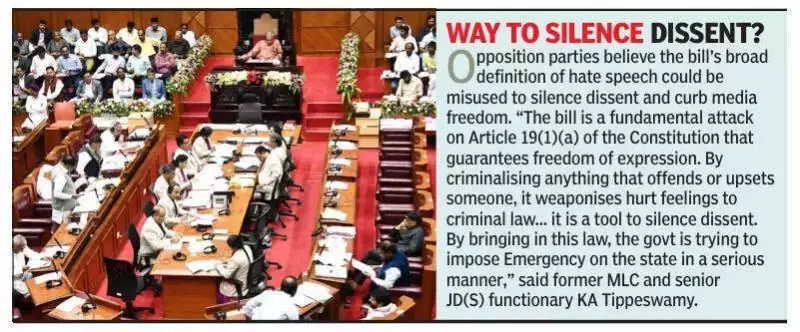
The bill has ignited strong protests from the opposition BJP-JD(S) alliance and several social organizations. Their primary contention is that the legislation's broad language poses a severe threat to freedom of expression, a fundamental right enshrined in Article 19(1)(a) of the Constitution. A JD(S) delegation met the Governor on Thursday, urging him to reject the bill outright, while the BJP plans to follow suit with a meeting on Sunday.

The opposition has zeroed in on Clause 6 of the bill, which grants the government power to direct any entity, including electronic media, to remove or block content it classifies as a hate crime. Former MLC and senior JD(S) leader KA Tippeswamy condemned the bill, calling it "a fundamental attack" on free speech and a tool to "silence dissent," equating its potential misuse to imposing an "Emergency" in the state. Council opposition leader Chalavadi Narayanaswamy vowed that the alliance would fight until the government withdraws the legislation.
A Turbulent Legislative Journey and Other Bills
Karnataka made history by becoming the first Indian state to propose a dedicated law against hate speech when the Congress government tabled the bill in Belagavi. Its passage, however, was tumultuous. The bill was passed in the assembly without debate amid opposition protests. The council witnessed a marathon, nearly 11-hour discussion marked by repeated adjournments and sharp exchanges before the ruling party managed to secure its passage.
In contrast to this friction, the opposition supported most other bills from the session. The Karnataka Social Boycott (Prevention) Bill, 2025, was passed unanimously. Another initially contentious bill, the Karnataka Scheduled Castes and Scheduled Tribes (Amendment) Bill, 2025, which proposes internal reservation among Dalit communities, eventually gained opposition support after the government amended provisions to prioritize a 1% quota for nomadic communities.
As the Governor's office meticulously reviews the Hate Speech Bill, the political debate intensifies. The outcome will set a significant precedent, balancing the imperative to curb hate crimes against the sacrosanct principle of free speech in India's largest democracy.