

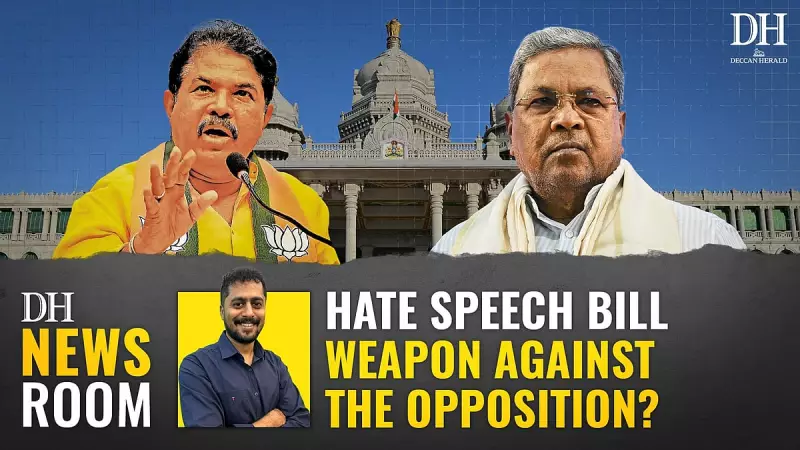
The Karnataka Legislative Assembly witnessed high drama and a major political confrontation on Tuesday as the ruling Congress government tabled a stringent new bill aimed at curbing hate speech. The proposed legislation, officially named The Karnataka Prevention and Control of Hatred and Hate Crimes Bill, 2025, immediately triggered a fierce backlash from the principal opposition party, the Bharatiya Janata Party (BJP).
The Bill That Sparked the Storm
The contentious bill was introduced by Karnataka's Law and Parliamentary Affairs Minister, H.K. Patil. Its core objective is to establish a strong legal framework to prevent and punish acts that promote hatred on grounds of religion, race, caste, community, language, sexual orientation, and other identities. The bill proposes severe penalties, including imprisonment and hefty fines, for those found guilty of hate crimes and hate speech.
However, the BJP legislators erupted in protest the moment the bill was presented. Their central accusation was that the legislation was not a genuine effort to maintain social harmony but a politically motivated tool. The opposition claimed the bill's broad definitions and provisions could be weaponized to target and silence specific ideological organizations, namely the Rashtriya Swayamsevak Sangh (RSS) and its affiliate, the Bajrang Dal.

Leader of the Opposition, R. Ashok, led the charge, arguing that the bill was "draconian" and designed to intimidate and harass workers of nationalist organizations. Amidst loud protests and sloganeering, the BJP MLAs staged a dramatic walkout from the Assembly, refusing to participate in the proceedings related to the bill.
Political Accusations and Government's Defense
The walkout underscored the deep political fissures over the issue. BJP leaders alleged that the Congress government, led by Chief Minister Siddaramaiah, was attempting to push a "vendetta-driven" law to settle political scores. They contended that existing laws under the Indian Penal Code (IPC) were sufficient to handle cases of hate speech, making the new bill redundant and oppressive.
On the other side, Law Minister H.K. Patil and other Congress leaders staunchly defended the bill as a necessary and progressive step. They argued that rising incidents of hate-mongering and targeted violence in society demanded a specific and robust law with clearer definitions and stricter punishments. The government maintained that the bill was aimed at protecting all communities and fostering a climate of tolerance, not at targeting any particular group.
The minister emphasized that the bill was modeled on recommendations from various law commissions and similar laws in other countries. He invited the opposition to discuss and debate the provisions constructively rather than resorting to a walkout.
Implications and the Road Ahead
The introduction of the bill and the subsequent walkout have set the stage for a prolonged and bitter political battle in Karnataka. The controversy has several immediate implications:
First, it has brought the issue of hate speech legislation to the forefront of state politics, polarizing opinions along party lines.
Second, the bill's fate in the Assembly remains uncertain. With the BJP vowing to oppose it tooth and nail, the Congress government will need to navigate the legislative process carefully. The bill is yet to be taken up for detailed discussion and voting.
Third, the incident has galvanized political bases on both sides. While the BJP can rally its supporters by portraying itself as a victim of political targeting, the Congress can position itself as a party taking a firm stand against social divisiveness.
The Karnataka Prevention and Control of Hatred and Hate Crimes Bill, 2025, has clearly touched a raw nerve. It transcends a simple legal debate and has morphed into a significant political flashpoint. Whether it becomes law or remains a symbol of political wrangling will depend on the dynamics in the Assembly in the coming days. One thing is certain: the debate over balancing free speech, social harmony, and political freedom in Karnataka has just intensified.






