

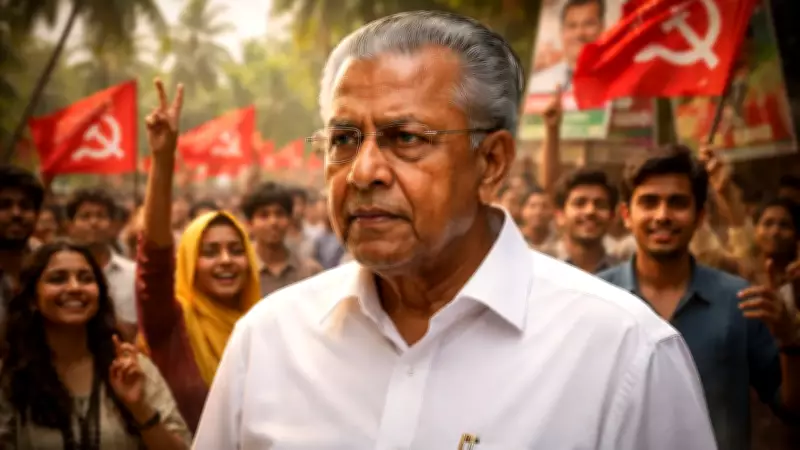
Kerala's 2026 Election: The Future of Left Politics Beyond Pinarayi Vijayan
As Kerala steadily advances toward the crucial 2026 assembly elections, a profound and pressing question dominates the state's political discourse: what lies ahead for the Left Democratic Front (LDF) once Chief Minister Pinarayi Vijayan steps aside? For nearly a full decade, Vijayan has served as the undisputed and dominant face of the LDF, skillfully navigating the coalition through catastrophic floods, a global pandemic, severe fiscal constraints, and a historic re-election victory in 2021. This victory remarkably broke Kerala's entrenched four-decade pattern of alternating governments between the LDF and the United Democratic Front (UDF).
However, as the chief minister approaches 81 years of age, conversations within party ranks and among the broader electorate have subtly but decisively shifted from pure governance discussions to urgent questions of political succession. Kerala stands as the only Indian state currently governed by the Left, making the upcoming 2026 election far more than a routine political contest. It is effectively a referendum on the future trajectory of communist politics in India and a test of whether the LDF can successfully renew and revitalize itself to connect with an entirely new generation of voters.
The Vijayan Factor: Age, Authority, and the Continuity Conundrum
At 80 years old, Pinarayi Vijayan remains the central, indispensable pivot of the LDF's entire campaign strategy and governance narrative. His formidable leadership received widespread credit for the coalition's impressive 2021 victory, where the front secured 99 out of 140 assembly seats. This marked the first time in forty years that an incumbent government returned to power in Kerala. The current administration has consistently highlighted significant welfare expansion, including raising social security pensions from Rs 600 to Rs 2,000, committing to infrastructure spending estimated at nearly Rs 2 lakh crore through various budgetary channels, and pushing toward establishing a "knowledge economy."

Yet, the core question is less about past performance and more about future continuity. "Leadership transition represents a fundamental structural issue for cadre-based political parties," explained a political science professor from Delhi University. "The Left's traditional strength has always been its emphasis on collective leadership. However, electorally, Kerala voters are increasingly responding to strong, identifiable individual faces." Sherwin, a young freelancer originally from Thrissur now based in Delhi, articulated a common sentiment: "If not for Vijayan, the Left possibly would not be returning to power." He highlighted another critical reason for his potential support: "because the Congress party is always embroiled in internal fighting, so I do not view that as a viable alternative."
Conversely, Dhristi, an active member of a Left student organization, offered a contrasting perspective: "Vijayan is not as glossy as he might appear. Perhaps right now there is nobody positioned to replace him, but that alone does not make him the optimal choice." She emphasized, "I believe it is time that more young faces are given a genuine chance. Just examine the politburo; the individuals sitting there often have limited connection with ground realities and the specific issues confronting today's youth."
The Missing Second Rung of Leadership
Unlike previous phases in Kerala's political history, no widely projected younger leader is currently positioned as Vijayan's natural successor. While several senior ministers and party leaders retain considerable influence within the Communist Party of India (Marxist), the dominant partner in the LDF coalition, none currently command statewide mass appeal comparable to the chief minister. A member of the Left's student wing noted that prematurely projecting a successor could trigger damaging factional tensions. "The party strongly prefers continuity and collective functioning. The organizational focus remains firmly on policies, not personalities," he stated.

Nevertheless, contemporary electoral politics is becoming intensely personality-driven. The absence of a clearly visible next-generation face may significantly complicate the LDF's outreach to first-time voters, particularly in urban constituencies where three-cornered contests are sharpening, alongside an increasing electoral footprint for the BJP-led National Democratic Alliance (NDA).
First-Time Voters: A Rapidly Shifting Electorate
The substantial scale of the youth electorate is becoming increasingly clear. According to official figures cited by AIR News following the publication of draft electoral rolls, over 121,000 applications were received for updates and corrections. Of these, a striking 96,785 were submitted specifically for the inclusion of first-time voters who have turned 18 or sought constituency transfers. For the LDF, engaging Generation Z voters presents both a significant opportunity and a formidable challenge. This demographic has matured in a hyper-connected political environment, shaped as much by social media narratives as by traditional party cadre networks.
Vishnu, a 22-year-old first-time voter from Alappuzha studying in Delhi, expressed a common priority: "Development and job creation matter far more to us than rigid ideology. We want to see tangible opportunities within the state so we are not compelled to leave Kerala for employment." Another student from Kozhikode noted that while welfare measures are important, "the online conversation is distinctly different; people frequently discuss entrepreneurship, start-ups, and global exposure."
The LDF has responded with a renewed emphasis on digital outreach, complementing its traditional, extensive house-visit program where leaders, from state-level figures to local branch secretaries, engage households directly to gather feedback. However, Sherwin observed, "Although there is a very active young group working for the Left on the ground, and they consistently introduce various schemes, the Congress undertakes similar efforts. I do not perceive anything distinctly different that the Left is doing to specifically woo the youth."
Local Body Polls 2025: A Stark Reality Check
If the 2021 assembly verdict was historic for the LDF, the 2025 local government elections served as a sobering reality check. The scale of losses was considerable. The LDF's control in grama panchayats fell sharply from 577 to 340, in block panchayats from 111 to 63, and in district panchayats from 11 to just 7. In urban Kerala, the decline was even steeper: municipal corporations under LDF control plummeted from five to merely one, while municipalities decreased from 43 to 29.
The most symbolic and politically significant blow came in Thiruvananthapuram, where the Bharatiya Janata Party captured the Corporation for the first time, winning 50 of 101 wards. For a front that had dominated the capital's civic body since 1980, this loss carried substantial political weight beyond mere numbers.
However, vote share data reveals a more nuanced narrative. Despite significant seat losses, the LDF polled close to 40% of the vote statewide. The UDF secured 43.21%, maintaining a lead but not achieving a landslide margin. The BJP-led NDA's vote share remained around 16%, marginally higher than in previous local polls yet lower than its 19.4% performance in the 2024 Lok Sabha election. The party's gains stemmed from concentrated seat conversion rather than dramatic vote expansion.
In assembly segment terms, the UDF held leads in 81 constituencies, while the LDF led in 57. Crucially, in 32 constituencies, the margin of defeat for the LDF was between 1,000 and 10,000 votes, indicating that micro-level swings could dramatically reshape the 2026 electoral map. With minorities constituting nearly half the state's population, the LDF's near-40% vote share suggests it retained a substantial segment of minority voters among other sections, even as some segments appeared to consolidate behind the UDF in parliamentary-style contests. The data indicates clear shifts, but not a total collapse.
From the Left's analytical viewpoint, the local body verdict reflects three critical trends: sharper three-cornered contests, more efficient seat conversion by both the UDF and BJP, and pronounced vulnerability in urban middle-class pockets, especially among younger voters. Whether the 2025 results were a precursor to 2026 or merely a mid-term correction remains an open and hotly debated question.
Navigating Between Welfare Governance and Public Perception
The Delhi University professor argues that simple anti-incumbency does not fully explain the LDF's recent setbacks. Instead, "electoral shifts reflect layered dynamics, including consolidation of minority votes behind the UDF, sharper electoral arithmetic in urban areas, and the BJP's targeted, strategic expansion." Simultaneously, after two consecutive terms, the LDF is actively recalibrating its political messaging amid significant demographic and ideological churn.
This recalibration became publicly visible during the controversy surrounding Jamaat-e-Islami Hind. The CPM and BJP both accused the Congress-led UDF of accepting support from the organization. The controversy escalated when senior CPM leader A K Balan warned that a UDF government could allow Jamaat influence over the home ministry, potentially leading to incidents reminiscent of the 2002–03 Marad riots. Chief Minister Vijayan initially backed Balan's remarks, though the CPM later described them as his "personal view" following criticism that the rhetoric echoed narratives typically associated with the Sangh Parivar. This incident was somewhat uncharacteristic for the Left, which, compared to much of India's political landscape, has generally avoided communal or polarizing rhetoric.
Concurrently, the Left moved to reinforce ties with sections of influential Muslim bodies like Samastha, including the nomination of Ummer Faizi Mukkam to the Kerala State Waqf Board—a step widely interpreted as calibrated engagement with constituencies seen as distinct from the Indian Union Muslim League (IUML). On the majority community front, the government's role in facilitating the Global Ayyappa Sangamam, linked to the Sabarimala temple managed by the Travancore Devaswom Board, drew considerable attention, given the Left's earlier strong backing of the 2018 Supreme Court verdict allowing entry of women of all ages. As the 2026 polls approach and Sabarimala potentially snowballs into a larger electoral issue, the Left is increasingly adopting a vague stance, with its ministers explicitly refusing to provide clarity. Collectively, these episodes reflect the LDF's complex attempt to navigate a more polarized landscape, balancing welfare-driven governance with identity-sensitive politics as it prepares for the high-stakes 2026 election.
The Revival Playbook and Strategic Recalibration
Party leaders have openly acknowledged the necessity to "learn from the people" and correct identifiable gaps in both policy implementation and political communication. A comprehensive statewide house-visit program has been launched. In parallel, the LDF has intensified its campaign against what it terms fiscal discrimination by the central government. Issue-based mobilization is also being sharpened, including focused campaigns around MGNREGA allocations and the implementation of new labour codes.
The deeper, more fundamental challenge, however, is political positioning. The Left's historical growth in Kerala was deeply rooted in class mobilization that cut across caste and religious lines. Recent elections have exposed inherent tensions between welfare-driven governance, steadfast secular positioning, minority community anxieties, and attempts at broader social outreach. A sustainable political revival may require renewed clarity in ideological messaging as much as continued administrative efficiency. The revival question, therefore, is less about mere electoral arithmetic and more about organizational and ideological adaptability.
What Next for the Left? The Stakes for 2026 and Beyond
For the Left, the 2026 election is not merely about retaining political power but about redefining its contemporary relevance. The stakes are undeniably national: Kerala represents the last remaining state under communist governance in India. An electoral defeat would mean the absence of a Left-led state government anywhere in the country for the first time in decades.
The immediate LDF strategy appears two-fold: consolidating welfare beneficiaries through persistent grassroots engagement, and countering opposition narratives via coordinated political campaigns and aggressive social media mobilization. Yet, the structural question remains profoundly unresolved: can the LDF successfully transition from a leadership model anchored firmly in Vijayan's personal authority to one that genuinely inspires confidence among younger, first-time voters?
As Kerala's electorate expands with tens of thousands of first-time voters, the 2026 contest may hinge less on political legacy and more on generational trust. Whether the Left can bridge that critical gap, both organizationally and politically, will ultimately determine if its iconic red bastion remains intact or enters a new, uncertain phase of political churn. The question, for now, is simple, direct, and unavoidable: After Vijayan, who?





