Kerala Braces for Pivotal Assembly Election in High-Stakes Triangular Contest
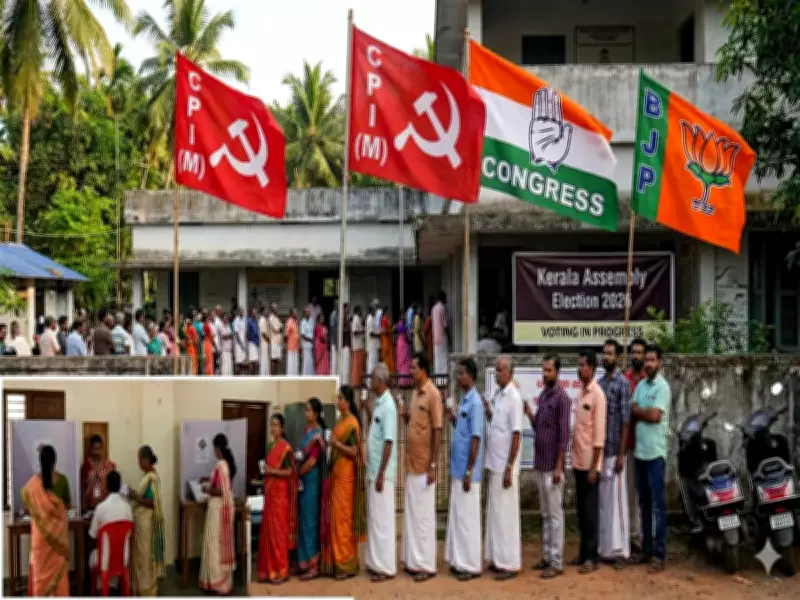
The southern state of Kerala is poised for a decisive assembly election on Thursday, with an electorate of 2.71 crore voters set to cast their ballots in a fiercely contested triangular battle. This election will critically test the ruling Left Democratic Front's ambitious bid for an unprecedented third consecutive term, the opposition United Democratic Front's determined efforts to stage a comeback, and the National Democratic Alliance's persistent push to secure its first-ever seat in the state legislature.
Massive Electorate and Single-Phase Polling
After nearly a month of intense and high-decibel campaigning, Kerala will conduct voting in a single phase, scheduled from 7 am to 6 pm across all 140 constituencies. A total of 883 candidates are in the fray, reflecting the competitive nature of this electoral exercise. The electorate composition is notably diverse, comprising 1.32 crore men, 1.39 crore women, 273 transgender persons, and over 2.42 lakh overseas voters, underscoring the extensive scale and inclusivity of this democratic process.
Bipolar Legacy Meets Triangular Dynamics
While the contest has evolved into a triangular affair with the active participation of the NDA, it remains deeply rooted in Kerala's traditionally bipolar political landscape, where power has historically alternated between the LDF and the UDF. The election outcome will serve as a crucial indicator of whether this long-standing pattern of alternation continues or if the state is witnessing a fundamental shift in its electoral dynamics towards a more multipolar system.

LDF's High-Stakes Bid for Historic Continuity
For the CPI(M)-led Left Democratic Front, this election represents a monumental test of its attempt to retain power for a third straight term—an achievement that would be politically significant in a state renowned for consistently voting out incumbents. Led by Chief Minister Pinarayi Vijayan, the Left Front has aggressively foregrounded its 10-year governance record, emphasizing achievements in infrastructure development, implementation of welfare schemes, and effective crisis management. However, the alliance confronts substantial challenges, including palpable anti-incumbency sentiments and questions arising from setbacks in the 2024 Lok Sabha polls and recent local body elections. The LDF has sought to counter these concerns by projecting an image of continuity, stability, and tangible delivery, while vehemently rejecting Opposition allegations of corruption and misgovernance.
UDF Eyes Return by Targeting Incumbent Government
The Congress-led United Democratic Front perceives this election as a major opportunity to return to power, banking on Kerala's historical alternating voting trend and what it describes as growing public dissatisfaction with the incumbent Vijayan administration. Its campaign has relentlessly focused on governance issues, alleged corruption scandals, and the functioning style of the current government. The UDF has sharpened its political messaging by alleging a covert understanding between the CPI(M) and the BJP, while accusing the Left of maintaining links with outfits like the Social Democratic Party of India, the political arm of the banned Popular Front of India. By positioning itself as the principal force against the BJP, the alliance aims to consolidate its traditional support base and capitalize on voter discontent.
NDA's Determined Push for a Historic Breakthrough
For the BJP-led National Democratic Alliance, this election marks a critical juncture in its persistent efforts to expand its footprint in Kerala's Assembly politics. Despite steadily improving its vote share over successive elections, the alliance has so far failed to secure a single seat in the state Assembly. The NDA has projected itself as a viable alternative to both the LDF and the UDF, arguing that Kerala has not witnessed adequate development or transformative governance under either front. Buoyed by its improved performance in recent local body polls, including a notable win in the Thiruvananthapuram Corporation, the alliance is aggressively aiming to convert its growing vote share into tangible legislative seats, which could potentially reshape the state's political equations.

Intense Campaign Marked by Sharp Exchanges
The nearly month-long campaign witnessed intense political exchanges and sharp rhetoric, with all three fronts engaging in vigorous attacks and counter-attacks. While the Opposition focused predominantly on corruption allegations and governance deficiencies, the LDF countered with its development narrative and questioned the track record of previous UDF governments. The CPI(M) also targeted the Congress over perceived delays in rehabilitation efforts following the 2024 Wayanad landslide, while the UDF pointed to reported defections within the Left camp as signs of internal strain and disunity.
National Leaders Amplify Campaign Significance
The campaign garnered heightened attention with active participation from top national leaders, underscoring the broader political significance of this election. Prime Minister Narendra Modi and Union Home Minister Amit Shah led the NDA's extensive outreach efforts, while Congress leaders Rahul Gandhi and Priyanka Gandhi Vadra campaigned extensively for the UDF. Chief Minister Pinarayi Vijayan remained the central and dominant face of the LDF campaign, emphasizing his government's achievements and vision for continuity.
Silence Period and Final Mobilization
With campaigning officially concluding on Tuesday evening, the state has entered the mandatory 48-hour silence period, during which all political parties have shifted to low-key, door-to-door outreach strategies to mobilize voters and ensure high turnout. This phase is critical for last-minute persuasion and addressing any residual voter concerns in a more personalized manner.
What's at Stake for Kerala's Political Future
The outcome of the April 9 polls is expected to have profound implications for Kerala's political trajectory and governance model. A victory for the LDF would break the state's entrenched alternating pattern and reinforce its development-oriented governance approach, while a UDF win would signal a return to the traditional cycle of power rotation. For the NDA, even a modest breakthrough with a few seats could fundamentally reshape the state's political landscape by making future contests more competitive and introducing a viable third force. This election, therefore, stands as a pivotal moment that will not only determine the immediate government but also influence Kerala's democratic dynamics for years to come.