

Kerala's Political Landscape Transforms: Identity Politics Takes Center Stage
In a significant departure from its historical trajectory, Kerala's politics is undergoing a profound transformation. Religion and caste, once operating at the margins of the state's political discourse, are now becoming central to electoral mobilization. This shift marks a dramatic change for a state long defined by class struggles, landmark land reforms, exceptional literacy rates, comprehensive welfare systems, and a broadly secular public culture shaped by both the Left and the Congress.
Identity Politics Gains Ground Across the Spectrum
This fundamental shift is now visible across the entire political spectrum. Even without achieving major electoral breakthroughs, the Bharatiya Janata Party (BJP) has fundamentally altered the terms of political competition in Kerala. The BJP's presence has pushed both the Communist Party of India (Marxist)-led Left Democratic Front (LDF) and the Congress-led United Democratic Front (UDF) to engage more openly and strategically with religious identities, caste blocs, and community anxieties. What was once treated as peripheral in Kerala's public life is now moving decisively into the electoral mainstream.
"Not just religion, even caste has gained renewed salience for political parties, largely to mobilise votes," stated political scientist G. Gopa Kumar, highlighting the changing priorities.

Post-election studies following the 2021 assembly and 2024 Lok Sabha polls indicate significant shifts among two key Hindu communities. The Ezhavas, traditionally seen as a strong support base for the LDF, and the Nairs, sections of whom appear to have moved towards the BJP since 2018-19, are at the heart of this churn. According to detailed data from a Lokniti-CSDS survey, the share of Ezhava voters aligning with the LDF fell to approximately 49% in the 2016 assembly polls from a robust 64% in 2006. Concurrently, CPM support among Nair voters dropped sharply during the 2019 Lok Sabha elections. Much of this political realignment appears to have directly benefited the BJP, whose Ezhava vote share notably rose from 6% to 17% over the same period.
"It is time to admit that 'Hindutvaisation' has become a major force in Kerala and is now part of the political consciousness across parties. Even the LDF is not exempt," explained political analyst Sunny Kapikad. "In Kerala, Hindutva is often framed as a cultural legacy, not just a religious identity."
A New Era of Three-Way Electoral Competition
The December 2025 local body elections powerfully underlined this emerging trend, pointing clearly toward a more competitive three-cornered contest in the state. The BJP-led National Democratic Alliance (NDA) successfully expanded its footprint in key urban pockets, including achieving a symbolic breakthrough in Thiruvananthapuram, while also making tangible gains in scattered local bodies across Kerala.
Simultaneously, Muslim and Christian voters appeared to consolidate behind the UDF in several regions, highlighting a parallel process of religious polarization within Kerala's evolving electoral landscape. This dual dynamic underscores the complex identity-based calculations now dominating political strategy.
"Political parties, across ideological divides, are ready to amplify demographic anxieties and identity-based claims for electoral gain," observed sociologist Antony Palakkal. "Forms of communal polarisation that were once marginal are now becoming explicit and central to political debate in Kerala."
The Left's Strategic Recalibration
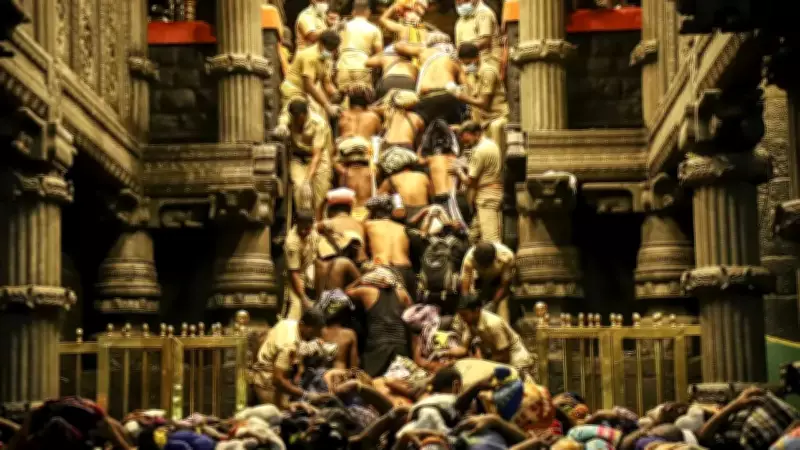
The LDF's response has actively reflected this changing political terrain. In a significant strategic shift, Chief Minister Pinarayi Vijayan's government notably stepped up its outreach to Hindu organizations. Through the influential Travancore Devaswom Board (TDB), the government organized the high-profile Global Ayyappa Sangamam at Pamba in September 2025 to mark the board's 75th anniversary. This event was strategically designed to project the Sabarimala temple as a "divine, traditional and sustainable global pilgrimage centre," appealing directly to Hindu sentiment.

Furthermore, the CPM engaged directly with powerful and influential Hindu community organizations, including the Nair Service Society (NSS), the Sree Narayana Dharma Paripalana Yogam (SNDP Yogam), the Kerala Pulaya Maha Sabha (KPMS), and the Malayaraya Mahasabha. Many of these key groups had notably drifted towards the BJP and the Congress in the aftermath of the contentious Sabarimala temple-entry controversy, making their re-engagement a priority for the Left.
Sharpening Rhetoric and Minority Politics
At the same time, the LDF has deliberately sharpened its rhetoric around minority politics. A remark by senior CPM leader A. K. Balan, suggesting that the Jamaat-e-Islami could influence the home department if the UDF came to power, was widely interpreted as a calculated attempt to stoke specific communal anxieties. In a swift counter, Indian Union Muslim League (IUML) leader K. M. Shaji accused the CPM of deliberately fueling Islamophobia. UDF leaders, in turn, alleged that the Left was resorting to communal rhetoric primarily to deflect public attention from pressing governance issues.
The government has also notably recalibrated its official position on the sensitive Sabarimala women's entry issue. It now publicly backs the protection of traditional customs that restrict the entry of women of menstruating age, specifically those between 10 and 50 years, marking a clear departure from its earlier stance.
The Sabarimala Flashpoint and Electoral Calculus
However, the LDF's extensive outreach has not been without significant complications. The alleged theft of more than 4.5 kilograms of gold from the Sabarimala temple, which surfaced in late 2025, handed both the BJP and the UDF a potent opportunity to attack the government and attempt to consolidate Hindu sentiment. While the BJP pursued this line of attack openly and aggressively, the UDF responded with more caution, being acutely mindful of its substantial minority support base.
Despite these concerted efforts, seasoned political analysts caution against assuming that a broad, monolithic Hindu consolidation will automatically follow.
"All these efforts may just go in vain. The Hindu consolidation may not hold," warned Gopa Kumar, offering a nuanced perspective. "Nair votes are likely to split between the BJP and the Congress, while Ezhava votes could divide mainly between the Left and the BJP, with a smaller share going to the Congress. Yet, this churn is necessary, as the Left knows that even marginal gains among Hindu voters could prove crucial in the upcoming assembly elections."
This intricate dance of identity, religion, and caste signals a new, complex chapter for Kerala politics, where traditional class-based narratives are being vigorously challenged by the potent forces of community-based mobilization.





