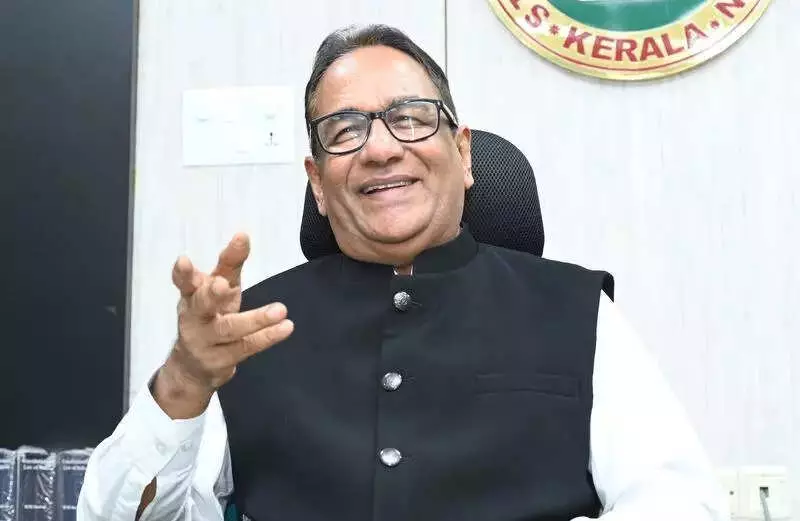
As Kerala prepares for the crucial two-phase elections to its local self-government institutions on December 9 and 11, the spotlight falls on the formidable authority steering the process. The Kerala State Election Commission (SEC) stands out as one of the most powerful state electoral bodies in India, armed with sweeping constitutional powers that extend far beyond merely conducting polls.
Unparalleled Powers and Constitutional Immunity
In an exclusive interaction, State Election Commissioner A Shajahan detailed the commission's extensive mandate. The foundation of its authority lies in the Kerala Panchayat Raj and Municipality Acts of 1994. These acts not only empower the commission to conduct elections for over 23,612 wards but also grant it significant adjudicatory powers to ensure elected bodies function in accordance with the law.
The commission operates with full constitutional immunity from state government influence. Once appointed, the state government has no authority over the SEC. The removal of a state election commissioner is a rigorous process, requiring impeachment in Parliament. This insulation is a deliberate provision to ensure the commission functions in a free and fair manner, commanding the services and resources of the entire state government machinery for election duties.

Beyond Elections: Adjudication and Voter Empowerment
What truly sets the Kerala SEC apart is its role as a judicial authority. "Kerala State Election Commission is the only such panel in the country with adjudicatory powers," Shajahan stated. Under the Kerala Local Authorities (Prohibition of Defection) Act, 1999, the commission can hear complaints and disqualify elected members through a formal judicial procedure. Its headquarters even features a dedicated courtroom for this purpose.
Kerala's legislation is pioneering in its direct empowerment of voters. It grants them the unique power to rescind the mandate of an elected representative. If a member fails to convene mandatory grama sabha or ward committee meetings within prescribed intervals, any voter can file a complaint. Upon proof, the commission can disqualify the member—a provision absent elsewhere in India.
Logistics, Cost, and a Model for Devolution
Managing elections at such a vast scale is a colossal task for a single-member commission. The SEC relies on the district administration, where the District Collector acts as the District Election Officer, executing the commission's guidelines. The estimated expenditure for conducting the Local Self Government Institution (LSGI) polls is substantial, averaging over Rs 200 crore. A significant portion, over Rs 30 crore ahead of the current election, was spent solely on acquiring a new set of Electronic Voting Machines (EVMs), which the commission maintains independently.
Commissioner Shajahan attributes Kerala's success as a model in implementing the 1992 constitutional amendment on Panchayati Raj to consistent political will. "The political parties that came to power in the state never hindered the process of devolution of power to local self-governments," he noted. This commitment is complemented by technological advancements like app-based delimitation map-making and online election expenditure filing, unique to Kerala.
The Supreme Court has clarified that state election commissions hold powers equivalent to the Election Commission of India. However, the actual scope varies based on state legislation. In this regard, Kerala's assembly has been exceptionally generous, crafting a framework that strengthens both the election watchdog and the local self-government institutions, setting a benchmark for democratic decentralization in the country.