Kolkata Assembly Election: Massive Voter Deletion Sparks Political Controversy
In a significant development ahead of the assembly elections, Kolkata's electoral list has witnessed a dramatic reduction of approximately 7 lakh voters. This substantial cleanup of voter rolls has ignited a fierce political debate, with the ruling Trinamool Congress (TMC) accusing the Election Commission of India (ECI) and the Bharatiya Janata Party (BJP) of conspiring to disenfranchise genuine voters.
Extensive Deletions Across Kolkata's Assembly Segments
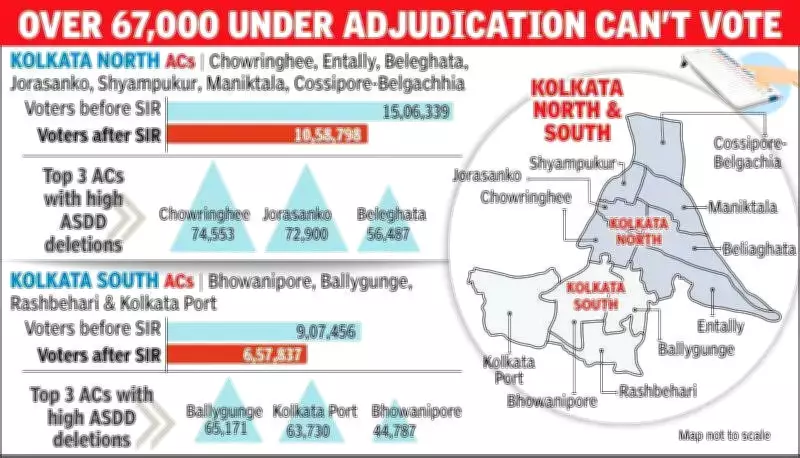
The voter deletion process has affected both Kolkata North and Kolkata South constituencies extensively. Prior to the Special Summary Revision (SIR), Kolkata North's seven assembly segments had a combined voter count of 15,06,339. Following the latest deletions, this number has plummeted to 10,58,798, representing a loss of 4,47,541 voters. Similarly, Kolkata South's four assembly segments saw their voter base shrink from 9,07,456 to 6,57,837, with 2,49,619 voters removed from the rolls.
Kolkata North has been particularly hard hit, with seven assembly segments collectively losing almost 30% of their total voters—the highest deletion percentage in the entire state. Kolkata South follows closely with 27.5% deletions. The deletions stem from various categories including deceased voters, those who have shifted residences, and cases identified as having logical discrepancies in the electoral data.

Adjudication Process Reveals High Ineligibility Rates
According to ECI data released on Tuesday, the adjudication process—where voter eligibility is reviewed—resulted in significant findings. In Kolkata North, nearly 64% of individuals under adjudication (39,164 out of 61,236 voters) were deemed ineligible to vote. In Kolkata South, 36% of voters under adjudication (28,468 out of 78,657) were found ineligible.
The assembly segments affected in Kolkata North include Chowringhee, Entally, Beleghata, Jorasanko, Shyampukur, Maniktala, and Cossipore-Belgachhia. Kolkata South comprises Bhowanipore, Ballygunge, Rashbehari, and Kolkata Port constituencies.
TMC Leaders Voice Strong Opposition to Deletions
Trinamool Congress leaders have expressed vehement opposition to the voter deletions, alleging systematic targeting of specific communities. Shashi Panja, minister and TMC candidate in Shyampukur, stated, "On Tuesday, the ECI published a list where 39,164 out of 61,236 voters in Kolkata North who were under adjudication were termed ineligible to vote. In my constituency, at least 2,100 such voters under adjudication have been deleted. I know many of them personally. They are all legal citizens of India. The ECI and BJP are snatching people's basic rights in their nasty attempt to win the election."
Nayna Bandyopadhyay, TMC candidate in Chowringhee, highlighted the diverse demographic impact, saying, "Chowringhee has a mixed population where Bengalis, Muslims, Biharis, Odias, Anglo-Indians and Christians have been living for decades. The SIR is stripping genuine voters of their rights. Not just Muslims, but a significant number of people from the Odia and Bihari communities, who chose to keep their voting rights in Bengal, have also been deleted. Dalit votes have also been cut."
Specific Constituencies Witness Significant Reductions
A Trinamool source provided detailed examples of the deletions, noting that different wards under the Chowringhee constituency experienced substantial reductions. The minority-dominated ward 44 saw 2,700 deletions out of 3,789 under-adjudication cases. Similarly, in Jorasanko assembly constituency, approximately 62% of voters from the under-adjudication list have been deleted so far from the original 5,652 cases.
An aide of Sovandeb Chattopadhyay, TMC candidate in Ballygunge, commented on the situation in Kolkata South, stating, "BJP and the ECI have targeted voters from minority sections and deleted their names. But, there have been many who fought their way to get their names back on the roll. Our party helped them."

Broader Implications for Electoral Process
The massive voter deletion exercise raises important questions about electoral integrity and voter rights. While the ECI typically conducts such cleanups to remove duplicate, deceased, or ineligible voters from the rolls, the scale of deletions in Kolkata has drawn unprecedented attention and criticism.
The controversy underscores the tension between ensuring accurate voter lists and protecting citizens' fundamental right to vote. With assembly elections approaching, the political ramifications of these deletions could be significant, potentially affecting electoral outcomes in key constituencies.
As the debate continues, all eyes remain on how the Election Commission will address the concerns raised by political parties and whether additional measures will be implemented to verify the eligibility of deleted voters who claim to be genuine citizens entitled to participate in the democratic process.