

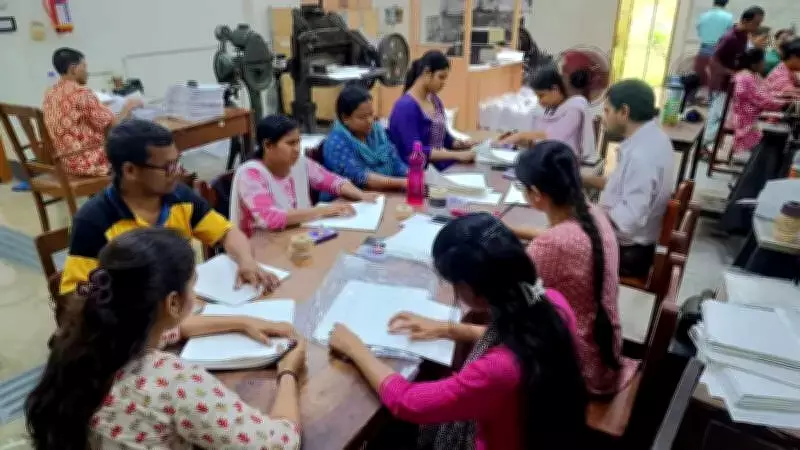
Kolkata Braille Press in Race Against Time for Bengal Election Accessibility
As West Bengal gears up for its crucial assembly elections, a dedicated team at the Regional Braille Press in Narendrapur, Kolkata, is working tirelessly to ensure that thousands of blind voters can participate in the democratic process with full dignity and accuracy. Operated by the Ramakrishna Mission Blind Boys' Academy, this specialized facility has become the epicenter of electoral inclusion, printing Braille ballot papers for all 183 constituencies across the state.
Historic Mission with Modern Technology
Established in 1967, the press has been the backbone of accessible voting in the region since 2011, handling Braille ballots for every Lok Sabha and assembly election. For the current polls, with the first phase scheduled for April 23, the press received an order for 68,000 Braille ballots on April 2. However, actual printing could only commence on April 9, once the final list of candidates was officially frozen and confirmed.
To meet this tight deadline, the press has extended its operating hours significantly, pushing its usual 6 pm closing time to 10 pm daily. Under the supervision of Swami Mahananda, principal of the Blind Boys' Academy, a team of 18 dedicated employees is working round the clock. This team includes two blind proof-readers who play an indispensable role in verifying the accuracy of the tactile text, ensuring every ballot is error-free.

Comprehensive Voter Support Beyond Ballots
Beyond the ballot papers themselves, the press has also printed 39,311 Braille voter information slips. These slips are designed to help blind voters navigate their polling stations independently, providing crucial details about location and procedures. This holistic approach underscores the commitment to making the entire voting experience accessible.
The press utilizes four high-end printing machines imported from Norway, powered by specialized Duxbury software. Normally, these machines are used to print textbooks for the Bengal and various state boards across Northeast India, but they have been fully repurposed for this critical electoral task.
Rigorous Quality Control Measures
"Given the absolute need to maintain 100% accuracy, the time constraint is our major challenge," explained Arup Chatterjee, the manager of the press. To eliminate any margin of error, every single ballot undergoes a double-checking process. Furthermore, the Visibility Commissioner has deployed a 20-member authentication team—half of whom are blind—to verify the ballots before they are dispatched to the field.
A significant portion of the ballots has already been delivered to election officials across the state. The press has prioritized constituencies voting in the initial phases, ensuring that materials are ready well in advance. This meticulous planning and execution highlight how technology and human dedication are combining to uphold the democratic rights of visually impaired citizens, setting a powerful example of inclusivity in Indian elections.






