

Kolkata's Orange Line Metro Hits Fresh Obstacle with Police Rejection of Airport Traffic Plan
The ambitious Orange Line Metro project in Kolkata has encountered another significant setback. Bidhannagar Police has refused to grant approval for a crucial traffic diversion plan at the airport exit point, effectively halting progress on the construction of the final 135-meter segment that would connect the line to the airport. Authorities cited severe concerns over massive traffic congestion on surrounding roads as the primary reason for this decision.
Ongoing Delays and Construction Challenges
This latest hurdle compounds existing delays for the New Garia-Airport Metro corridor. Work has already been stalled at Chingrighata, where Kolkata Police has been withholding approval for a separate diversion plea necessary to construct a viaduct across the E M Bypass. The overall project, spanning 31 kilometers, has faced multiple technical and logistical challenges.
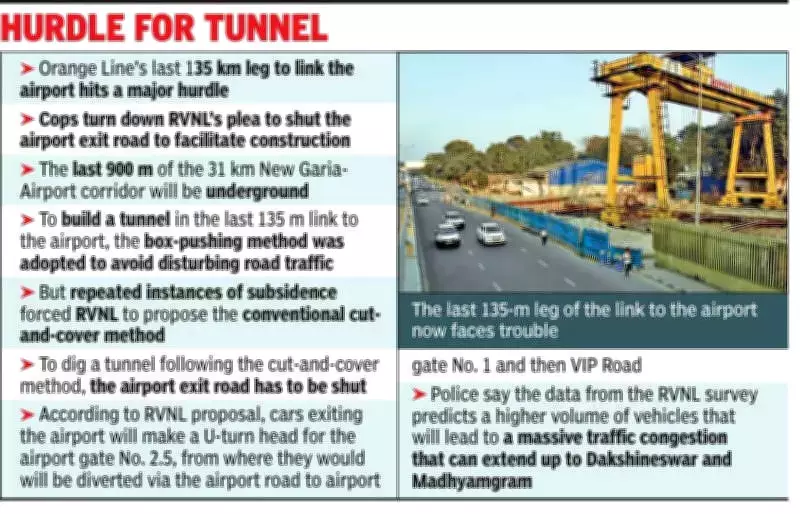
In January 2025, engineers initiated India's longest "box-pushing" tunnelling operation beneath the airport flyover to complete the last underground section of the Orange Line. Approximately 900 meters of the corridor runs underground due to strict airport regulations, with the box-pushing method specifically adopted for the final 135 meters leading to the airport terminal.

From Box-Pushing to Cut-and-Cover: A Methodological Shift
The innovative box-pushing technique involved pushing massive concrete boxes, each equivalent to three train coaches in size, through the soil to create the tunnel structure. However, this approach was abandoned several months ago following multiple instances of ground subsidence. After extensive attempts to reinforce the soil proved insufficient, Rail Vikas Nigam Limited (RVNL) engineers determined that a traditional cut-and-cover method represented the only viable alternative.
This revised approach requires excavating a deep trench along the road from the airport toward VIP Road, constructing the tunnel within it, and then covering it with soil or a concrete roof slab. To implement this method safely and efficiently, temporary road closures and traffic rerouting are essential.
Police Concerns Over Traffic Management
At the request of the Airports Authority of India, RVNL conducted a comprehensive traffic survey and submitted its findings to Bidhannagar Police for review. The proposed diversion plan would have redirected vehicles from the current airport signboard location through a 1.3-kilometer stretch, funneling traffic toward airport gate No. 2.5 on Jessore Road. From there, vehicles would proceed to airport gate No. 1 before merging onto VIP Road.
However, police analysis of the survey data revealed alarming projections. The traffic volume at the crossing of airport gate No. 2.5 was estimated to reach 2,649 passenger car units (PCUs) per hour over a 24-hour period, exceeding the 2,400 PCUs per hour limit established by the Indian Road Congress. During peak hours, this volume was predicted to surge beyond 4,000 PCUs per hour, far surpassing recommended capacity thresholds.
An officer explained that implementing the proposed diversion would likely create traffic jams extending as far as Dakshineswar and Madhyamgram during rush hours. This congestion would not only disrupt daily commuters but also significantly delay passengers traveling to and from the airport, particularly those originating from Kolkata's northern suburbs.
The police rejection leaves project planners and engineers searching for alternative solutions to complete this critical infrastructure link without exacerbating Kolkata's already challenging traffic conditions.






