

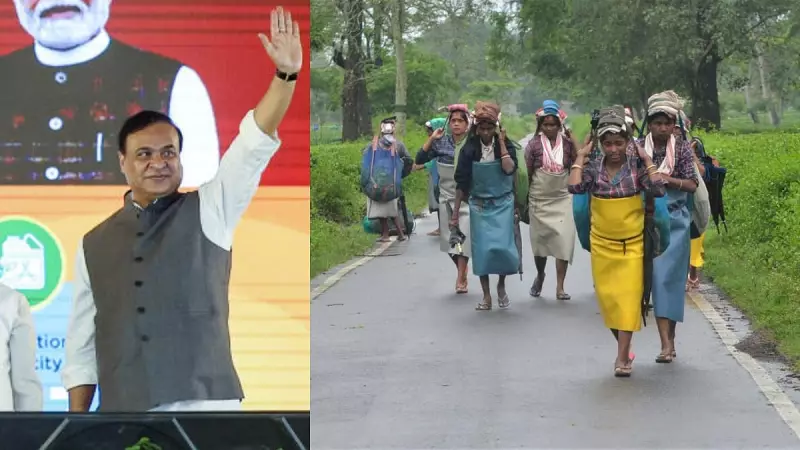
The Assam government's ambitious electoral promise to grant land rights to thousands of tea garden workers has encountered significant legal and administrative hurdles, casting uncertainty over the initiative. The plan, a key political pledge, aims to provide 3 bighas of land to each eligible worker's family but is now mired in complexities.
Legal and Procedural Tangles Stall Distribution
The core of the problem lies in the land itself. A large portion of the land identified for distribution is classified as "tea garden land" or "VGR" (Village Grazing Reserve). State government officials confirm that allotting such land requires prior clearance from the central government, a time-consuming process that has not been completed. Furthermore, much of this land is currently under the possession of local tea estates, making direct transfer to workers legally fraught.
This bureaucratic impasse was starkly visible at a recent "Cha Bagichar Dhan Puraskar Mela" (Tea Garden Wealth Award Fair) held in Sivasagar district on February 24. While the event was intended to symbolically hand over land allotment certificates, the actual distribution could not proceed. Officials were forced to admit that the physical handing over of land documents was not possible at this stage due to these unresolved issues.

A Promise Made During Election Season
The land allotment scheme has been a major talking point for the ruling Bharatiya Janata Party (BJP) in Assam, especially with the Lok Sabha elections on the horizon. The community of tea garden workers, often referred to as 'Tea Tribes', represents a substantial voter base in numerous parliamentary constituencies across Upper Assam and parts of northern Bengal. The promise of land ownership is seen as a transformative measure for a community historically living in designated "labour lines" within estate boundaries without proprietary rights.
Chief Minister Himanta Biswa Sarma has been a prominent advocate of the scheme. However, the recent events indicate a gap between the political announcement and the ground-level execution. The government now faces the challenge of navigating complex land laws and negotiations with tea estate managements to make the promise a reality.
What Comes Next for the Workers?
The delay has left thousands of hopeful worker families in a state of uncertainty. The administration is reportedly exploring alternative options, including identifying other categories of available land. However, no concrete timeline has been provided for when the actual allotment might commence.
The situation highlights the intricate challenges involved in implementing welfare schemes that involve land redistribution, especially when it intersects with existing agricultural and industrial land use patterns. The Assam government's next steps will be closely watched, as the resolution of this issue holds significant political and socio-economic implications for the state's crucial tea belt region.






