Maharashtra Government Approves Major Compensation Package for Factory Blast Victims
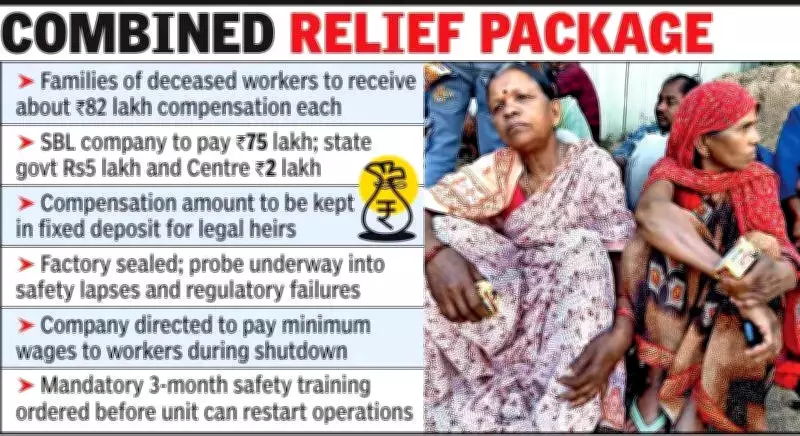
In a significant development following the tragic explosive factory blast in Raulgaon village of Katol taluka, the Maharashtra government has approved a comprehensive relief package that will provide approximately ₹82 lakh in financial assistance to the family of each deceased worker. The decision was finalized during a high-level meeting chaired by Maharashtra Revenue Minister Chandrashekhar Bawankule on Monday.
Compensation Breakdown and Distribution Mechanism
Under the approved relief measures, SBL Explosive Manufacturer Company, the firm involved in the incident, has agreed to pay ₹75 lakh to the family of every deceased worker and ₹25 lakh to each injured laborer. The Maharashtra government will provide an additional ₹5 lakh to the next of kin of each victim, while the Central government will contribute ₹2 lakh per family.
Officials confirmed that the total compensation of roughly ₹82 lakh for each deceased worker will be deposited in bank accounts in the names of the legal heirs. The principal amount will remain secured as a fixed deposit, with the head of the family permitted to withdraw the interest. Special provisions have been made for cases where the deceased worker's child is a minor, with the amount scheduled for release when the child attains legal adulthood.
Factory Operations and Safety Review
Authorities have sealed the factory pending completion of the investigation into the explosion that claimed 17 lives. Minister Bawankule directed the company to continue paying minimum wages to its workers during the shutdown period to prevent financial hardship among laborers.
The minister issued specific instructions regarding future operations:
- All workers must undergo at least three months of mandatory safety training in accordance with industrial safety standards
- The factory will only be permitted to restart after all deficiencies identified during inspection are rectified
- The district collector must personally verify compliance before operations can resume
Systemic Examination and Safety Concerns
During the review meeting, officials examined existing legal provisions governing explosive manufacturing units and coordination gaps among departments operating under both state and Central governments. Participants raised critical questions about whether workers received proper safety equipment and training under labor laws, and whether industrial safety standards were adequately verified during inspections conducted by the Petroleum and Explosives Safety Organisation.
Finance and Planning Minister of State Ashish Jaiswal questioned whether merely introducing more legislation could address systemic failures. "The government adopted the ease-of-doing-business approach to ensure transparency and quicker decisions, but if someone misuses it, how many more laws should the government enact to fix the system?" Jaiswal emphasized that worker safety must remain the government's priority despite regulatory challenges.
Broader Implications and Future Measures
Bawankule announced that district disaster management authorities would examine whether the scope of the Disaster Management Act needs expansion to ensure faster response and stronger accountability in industrial accidents. This review aims to create more robust mechanisms for preventing similar tragedies in the future.
The relief measures were finalized during a comprehensive review meeting assessing Sunday's deadly explosion. The meeting saw participation from numerous dignitaries including Ramtek Member of Parliament Shyamkumar Barve, legislators Charansingh Thakur and Sameer Meghe, divisional commissioner Vijayalakshmi Bidari, former minister Anil Deshmukh, collector Vipin Itankar, Zilla Parishad Chief Executive Officer Vinayak Mahamuni, SP Harsh Poddar, and Dean of Government Medical College and Hospital Nagpur Raj Gajbhiye, along with labor representatives and senior officials from labor and industrial safety departments.
This coordinated response represents one of the most substantial compensation packages approved for industrial accident victims in recent Maharashtra history, reflecting both the severity of the tragedy and the government's commitment to supporting affected families while addressing systemic safety concerns in hazardous industries.