

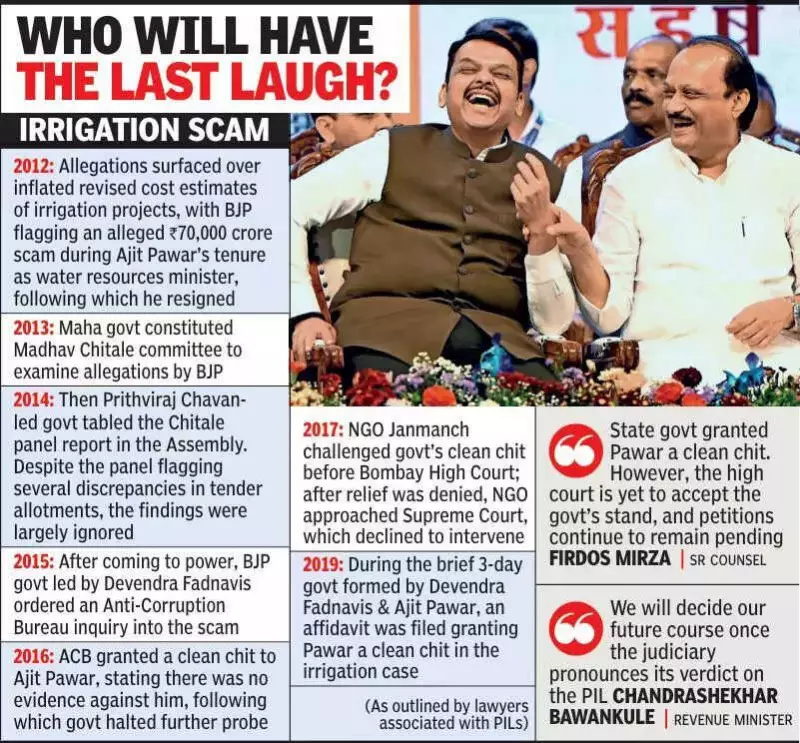
The political landscape of Maharashtra is once again being roiled by the ghosts of a massive, unresolved financial scandal. The alleged ₹70,000 crore irrigation scam, which had faded from daily headlines, has forcefully re-entered public discourse as campaigning intensifies for the upcoming municipal corporation elections. This revival has triggered a fresh wave of allegations, counter-allegations, and pointed exchanges among the state's top political leaders.
Political Firestorm Reignited
The controversy was reignited when Deputy Chief Minister Ajit Pawar referenced the case at a rally in Pune. Pawar, who was named an accused when the scandal first erupted in 2012, pointedly remarked that he was once accused of a "₹70,000 crore scam" but is now sharing power with the very leaders who had levelled those charges against him. This was an oblique reference to Chief Minister Devendra Fadnavis and the BJP. Pawar argued that individuals should not be targeted politically unless the judiciary formally pronounces them guilty.
His comments drew swift reactions. Chief Minister Fadnavis responded indirectly at another rally, stating that those accusing the BJP of corruption in Pune should first examine their own records. Revenue Minister Chandrashekhar Bawankule was more direct, criticising Pawar for resurrecting a sub judice matter that remains pending before the Nagpur bench of the Bombay High Court. Bawankule asserted that raking up such issues during elections served narrow political purposes, adding that the government's future course would be decided only after a judicial verdict.

The Unresolved Legal and Alleged Financial Maze
At the heart of the political storm lies a web of serious allegations concerning irrigation projects in Maharashtra, particularly in the Vidarbha region. The scandal was a defining issue that contributed to the collapse of the Congress-NCP-led Democratic Front government in the 2014 assembly elections, with the BJP using it as a central campaign plank.
Rajiv Jagtap, president of the NGO Janmanch, which filed the relevant Public Interest Litigations (PILs), reiterated the core charges. He stated that the cost of 38 irrigation projects under the Vidarbha Irrigation Development Corporation ballooned by nearly ₹20,000 crore in just 7 months in 2009. According to the petition, project costs skyrocketed from ₹6,672 crore to ₹26,722 crore. Shockingly, 30 projects allegedly received swift approvals within 4 days before their costs were revised upwards.
Jagtap further claimed that 36 minor irrigation projects identified in 2001 at a cost of ₹244.22 crore saw expenses escalate by nearly 270% due to prolonged delays. Citing media reports, he also alleged that nearly ₹1 lakh crore meant for Vidarbha's irrigation was diverted to western Maharashtra over the past decade.
Legally, the matter is far from closed. PILs filed by Janmanch in 2012 (later disposed) and again in 2016 are still pending before the Nagpur bench of the Bombay High Court. Senior counsel Firdos Mirza, representing the petitioner, noted that while a government-appointed panel gave Pawar a clean chit, the High Court is yet to accept the government's stand, and the petitions remain pending.
Enduring Shadows on Electoral Politics
The re-emergence of this issue highlights how unresolved scandals continue to cast long shadows over Maharashtra's electoral contests. The revival has also prompted intervention from other quarters. Maharashtra Navnirman Sena chief Raj Thackeray questioned the fate of documents that Fadnavis, as opposition leader, had famously transported on bullock carts to a probe panel—a powerful symbol of the BJP's anti-corruption crusade a decade ago.

Political observers note that with civic polls approaching, the irrigation scam debate underscores the enduring fault lines in the state's politics. Past allegations, even those mired in legal limbo, remain potent tools for present-day campaigning, ensuring that this ₹70,000 crore question will continue to haunt the corridors of power in Mumbai and Nagpur for the foreseeable future.





