

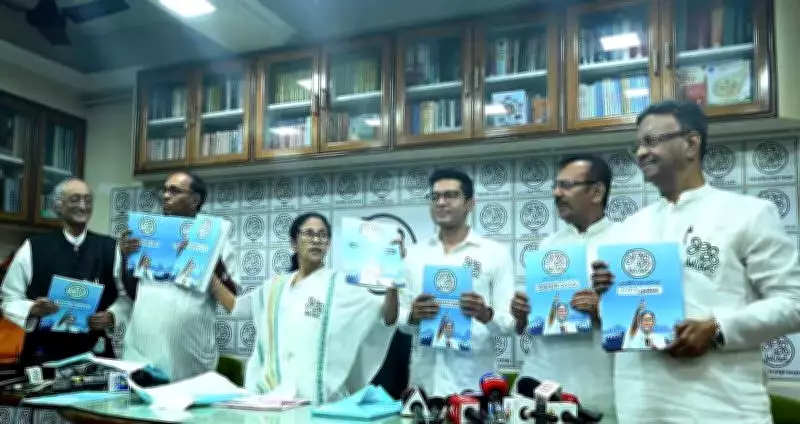
Mamata Banerjee Announces Trinamool's Vision for 2026 Bengal Elections
Kolkata: In a significant political move, West Bengal Chief Minister Mamata Banerjee on Friday unveiled the Trinamool Congress (TMC) manifesto for the 2026 state assembly elections, outlining ten key pledges aimed at transforming the state's socio-economic landscape. The manifesto, released with much fanfare, focuses on ambitious goals including healthcare accessibility, administrative restructuring, and economic growth.
Seven New Districts and Healthcare Initiatives
The manifesto proposes the creation of seven new districts in West Bengal: Kandi, Behrampore, Bishnupur, Sundarbans, Ranaghat, Ichhamati, and Basirhat. This expansion will increase the total number of districts from 23 to 30, aiming to enhance governance and local administration efficiency.
In the healthcare sector, the TMC plans to launch Duare Chikitsa, an annual state-run health camp program modeled after party-run initiatives like Sebashray. These camps will be held in every block and town to provide effective doorstep healthcare delivery. Additionally, the party commits to establishing fair-price medicine shops in all block-level health facilities.

Banerjee emphasized the state's healthcare achievements, stating, "Every year, in every block, Duare camps will take place. We have the Swasthya Sathi card, medical camps, multi-superspecialty hospitals, and mother-and-child hubs. This has boosted the institutional delivery rate to 99.5%, up from less than 60% previously." She also highlighted the development of 250–300 ICU-type vehicles using MPLAD funds.
Economic Ambitions and Infrastructure Development
The manifesto sets forth a bold economic vision, aiming to position West Bengal as the third-largest economy in India within the next 10 years. It targets building a Rs 40 lakh crore economy within five years, sustaining double-digit growth, and accelerating investments across sectors. Banerjee criticized the central government for blocking Bengal's dues, underscoring the state's resilience.
To boost trade, the TMC plans to establish Bengal as India's gateway for eastern India by developing a Global Trade Centre, expanding deep-sea and river port networks, and creating modern logistics hubs. This initiative is expected to enhance exports and generate high-quality employment opportunities.
Under the Mission Mahanagar programme, around 25 towns will be developed as model cities with state-of-the-art urban infrastructure. The list includes:
- Howrah
- Diamond Harbour
- Bardhaman
- Durgapur
- Bolpur
- Krishnanagar
- Barasat
- Raiganj
- Siliguri
- Behrampore
- Malda
- Kalyani
- Srirampur
- Andal
- Bankura
- Purulia
- Digha
- Midnapore
- Jhargram
- NKDA area
- Gangarampur
- Jalpaiguri
- Cooch Behar
- Alipurduar
- Darjeeling
Social Welfare and Governance Reforms
The manifesto includes a Gig Workers' Policy to bring all registered gig workers under the Bina Mulya Samajik Suraksha Yojana (BM-SSY), ensuring social security and institutional protection. For youth, the Yuba Sathi scheme will provide Rs 1,500 monthly (Rs 18,000 annually) to 1 crore individuals aged 21–40, regardless of scholarship status.
Banerjee contrasted Bengal's progress with national trends, noting, "The Modi government promised 2 crore jobs yearly, but unemployment has risen nationally by 40%. In Bengal, it has reduced by 40%. While more people nationally have fallen below the poverty line, we've lifted 1 crore 75 lakh people out of poverty in Bengal."
To ensure effective implementation, the manifesto proposes establishing the West Bengal High Performance Delivery Unit to monitor and evaluate last-mile service delivery. Other pledges include providing pucca homes for all Bengal families and safe drinking water supply across the state.
This comprehensive manifesto sets the stage for a competitive electoral battle in 2026, with TMC positioning itself as a champion of development and welfare in West Bengal.






