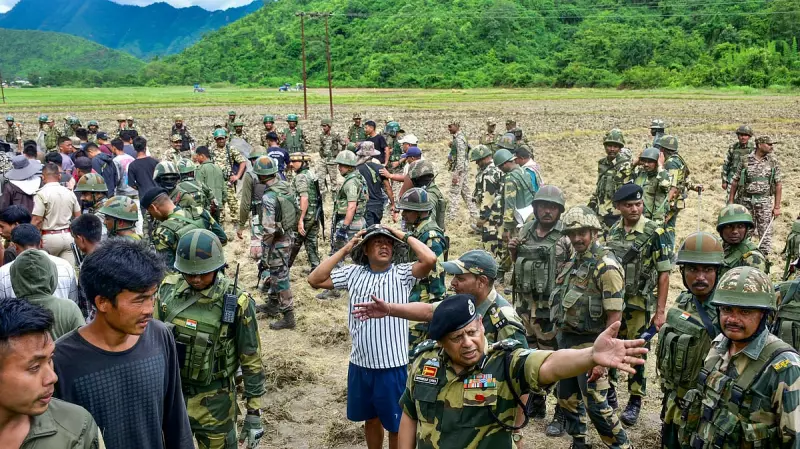
The northeastern state of Manipur continues to face a prolonged political deadlock, with the Bharatiya Janata Party's (BJP) attempts to forge a consensus for government formation repeatedly colliding with entrenched ethnic fault lines. As the impasse persists, concerns are mounting within the party about rapidly diminishing public support due to the failure to resolve the ongoing conflict and restore stable governance.
A State in Limbo: The Search for Political Stability
Manipur has been grappling with political uncertainty for an extended period, with the BJP-led administration struggling to navigate the complex ethnic landscape that defines the region. The party's leadership has been actively engaged in negotiations and dialogue with various stakeholders, aiming to build a broad-based consensus that could pave the way for a functional government. However, these efforts have consistently encountered resistance from different ethnic groups, each with their own distinct demands and historical grievances.
Shrinking Support Base and Leadership Concerns
A senior BJP leader based in Imphal, speaking on condition of anonymity, revealed the growing anxiety within party ranks. "Our support base is shrinking fast given the inability to end the conflict and restore the government," the leader told DH. This candid admission highlights the political cost of the ongoing stalemate, with the BJP facing increasing pressure from both its own cadres and the general public who are weary of the prolonged instability.

The leader's statement underscores several critical challenges:
- The erosion of public confidence in the BJP's ability to govern effectively in Manipur
- The growing frustration among party workers who face daily questions from constituents
- The economic and social consequences of prolonged political uncertainty
- The security implications of continued ethnic tensions without political resolution
Ethnic Fault Lines: The Core Challenge
Manipur's ethnic composition presents a particularly difficult challenge for any political party attempting to establish stable governance. The state is home to numerous ethnic communities, each with distinct cultural identities, historical narratives, and political aspirations. The BJP's consensus-building efforts must navigate:
- Historical grievances between different ethnic groups that span decades
- Competing demands for political representation and resource allocation
- Security concerns that have been exacerbated by the political vacuum
- Economic disparities that often fall along ethnic lines
These deep-seated divisions have proven resistant to quick political solutions, requiring nuanced approaches that acknowledge historical context while addressing contemporary concerns.
The Way Forward: Challenges and Possibilities
As Manipur waits for political resolution, several factors will determine whether consensus can be achieved:
Inclusive dialogue that genuinely incorporates all ethnic voices remains essential. The BJP's approach must move beyond traditional political calculations to address the root causes of ethnic tensions. Meaningful confidence-building measures between communities could create space for political compromise.
The party faces the dual challenge of maintaining its political standing while addressing legitimate ethnic concerns. This requires balancing immediate political necessities with long-term stability goals. The coming weeks will be crucial in determining whether the BJP can bridge these ethnic divides or whether Manipur's political stalemate will continue indefinitely.
Ultimately, the situation in Manipur serves as a reminder of how ethnic complexities can derail even well-intentioned political processes. The BJP's search for consensus continues against this challenging backdrop, with the state's future governance hanging in the balance.