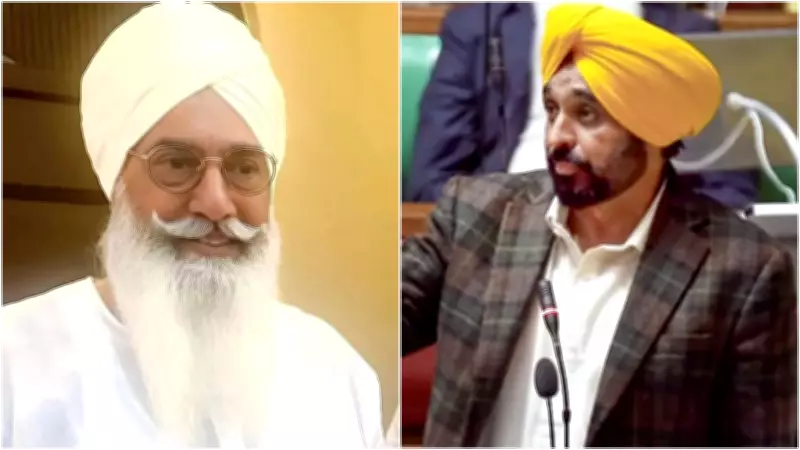
Bhagwant Mann's Swipe at Radha Soami Satsang Beas Chief Ignites Political Firestorm in Punjab
A political storm has erupted in Punjab following Chief Minister Bhagwant Mann's veiled attack on Gurinder Singh Dhillon, the head of the influential Radha Soami Satsang Beas. The controversy has exposed significant unease within the ruling Aam Aadmi Party (AAP) and drawn sharp criticism from opposition leaders, who have demanded clarity on whether Mann's remarks represent the party's official stance or his personal opinion.
The Controversial Remarks
On Tuesday, Mann took to social media platform X to post what appeared to be a thinly-veiled swipe at Dhillon, describing him as a "visitor to an undertrial acting as a judge." This remark came just one day after Dhillon met Shiromani Akali Dal (SAD) leader Bikram Singh Majithia at Nabha jail, where he publicly declared the charges against Majithia as "false and baseless."
Without directly naming Dhillon, Mann's post suggested that only divine intervention could save the judicial system when visitors to undertrials begin assuming judicial roles. The timing and nature of these comments have placed AAP at odds with religious institutions across Punjab, creating a delicate political situation for the party.

Background of the Conflict
This latest controversy follows another recent confrontation between Mann's administration and religious institutions. In January, the Chief Minister had accused the Rasokhana Nabh Kanwal Raja Sahib Gurdwara in Banga of possessing 169 "unauthorised" saroops (copies of the Sri Guru Granth Sahib). Mann claimed that 139 of these lacked proper documentation and were linked to the 328 saroops reported missing from the Shiromani Gurdwara Parbandhak Committee (SGPC).
The earlier incident had already triggered significant backlash within AAP ranks, leading Banga MLA Sukhwinder Kumar Sukhi to resign from his position as chairman of the Punjab State Container and Warehousing Corporation (CONWARE) in protest. The matter was eventually defused after intervention by senior AAP leaders including Finance Minister Harpal Cheema, Education Minister Harjot Bains, and Anandpur Sahib MP Malvinder Singh Kang, who visited the gurdwara and declared there were no issues with the saroops.
Political Fallout and Internal Unease
The Radha Soami Satsang Beas wields considerable influence among Punjab's voters, making Mann's latest remarks particularly concerning for AAP strategists. Sources within the party reveal that Cabinet Minister Hardeep Singh Mundian has been actively engaged in damage control, maintaining communication with Dhillon to find a "middle path" through the controversy.
An AAP leader speaking on condition of anonymity revealed: "There is a growing feeling within the party that the Bharatiya Janata Party (BJP) might be orchestrating these episodes to create divisions. We're working to navigate this situation carefully while maintaining our principles."
Adding to the political complexity, Dhillon's meeting with Majithia occurred just hours before the Supreme Court granted bail to the SAD leader, paving the way for his release after seven months in jail. Majithia had been arrested by the Vigilance Bureau in June last year in a disproportionate assets case allegedly involving money laundering of nearly Rs 540 crore linked to drug money.
Party Leadership Distances Itself
In a significant development, state AAP president Aman Arora appeared to distance the party from Mann's remarks, stating that Dhillon's visit to Majithia was a private matter. "Baba ji is honourable for me. I cannot raise questions on his statement or decision. We do not need to politicise it," Arora declared on Tuesday.
Finance Minister Harpal Cheema also downplayed the controversy, emphasizing that "anybody can go to meet anyone in jail if they are relatives." He reiterated that the matter remained sub judice while maintaining that Majithia would face legal consequences for allegedly amassing wealth disproportionate to his known sources of income.

Opposition Reactions Intensify
The political storm has drawn strong reactions from opposition parties across the spectrum. BJP spokesperson Pritpal Singh Baliawal criticized Mann's post on Instagram, stating: "Excess of everything is bad. Now you have even started schooling spiritual leaders? Baba Gurinder Singh Ji is the nucleus of faith for millions."
SAD chief spokesperson Arshdeep Singh Kaler described Mann's remarks as "distressing" and claimed they directly challenged constitutional values and sacred institutions. BJP leader Ravneet Bittu went further, accusing the Chief Minister of not shedding his "stage habit" and thinking he could "cross all limits."
Congress leader and Leader of Opposition Partap Singh Bajwa demanded immediate clarification from AAP regarding whether Mann's comments reflected the party's official position or his personal views. In a social media post, Bajwa expressed deep pain over the remarks, claiming they had hurt the religious sentiments of lakhs of followers both in India and abroad. He emphasized that such comments were alien to Punjab's cultural and spiritual ethos, where saints and spiritual leaders have traditionally commanded profound respect.
Broader Political Implications
The controversy emerges against a backdrop of broader political concerns for AAP. The party is reportedly worried about Prime Minister Narendra Modi's planned visit to Dera Sachkhand Ballan in Jalandhar, where he is scheduled to meet head Sant Niranjan Dass. This dera holds significant influence among the Ravidassia Dalit community, adding another layer of complexity to Punjab's religious-political landscape.
As the political storm continues to unfold, all eyes remain on how AAP navigates this delicate situation involving religious sentiments, political strategy, and internal party dynamics. The controversy highlights the challenging balance political parties must maintain when engaging with religious institutions in Punjab's complex socio-political environment.