The Martin Family's Political Debut: A Diversified Portfolio Emerges
The 2026 assembly elections in Tamil Nadu and Puducherry are witnessing a remarkable political phenomenon: the electoral debut of three members from the family of lottery baron Santiago Martin. This development signals the expanding footprint of a family previously known for its financial influence rather than direct political participation.
A Trio of Debutants Across Different Parties
The Martin family's political portfolio is remarkably diversified across party lines and regions. Leema Rose Martin, Santiago Martin's wife, is contesting from Lalgudi in Trichy as the AIADMK candidate. Meanwhile, their son Jose Charles Martin, founder of Latchiya Jananayaga Katchi (LJK), is contesting from Kamaraj Nagar in Puducherry as part of the AINRC–BJP alliance. Completing the trio is son-in-law Aadhav Arjuna, general secretary of TVK, who is in the fray from Villivakkam in Chennai.
What makes this development particularly noteworthy is that all three are making their electoral debut simultaneously, marking a significant shift from the family's previous role as political donors to active participants in the electoral process.

Jose Charles Martin's Puducherry Ambition
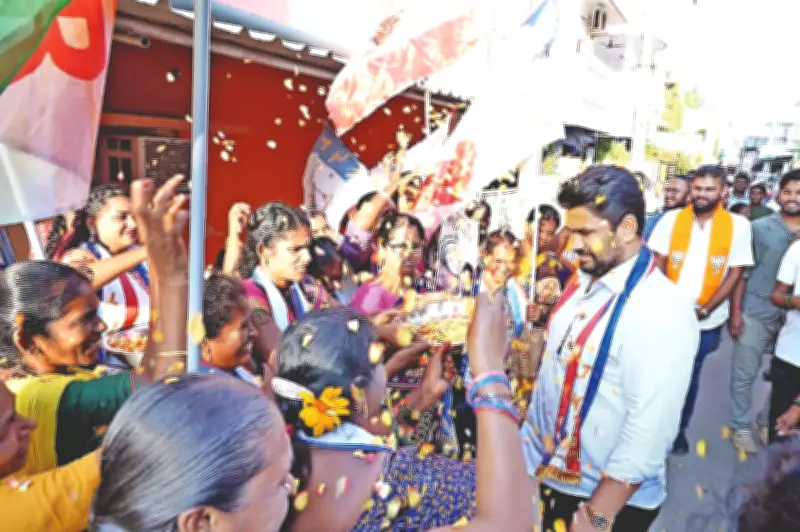
Jose Charles Martin, 38, chose Puducherry as his political launchpad two years ago, seeing the compact Union territory with its population of roughly 10 lakh as an ideal canvas for his vision. "In a place like Puducherry, I can show results faster," says Charles, who also serves as managing director of Martin Group. He envisions transforming the region into a modern, developed enclave comparable to Dubai or Singapore.
His political journey in Puducherry began with the launch of welfare platform Jose Charles Mandram, followed by the establishment of LJK in December 2025. Though initially planning to contest all 30 seats and project himself as a chief ministerial candidate, he later aligned with the BJP-led front and was allotted two seats. This move nearly strained AINRC–BJP ties, with AINRC chief N Rangasamy expressing wariness about associating with the lottery baron's family. "It took a phone call from Delhi to convince Rangasamy," reveals an LJK functionary.
Leema Rose Martin's Swift AIADMK Ascent
Leema Rose Martin's entry into AIADMK politics has been remarkably swift. As managing trustee of Martin Foundation with a 14-year stint in T R Paarivendhar's Indhiya Jananayaga Katchi (though never contesting elections), she joined AIADMK in February and was quickly appointed as the party's women's wing joint secretary. She has now been fielded as the party's candidate in Lalgudi.
While there was initial resistance among AIADMK ranks over her sudden prominence, party functionaries indicate she has managed to win over sections of the cadre. DMK views her as a serious challenger in Lalgudi, a constituency it has held since 2006 that carries significant political importance as home to leaders such as K N Nehru and Anbil Mahesh Poyyamozhi. "The fight has got tougher as four-time MLA Soundarapandian has not been given a ticket this time," notes a DMK functionary.
Her selection of Lalgudi despite having no direct links to the constituency (she hails from Devakottai in Ramanathapuram district) is seen as strategic, targeting a sizable Udayar and Christian voter base according to AIADMK cadre.
Aadhav Arjuna's Growing Influence in TVK
Aadhav Arjuna has chosen Villivakkam for his electoral debut after joining TVK in February 2025. His influence within the party has grown steadily, with insiders noting his key role in decision-making and close involvement in senior leadership engagements, including visits to Delhi.
Financial Clout and Political Contributions
Political observers argue that the family's growing influence is closely tied to its substantial financial resources. Santiago Martin has long maintained proximity to political power, emerging as one of the largest donors to major parties including DMK, AIADMK and BJP through electoral bonds.

According to Election Commission of India data, his company Future Gaming and Hotel Services Pvt Ltd purchased electoral bonds worth ₹1,368 crore between 2019 and 2024, making it the single largest donor to political parties. Of this amount, approximately ₹500 crore went to DMK. Additionally, Tiger Associates, a Kolkata-based lottery firm with Subbayan Nagarajan (identified in enforcement records as a close associate of Santiago Martin) as a designated partner, donated ₹50 crore to DMK and ₹60 crore to AIADMK in 2024–25.
In a 2023 statement, the company revealed that Martin and his group firms paid ₹23,199 crore in GST between July 2017 and September 2023, averaging ₹5,000 crore annually.
Charles dismisses criticism about financial influence driving their political acceptance: "Reducing our acceptance among the masses to mere financial influence is a desperate attempt to belittle our efforts."
Family Dynamics and Ideological Differences
Despite their collective political emergence, all is not harmonious within the family. Jose Charles has publicly criticized Aadhav Arjuna, citing ideological differences and alleging that he scuttled a potential alliance between LJK and TVK. "He has victimized my family. I have suffered because of him," says Charles.
Nevertheless, Jose Charles maintains that the family's political ventures are not strategically coordinated: "In a vibrant democracy, it is not mandatory for every family member to subscribe to the same political ideology."
The Changing Political Landscape
What has changed fundamentally is that the Martin family is no longer operating from the political sidelines as mere donors. Their simultaneous electoral debut across different parties and regions represents a significant evolution in their relationship with political power. The 2026 assembly elections will test whether their financial resources can translate into electoral success and lasting political influence in Tamil Nadu and Puducherry.
The Martin family's political expansion comes at a time when traditional political dynamics are being challenged by new entrants with substantial resources. Their success or failure in these elections could signal broader changes in how wealth influences political participation in South India.